

It’s not easy to find silver linings amid the rapid, human-driven destabilization of Earth’s climate—though that hasn’t stopped researchers from trying. One longstanding theory suggests that glacial melt could actually help slow climate change by feeding algae, but a new study just dumped cold water on the idea.
The findings, published in the journal Nature Communications Earth & Environment, show that meltwater from an Antarctic ice shelf pumps far less iron into surrounding waters than scientists previously thought. The authors argue that this undermines the iron fertilization theory, which posits that iron-rich glacial meltwater would feed algal blooms that pull planet-warming carbon dioxide out of the atmosphere as they grow.
“Our claim in this paper is that the meltwater itself carries very little iron, and that most of the iron that it does carry comes from the grinding up and dissolving of bedrock into the liquid layer between the bedrock and the ice sheet, not from the ice that is driving sea level rise,” principal investigator Rob Sherrell, a biogeochemistry professor at Rutgers University, said in a statement.
Field data challenges theory
Evidence to support the iron fertilization theory has primarily come from simulations and computer modeling. Sherrell and his colleagues wanted to test its legitimacy using real-world data, so they embarked on an expedition to the Amundsen Sea in West Antarctica.
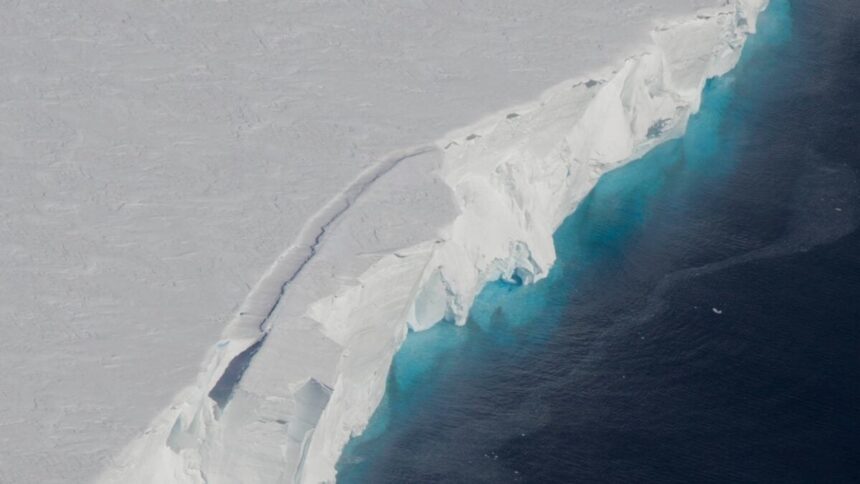
The Amundsen has the highest rates of ice shelf thinning in Antarctica and therefore accounts for most of the sea level rise driven by Antarctic melting. When warm seawater rises up from the deep ocean and enters cavities beneath an ice shelf—the seaward extension of a glacier away from the continent—it melts the shelf from below, releasing freshwater into the sea.
At the Dotson Ice Shelf, the researchers collected water samples at the point where seawater enters one such cavity and the point where it exits after meltwater flows in. Study lead author Venkatesh Chinni, a postdoctoral researcher at Rutgers, then analyzed the samples in the lab to assess their iron content, while collaborators at Texas A&M University measured isotopic ratios to pinpoint where the iron was coming from.
The analysis revealed that total meltwater only contributed about 10% of the outflowing dissolved iron, whereas 62% came from inflowing deep water. The researchers traced the remaining 28% back to inputs from shelf sediments. This contradicts the idea that meltwater could stimulate algal blooms enough to offset global warming.
The complexities of glacial melt and warming
While the study makes a compelling case against the iron fertilization theory, the authors note that a true understanding of the subglacial processes involved in iron flux requires additional research.
What’s more, they only investigated one Antarctic ice shelf, and the way water moves and mixes within subglacial cavities can vary depending on the shape of the shelf, nearby ocean conditions, and the properties of meltwater outflow. The researchers believe the fundamental balance of dissolved iron sources they observed at Dotson could generally apply to other ice shelves, but verifying this will also require further research.
This isn’t the first study to question the iron fertilization theory. For example, previous research found that past spikes in equatorial Pacific Ocean iron concentration had little to no effect on carbon-capturing algae. Meanwhile, there is ample evidence to suggest that glacial melt could exacerbate regional warming—and therefore melting—by darkening the surface of the glacier, causing it to absorb more solar radiation.
The interplay between the global climate and the marine processes that drive glacial melt is incredibly nuanced, which is why it’s so important for field studies to validate findings and theories based on modeling. Such work may not reveal many silver linings, but it will help scientists understand the future of a warming Antarctica.
Read the full article here