

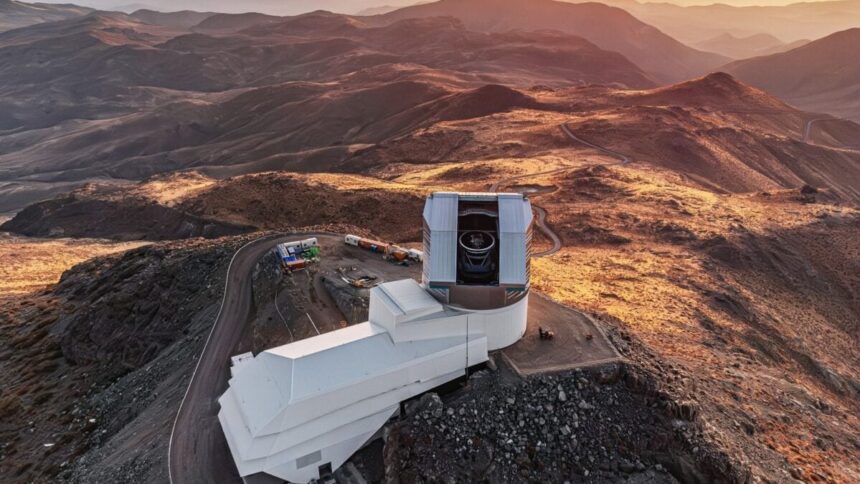
The Vera C. Rubin Observatory spent the night staring at the dark cosmos, alerting astronomers of ongoing changes in the skies in real-time.
The observatory fired off its first wave of notifications from its new alert system on Tuesday night, sending 800,000 alerts to astronomers’ computers around the world. The Alert Production Pipeline, a software developed at the University of Washington, is designed to eventually produce up to 7 million alerts per night, documenting celestial events spotted by Rubin.
“The scale and speed of the alerts are unprecedented,” Hsin-Fang Chiang, a software developer at SLAC National Accelerator Laboratory and lead of operations for data processing at the U.S. Data Facility, said in a statement. “After generating hundreds of thousands of test alerts in the last few months, we are now able to say, within minutes, with each image, ‘Here is everything. Go.’”
You up?
Nearly two decades in the making, the Rubin Observatory boasts the largest digital camera ever built for astronomy and an ultra-sensitive 28-foot (8.4-meter) primary mirror. The telescope’s alert system notifies astronomers of interesting astronomical events within two minutes of their discovery, allowing them enough time to request follow-up observations for a closer look.
“By connecting scientists to a vast and continuous stream of information, NSF-DOE Rubin Observatory will make it possible to follow the universe’s events as they unfold, from the explosive to the most faint and fleeting,” Luca Rizzi, a program director for research infrastructure at the National Science Foundation, said in a statement.
The first batch of notifications included detections of supernovae, variable stars, active galactic nuclei, and newly spotted asteroids in the solar system. Each alert signals something that has changed in a patch of the night skies since Rubin last looked, whether it’s a new source of light, a star that brightened or dimmed, or an object that moved.
A team of researchers and software developers has been working on the Alert Production Pipeline for the past decade, trying to figure out how to process 10 terabytes of images every night. “Enabling real-time discovery on such a massive data stream has required years of technical innovation in image processing algorithms, databases and data orchestration,” Eric Bellm, an astronomy professor at the University of Washington, who leads the Alert Production Pipeline Group for the Rubin Observatory, said in a statement.
Skygazing
The launch of Rubin’s alert system precedes the telescope’s Legacy Survey of Space and Time (LSST), which will launch later this year. During the upcoming 10-year-long survey, Rubin will generate a wide-field snapshot of the southern sky every few nights.
As the telescope captures views of the cosmos at unprecedented depths, the alerts will keep astronomers in the loop of the treasure trove of discoveries in real time. “Rubin Observatory’s groundbreaking capabilities are revealing untold astrophysical treasures and expanding scientists’ access to the ever-changing cosmos,” Kathy Turner, program manager in the High Energy Physics program in the U.S. Department of Energy’s Office of Science, said in a statement.
The Rubin Observatory, perched atop a mountain in the Chilean Andes, released the first images captured by its 3,200-megapixel camera to the public on June 23, 2025. During its test run, the telescope captured millions of galaxies and stars scattered across the Milky Way, in addition to 2,104 never-before-seen asteroids.
During the first year of its LSST, Rubin is expected to observe more objects than all other optical observatories combined and flood astronomers’ computers with notifications.
Read the full article here