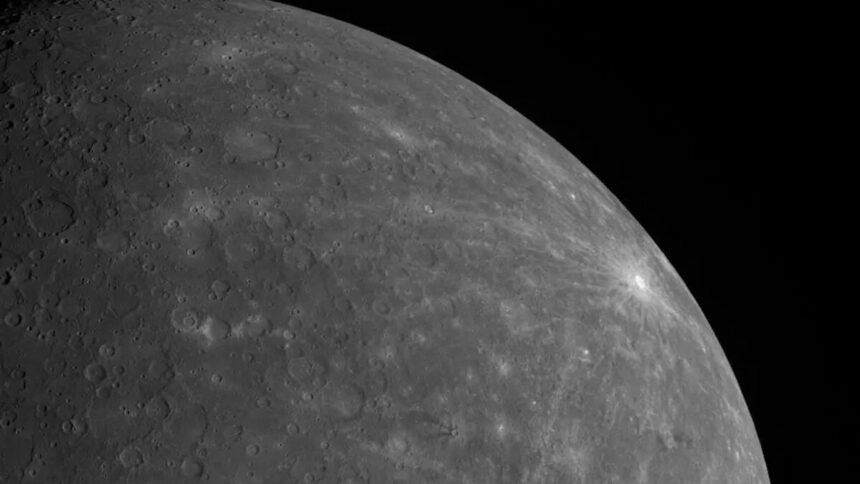
In 2012, a NASA probe confirmed something rather unexpected about Mercury. The scorching hot planet has deposits of water ice stashed in permanently shadowed areas. Exactly how the water got there, however, has remained a mystery. Now, a team of scientists has traced Mercury’s frozen water to a colossal impact that transformed the planet in a single Mercurian day.
A new study, published in the Journal of Geophysical Research: Planets, suggests a massive impact by a comet or asteroid deposited all of Mercury’s water in one go. The team of researchers behind the study simulated the event and found that the planet’s thick deposits of water ice were likely accumulated over a single day on Mercury (the equivalent of 157 Earth days) in both the north and south polar regions.
An unlikely place
Mercury is the closest planet to the Sun. If you’re standing on the surface of Mercury, the Sun would appear more than three times as large as it does from Earth, and its light would shine as much as seven times brighter.
Due to its proximity to our host star, the planet’s surface temperatures can reach highs of 800° Fahrenheit (430° Celsius). It’s still not the hottest planet in the solar system—that title proudly belongs to Venus due to its dense atmosphere. Without an atmosphere of its own, though, Mercury’s nighttime temperatures dip to -290° Fahrenheit (-180° Celsuis).
With Mercury being so close to the Sun, it is a rather unlikely place to host water on its surface. Yet ground-based observations of the planet in the 1990s revealed highly reflective patches near its north and south poles. The bright reflections indicated there may be water ice on Mercury.
NASA’s MESSENGER later confirmed that there were in fact massive deposits of water ice on Mercury when it became the first spacecraft to orbit the planet in 2011. Still, scientists couldn’t confirm how the water ended up on Mercury.
One fateful day
The team behind the new study, co-led by Parvathy Prem from the Johns Hopkins Applied Physics Laboratory, ran simulated models that incorporated maps of the permanently shadowed regions on Mercury and the planet’s surface temperatures.
The researchers found that the collision matched an impactor that’s roughly 10 miles wide (17 kilometers) crashing into Mercury at speeds of up to 18 miles per second (30 kilometers per second). Around an hour after impact, the collision likely generated a dense, temporary atmosphere rich in water vapor that enveloped the planet.
The majority of the impact-generated atmosphere would be broken down by interacting with photons through a process called photolysis. The rest of the water would then migrate toward Mercury’s poles and remain hidden in the planet’s permanently shadowed regions, according to the study.
In a large enough impact, the generated atmosphere would shield itself from the Sun’s ultraviolet radiation, thereby increasing the amount of water that was able to reach the permanently shadowed regions on Mercury. The dense atmosphere effectively slowed down the breakdown of the water molecules, allowing more water to survive the close proximity to the Sun.
Scientists are hoping to gather more clues on Mercury’s water ice deposits through the BepiColombo mission, which is set to become the second spacecraft to enter the planet’s orbit. The joint mission by the European Space Agency (ESA) and the Japan Aerospace Exploration Agency (JAXA) launched in 2018 and is scheduled to reach the planet in November.
Read the full article here