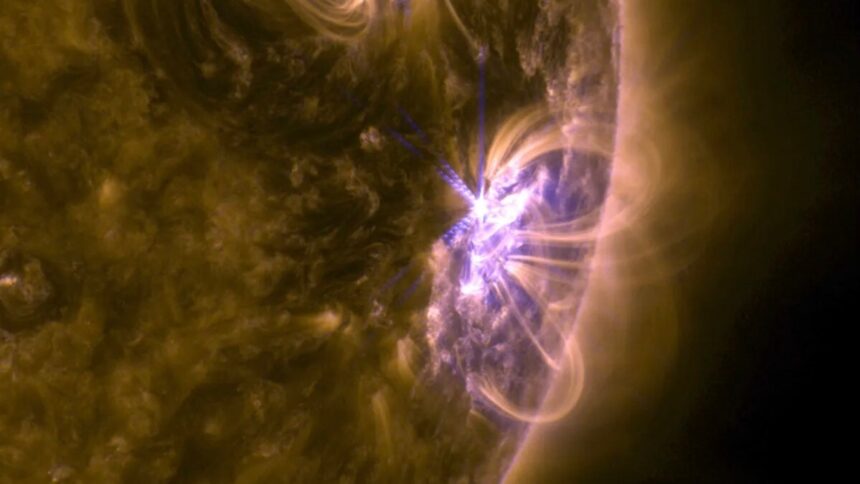
Cataclysmic solar storms may be rare, but they do happen. And unlike the legendary 1859 Carrington Event—which knocked out telegraphs across Europe and North America and dragged the Northern Lights down to Florida—some have happened recently enough to give us a sense of how modern electronics might fare. Solar radiation from 2003’s “Halloween Storms,” for example, disrupted a Federal Aviation Administration navigation system for 26 hours and led to the FAA’s first ever advisory warning of excessive radiation doses on commercial flights.
But space physicists led by NASA’s Goddard Space Flight Center in Maryland have recently determined that the very rarity of these major solar storms means scientists and policymakers have likely been underestimating the worst-case scenarios for solar weather’s impact. As detailed in their new study, published in the journal Nature, ongoing “erroneous measurements” have also skewed these estimates, bolstering the reigning theory that there is some kind of upper limit to the bursts of solar storm energy that can be transferred into Earth’s polar ionosphere. Shockingly, there may be no limit.
“Fortunately, these very extreme cases are rare, but this also means we have limited data to work with and only time will tell what happens at the very extreme one-in-a-thousand-year kind of event,” study coauthor Maria Walach said in a statement. “If there is no upper limit to our planet’s response to the solar wind, modelling for extreme cases needs to take this into account and we should be vigilant of space weather effects,” according to Walach, a space physics lecturer at Lancaster University.
A ‘problem of definition’
The problem, according to Walach and her coauthors, starts not with any kind of equipment error, but in some of the basic assumptions that have long gone into how physicists interpret their space weather measurements.
Spacecraft like NASA’s IMAP, for example, hover a little under one million miles from Earth in a gravitational sweet spot known as Lagrange point one (L1), where they can provide consistent early warning data on solar emissions toward Earth. At L1, these probes are essentially resting stationary, locked in an orbit where Earth’s and the Sun’s respective gravitational pulls cancel each other out. But—like guessing the power of an ocean wave as it laps against the sand by measuring its thundering power back when it crested—these measurements fail to take into account dissipating effects as a solar eruption’s high-energy particles careen through space.
The result is that this data appears to reliably overestimate the actual solar wind hitting Earth’s ionosphere, relying on measurements taken before these particles hit the protective blunt force of our planet’s magnetosheath, where solar storms are “influenced by local plasma and field conditions,” the researchers wrote.
“We usually assume the truth may be around its measurement. But probability theory says it leans one way,” the study’s lead author, NASA Goddard physicist Nithin Sivadas, said in a statement. “That’s why space weather risks appear underestimated.”
Closer to Earth
Walach, Sivadas, and their colleagues focused their attention on space weather measurements from satellites closer to the Earth, including NASA’s THEMIS all-sky imager, MMS, and DoubleStar, among others. This suite of craft allowed them to compare over a million solar wind measurements in contrast to ordinary readings of the magnetosheath and magnetosphere far up at the edge of Earth’s upper atmosphere and beyond.
Long story short, “there is currently no statistical evidence to suggest an upper limit to the energy transferred from the solar wind to the polar ionosphere,” the researchers concluded.
This is where the rarity of extreme solar storms contributes to researchers’ present uncertainty. “Our planet’s magnetic field does a really great job of protecting us against many space weather effects,” Walach noted. “There are however extreme cases, where satellites unexpectedly fall back to Earth, or we lose communication and GPS signals.”
Until a big storm arrives, in other words, it might be hard to predict how Earth’s magnetosphere might hold up.
Read the full article here