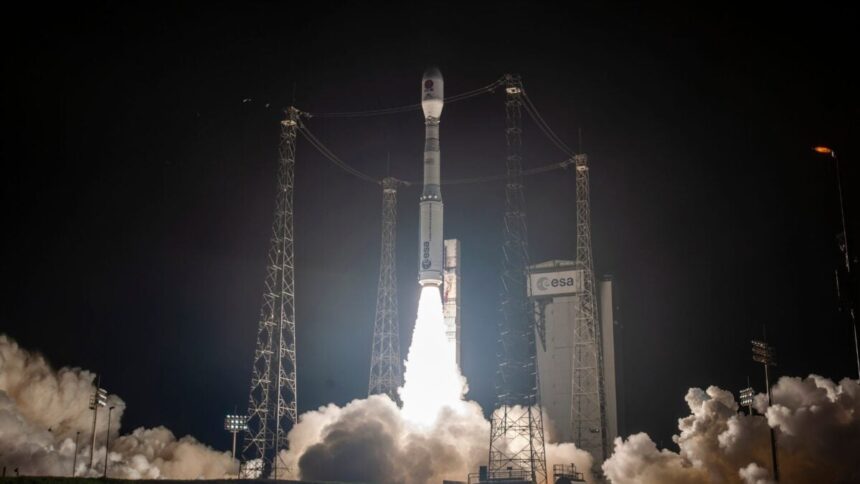
Late Monday evening, the European Space Agency’s Vega-C rocket lifted off from Kourou, French Guiana, carrying a spacecraft that promises to significantly enhance our understanding of space weather. The mission, developed jointly by ESA and the Chinese Academy of Sciences, has been more than a decade in the making.
The Solar wind Magnetosphere Link Explorer, or SMILE for short, is a remote-sensing satellite designed to capture the first global images of the magnetic bubble that surrounds Earth. This region, called the magnetosphere, acts as a shield against solar and cosmic particle radiation. When the Sun emits large bursts of radiation, such as a solar flare or coronal mass ejection, charged particles can interact with the magnetosphere to produce geomagnetic storms.
These storms can disrupt power grids, satellite communications, and other critical systems our modern lives depend on. SMILE’s unprecedented view of the magnetosphere should help scientists better understand these storms and how to forecast their impacts.
“We are about to witness something we’ve never seen before—Earth’s invisible armour in action,” ESA Director General Josef Aschbacher said in an agency release. “With SMILE, we are pushing the boundaries of science in an effort to answer big questions that have remained a mystery since we discovered, over seventy years ago, that Earth sits safely within a giant magnetic bubble.”
Seeing Earth from a new vantage point
SMILE separated from Vega-C’s fourth stage about 57 minutes after liftoff, then successfully deployed its solar arrays, according to SpaceNews. The rocket placed the spacecraft in an orbit roughly 439 miles (706 kilometers) above Earth, but over the next month, it will burn through about 3,000 pounds (1,350 kilograms) of propellant to climb into a highly elliptical science orbit, SpaceNews reports.
At its highest altitude, the satellite will be more than 75,300 miles (121,200 km) above the North Pole, reaching that point once every two days, according to ESA. That’s about a third of the average distance between Earth and the Moon.
From this vantage point, SMILE will be able to collect round-the-clock, global observations of the magnetosphere, image auroras, and take in situ measurements of solar wind and magnetic fields simultaneously. The satellite’s X-ray camera will produce the world’s first X-ray imagery of the magnetosphere, revealing how charged particles from solar wind disturb Earth’s magnetic shield. Meanwhile, SMILE’s ultraviolet camera will continuously observe auroras for 45 hours at a time.
“For the first time ever, we will be able to understand cause and effect,” ESA science director Carole Mundell said during a pre-launch press conference, according to SpaceNews. “This is critically important scientifically, but even more importantly, because nowadays modern life depends very much on our space infrastructure.”
A long time coming
SMILE was originally supposed to launch in 2021, but the mission was delayed several times by technical setbacks and the impacts of the covid-19 pandemic, according to Space.com.
Now that the satellite is finally in orbit, it is set to begin data collection in earnest in July. Over the next several weeks, the mission team will unfold booms, open camera covers, and confirm that all of SMILE’s instruments are operating as expected.
As society grows more dependent on technology vulnerable to space weather, understanding these storms has never been more important. If SMILE succeeds, it could help scientists better predict and prepare for their impacts before they hit.
Read the full article here