“Radio-quiet” regions, like the area around West Virginia’s Green Bank Observatory, are hard to come by. The spots are so coveted by astronomers that NASA launched plans in 2023 to put radio telescopes all the way on the dark side of the Moon just to get enough silence to do this work in peace.
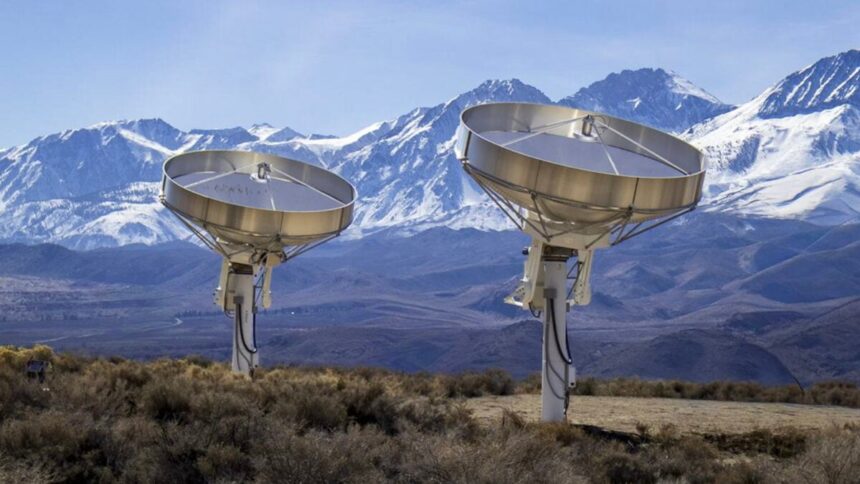
Caltech’s plans might not be for the Moon, but they’re still tremendously exciting. The university announced final design specs last Thursday to colonize a desolate patch of the Nevada desert for a radio telescope that promises to survey the cosmos 100-times faster than any other known telescope in the world. Named the Deep Synoptic Array (DSA), this vast field of 1,650 radio dishes will span roughly 12 by 10 miles (20 by 16 kilometers), supported by a supercomputer capable of synthesizing its flood of data into exceedingly crisp images in real-time.
But, perhaps most impressive of all, the DSA’s space science bounty will be free to slice, dice, analyze, and utilize in real time by anyone, scientists and citizen scientists alike.
“We want the whole world to also have access to the data just as quickly as we do,” Caltech astronomer Katie Jameson, lead project manager for the DSA, explained in a press statement.
High fidelity
The universe is humming with intergalactic radio signals. The spinning of magnetized dead stars, known as pulsars, pumps out a steady rhythm of radio waves, as do the electromagnetic “burps” of star-gobbling black holes and many other cosmic enigmas, including the unsolved mysteries of “fast radio bursts.”
Broadly speaking, astronomers and astrophysicists study radio emissions off these celestial events via two kinds of radio telescopes. First, there are the gigantic single satellite dishes, à la the dearly departed Arecibo Observatory, which operated from 1963 until it suffered major structural damage in 2020. Second, there are the sprawling networks of smaller dishes, like New Mexico’s Very Large Array (VLA), which you might have noticed last year on Vince Gilligan’s new Apple TV show Pluribus. Caltech’s DSA will fall into that latter category—as arguably the most maximalist iteration yet attempted.
Beyond the DSA’s 1,650 radio dishes, which Caltech describes as “by far the most dishes to make up a radio array,” the telescope will also sync with a supercomputer capable of rapidly processing this stream of radio waves into images. It’s a complex process, but one common to radio telescope arrays. What makes the DSA different will be its vertically integrated ability to generate these “radio images” in real time. According to Caltech astronomy professor Gregg Hallinan, it’s this feature that makes it possible for the project to have so many radio dishes operating at all.
“Without the radio camera, we would have to store 100 exabytes of data [100 billion gigabytes] to complete our survey,” Hallinan said. “This would require 5 million hard drives in a multi-billion-dollar facility the size of multiple football fields.”
Radio ‘free’ universe
Hallinan noted that part of the hope in making the DSA’s radio images free, with no proprietary lagtime, is that far-flung members of the scientific community and the public will be curious enough to help analyze it all.
“There will be enough discoveries to occupy every radio astronomer on the planet,” Hallinan opined. “With fully public, science-ready data, some of these discoveries may even be made by a high-school student with a clever idea.”
Schmidt Sciences, a philanthropic effort of ex-Google CEO Eric Schmidt and his wife Wendy, has funded the DSA alongside Caltech at an estimated total cost near $200 million. The array’s anticipated completion date is 2029, but Caltech’s team has already stationed and tested prototypes out along a stretch of California’s Mojave Desert. So, Hallinan is confident the true DSA will be up and running soon enough.
“While all other radio telescopes combined have so far found about 20 million radio sources, the DSA will match that in the first day of operations,” the astronomer said. “By the end of its initial survey, it will have discovered about 1 billion new radio sources.”
Read the full article here