
In the Middle Ages, the Black Death infamously swept through Europe, killing an estimated 25 million people. While the plague existed before this time, many researchers believed that it wasn’t as fatal or contagious before the medieval pandemic—until now.
In a study published today in Nature, an international team of researchers reports the discovery of ancient bacterial genomes pointing to a previously unknown strain of the plague. The genetic information comes from the teeth of humans in small hunter-gatherer communities from approximately 5,500 years ago. Shockingly, 18 of 46 individuals studied had traces of Yersinia pestis DNA, the bacterium that causes the plague. The findings represent the earliest plague genome ever identified and suggest that the deadly virus originated in Central Asia long before the famous outbreak in Europe.
“This provides conclusive evidence that these outbreaks of plague would have been deadly,” Ruaridh Macleod, the study’s first author and an archaeologist at the University of Oxford in the U.K., said during a press briefing on the paper. “That’s something that up until this point has been very hotly debated between archaeologists and scientists.”
Graveyard mysteries
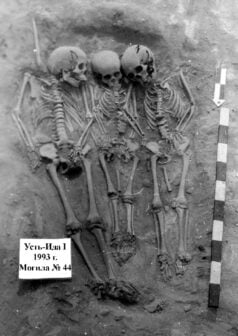
For the study, the team analyzed remains from four ancient cemeteries gathered around Lake Baikal in Siberia. Advanced DNA studies of 46 hunter-gatherers revealed Y. pestis in 18 of 46 hunter-gatherers from the Neolithic. Furthermore, genetic evidence indicated that small family groups were affected and that relatives were buried in separate graves at slightly different times. Radiocarbon dating suggested that this region suffered two separate plague outbreaks between 5,520 and 5,265 years ago and again between 5,315 and 4,425 years ago.
On a particularly grim note, a sizeable number of the dead were children and young teenagers. Researchers working at the site had actually known about this “unusual mortality profile” for over 40 years but had “no clear explanation as to why that was the case,” Macleod explained during the briefing.
“Finding out that plague was the cause is extraordinary, but it makes so much sense,” study co-author Andrzej Weber of the University of Alberta said in a statement.
Ominous remains
According to the study, the primary transmitter of plague was likely the marmot, which humans at Baikal have long hunted for meat and fur. This was also the case for prehistoric hunter-gatherers, as archaeologists previously found numerous marmot teeth inside early Neolithic graves.
As for the prevalence of young plague victims, the researchers hypothesize in the paper that individuals who survived to adulthood may already have suffered and recovered from the plague as children. If so, this would mean that ancient communities regularly experienced plague outbreaks. Alternatively, ancient societies may have divided tasks or roles by age, and younger members were more frequently exposed to marmots. However, the team concluded that the current work is insufficient to decisively prove either theory.
Overall, the findings provide new evidence that plague mass outbreaks were “likely prominent among hunter-gatherers, questioning arguments that outbreaks were only restricted to more [densely populated] societies,” Eske Willerslev, the study’s co-author and a researcher with the University of Copenhagen and the University of Cambridge in the U.K., said during the press briefing.
“The plague has played an extremely important part in human history,” Willerslev added. “But we also have to remember that there [are], in fact, still people dying from plague even today. So it’s important to understand how we have become who we are as humans and also how pathogens are evolving and changing through time.”
Read the full article here