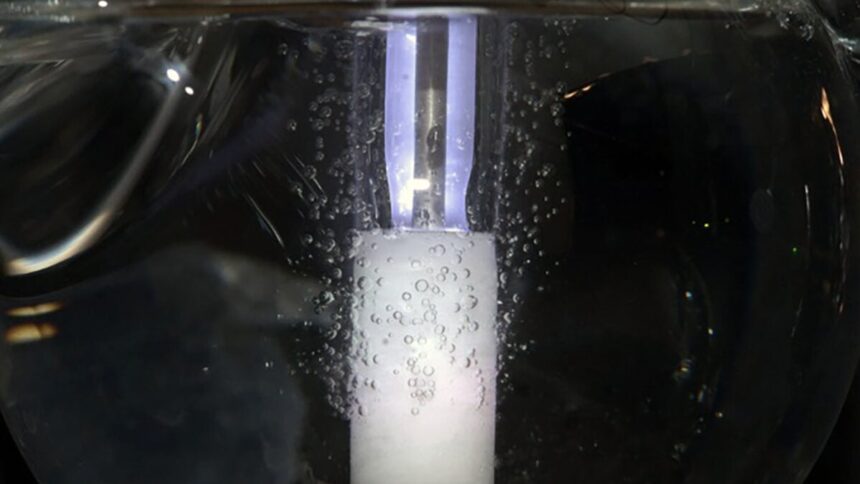
The right chemical formula can give mundane materials the most unlikely of makeovers. If you have any doubts, recent transformations, such as using forever chemicals to make lithium or recycling plastic using spent car fuel, will make you a believer. However, the most recent makeover might be the most eye-catching yet—considering it’s literally lightning in a bottle.
In a study published today in the Journal of the American Chemical Society, chemists report a novel technique to convert methane into methanol and other valuable compounds. The method essentially subjects bubbling methane gas to high-voltage electricity, which generates plasma that resembles lightning bolts under certain conditions. As a result, the team successively oxidized methane to methanol at about 97% selectivity.
“We also simultaneously made other valuable gaseous products, such as hydrogen and ethylene, which are unique to our plasma-based method,” study co-author Dayne Swearer, a chemist at Northwestern University, told Gizmodo. “It will still take a lot of work for this chemistry to compete with highly optimized chemical facilities, but it demonstrates that methanol can be made in a single step.”
The ‘holy grail’ of catalysis
Methane is a relatively common natural gas typically used as fuel. At the same time, it’s a primary source of human-influenced greenhouse gas, contributing to around 11 percent of global emissions, according to the U.S. Environmental Protection Agency.
Methanol, an oxidized, liquid derivative of methane, has an even wider range of uses, from industrial solvents and pharmaceutical production to antifreeze and, of course, fuel. Accordingly, some have even called the methane-to-methanol conversion the “holy grail” of catalysis, a branch of chemistry that studies how catalysts improve critical reactions.
Tearing gas apart
According to Swearer, the world produces nearly 110 million metric tons of methanol each year. The current method for converting methane into methanol essentially deconstructs methane twice and puts it back together as methanol. Specifically, methane first gets treated with steam, and the resulting amalgam of carbon monoxide and hydrogen is consequently subjected to high pressures and temperatures.
“While this two-step industrial process is highly optimized, it’s not the most straightforward route,” Swearer said.
In fact, the process itself “consumes an enormous amount of heat and inherently generates carbon dioxide along the way,” Northwestern explained in a press release about the study.
Why so complicated?
The new study aimed to simplify the process so that this conversion would become more intuitive and less energy-consuming. To achieve this, the researchers developed a plasma-bubble reactor coated with a copper oxide catalyst. Once the methane entered the reactor tube, electrical pulses triggered the breakdown of the gas into highly reactive compounds that quickly recombined into methanol. As soon as that occurred, the reactor inserted the methanol into surrounding water to prevent the valuable product from decomposing.
“Our key breakthrough was recognizing that the short-lived reactive species in the plasma needed to be harnessed as quickly as possible,” Swearer told Gizmodo. “By placing a catalyst along the plasma’s path, we could control the outcome to form more desirable products.”
Plasma here and there
For Swearer, a particularly exciting aspect of the new findings is the extensive use of plasma. The so-called “fourth state of matter” makes up over 99% of the visible universe but is relatively rare on Earth. That said, plasma science has already played a significant role in the development of most electronics and continues to do so. Still, the new study indicates that there’s still more untapped potential for plasma in unexpected areas.
“This is a great example of how fundamental research can help optimize molecular interactions and, perhaps one day, create substantially smaller, clearer, and more energy-efficient chemical technologies,” Swearer said. “There are truly amazing possibilities in this research area, but there is still a lot of work to do.”
Read the full article here