Over the next ten years, a groundbreaking facility in northern Chile will capture a full view of the southern sky every three days, allowing us to see the universe in unprecedented detail.
The Vera C. Rubin Observatory officially began its Legacy Survey of Space and Time (LSST) on Tuesday, capturing hundreds of images each night to enable discoveries related to dark matter, dark energy, supernovae, and near-Earth asteroids. The decade-long cosmic survey is designed to create the most comprehensive record of the universe in history, combining Rubin’s immense field of view with depth and speed to detect extremely faint objects.
The telescope, overseen by the U.S. National Science Foundation (NSF) and the Department of Energy (DOE), will use its 3,200-megapixel camera to capture the universe like never before. “Today, we begin filming the greatest cosmic movie ever made,” Brian Stone, performing the duties of NSF director, said in a statement.
Window to the universe
The Rubin observatory, perched atop a mountain in the Chilean Andes, is equipped with the largest digital camera ever built for astronomy and an ultra-sensitive 28-foot (8.4-meter) primary mirror.
During the 10-year-long survey, Rubin will generate a wide-field snapshot of the southern sky every few nights. With its unique three-mirror design, which includes the largest convex mirror currently in operation, Rubin will observe the cosmos on an automated schedule. Each 30-second exposure will cover an area around 45 times the size of the full Moon. Then, the LSST camera will capture wide-field images and stitch them together to create a complete view of the southern sky every three nights.
During the first year of its LSST, Rubin is expected to observe more objects than all other optical observatories combined. Rubin’s unique capabilities will provide scientists worldwide with a treasure trove of data.
First light
Nearly two decades in the making, the Rubin Observatory released its first images to the public on June 23, 2025.
During its test run, Rubin used its car-sized camera to conduct 10 hours of test observations. The telescope captured millions of galaxies and stars scattered across the Milky Way, in addition to 2,104 never-before-seen asteroids.
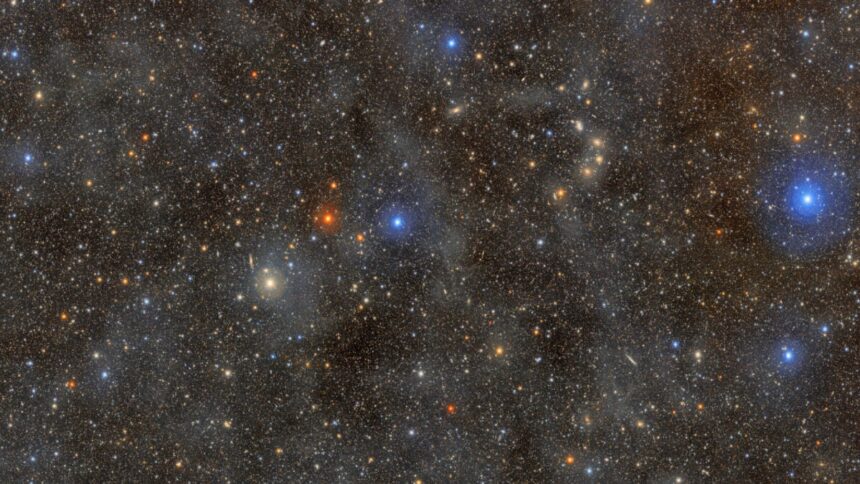
Rubin’s first released composite image, titled “The Cosmic Treasure Chest,” was compiled from 1,185 individual exposures. The most notable aspect of the image is that instead of the usual dark void between objects, the entire field of view is brimming with details thanks to the observatory’s ultra-sensitivity.
Earlier this year, the observatory fired off its first wave of notifications, sending 800,000 alerts to astronomers’ computers around the world. The Alert Production Pipeline, a software developed at the University of Washington, is designed to eventually produce up to 7 million alerts per night to notify astronomers of ongoing changes in the skies in real-time.
When the LSST is complete, the final dataset will contain billions of objects with trillions of measurements, which will all be accessible through regular data releases. “With the launch of the 10-year Legacy Survey of Space and Time, NSF–DOE Rubin Observatory is opening a new window on the universe,” said Darío Gil, under secretary for science at the U.S. Department of Energy. “It is embarking on a mission that will redefine modern cosmology and astrophysics.”
Read the full article here