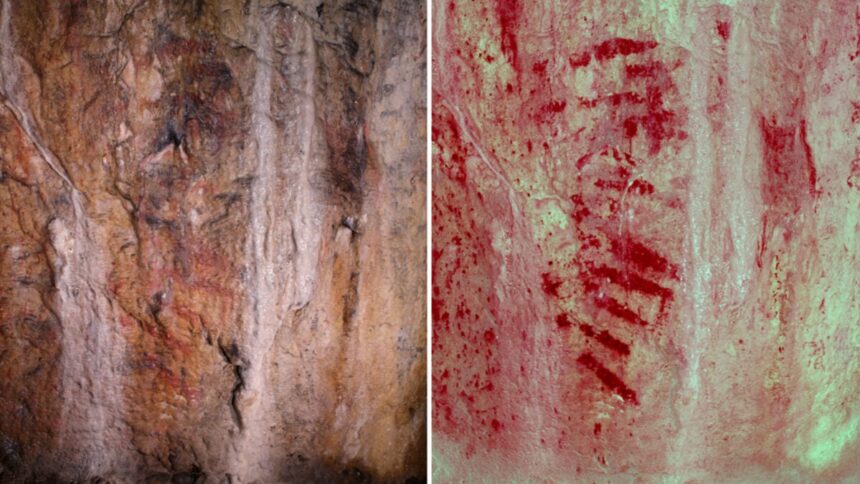
For nearly a century, skeptics dismissed a Paleolithic cave painting as merely rust-red iron oxides, the kind of natural staining one might see from mineral runoff on cave walls practically anywhere in the world. The painting’s almost modernist aesthetic didn’t help either: a column of parallel lines beside speckled splotches of red like a Jackson Pollock original.
But new research, including radioactive isotope dating and advanced image processing, has now confirmed that these unusual markings found inside a south Wales cave in 1912 really are ancient abstract art. Study coauthor George Nash, an archaeologist who specializes in prehistoric paintings, said he surprised himself with his team’s ability to correct the record on this wrongfully discredited find, vindicating the turn-of-the-century British and French anthropologists who first made this discovery.
“It was never considered to be rock art after 1928, and also it could never be dated, because in those days they didn’t have the scientific means that we have today,” Nash told The Guardian, in a story amounting to a correction to a correction amending the paper’s original 1912 coverage.
“I was taken aback that we were able to date it and analyse the pigments,” Nash said. “We’ve got data 17,100 years before present, which makes it the oldest rock art in the British Isles.”
Upper Paleolithic ‘modern’ art
Back in 1912, British geologist and anthropologist William Sollas and his French partner, the anthropologist and Catholic priest Henri Breuil, celebrated their discovery in south Wales’s Bacon Hole cave as “the first specimen of prehistoric cave painting ever discovered in England.”
Although the cave had already been well known for decades, the ancient paintings had eluded identification in part because a local fisherman, Jonny Bates from nearby Oystermouth, had made his own artistic contributions to the cave walls in the late 19th century.
“It is possible that some of the painted graffiti, including that of Jonny Bates from 1894, may obscure earlier historic and prehistoric painted imagery,” Nash and his coauthors wrote in their new study, published last week in the journal Quaternary. Other aspects of the cave added to this confusion, including a ruddy-reddish large stalagmite “much resembling rashers of bacon,” which seems to have inspired the site’s Bacon Hole name.
Nash and his team used a radiometric technique, uranium–thorium (U-Th) dating, to estimate the age of the cave art’s pigment material via the ratio of radioactive decay measurable in the trace amounts of uranium and thorium isotopes embedded within the cave wall’s stained calcite crust samples.
These samples, taken from Bacon Hole in 2023, dated this cave painting to about 17,000 years ago in the Upper Paleolithic, or the last phase of the “Stone Age.” While some samples were layered over with the same steady drip of carbonate mineral deposits that form stalactites and stalagmites in caves, dated to roughly 2,570 years ago, the team measured other key rock formations in Bacon Hole that corroborated this rock art’s age.
Uranium–thorium dating of key structural aspects of the cave place its formation to the retreat of a glacial ice sheet just a few millennia prior, which would indicate “a minimum age for the painting” of 15,700 years ago, or roughly 13,600 BCE “at 95% confidence.”
Artist unknown
Other physical aspects of these red markings, according to Nash and his collaborators, tend to corroborate the theory that it was made by ancient human hands. The team turned to a color enhancement method used by both archaeologists and satellite imagers to help draw out subtle color differences, D-Stretch.
The rhythm of the markings’ parallel horizontal lines, they wrote, “is a classic indicator of human symbolic behaviour and has no equivalent in natural mineral precipitation processes,” even though the pigment is indeed rich in mineral iron oxides. Its speckled “finger dots” and “splashes of pigment,” they noted, suggest a “spitting or blowing” technique—or perhaps even a very early predecessor to that “drip” technique Pollock made famous in the 1940s.
Beyond taking more samples to double check their results, Nash and his team hope future research might uncover something (anything) about the still mysterious prehistoric community that inspired this unknown artist.
“Bacon Hole and other caves along what is now the southern coastline of the Gower Peninsula would have offered suitable habitation sites for hunter–fisher–gatherer groups,” Nash’s team wrote, “although no evidence of occupation has yet been identified in or around the cave.”
Read the full article here