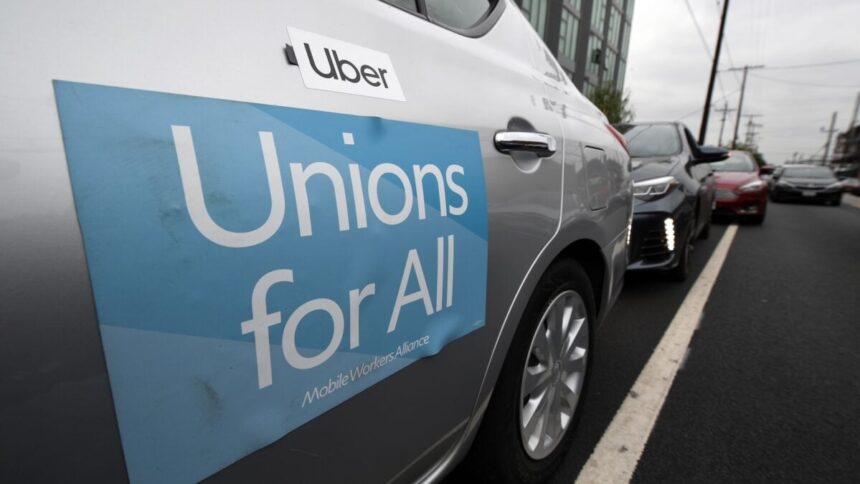
In Massachusetts, rideshare app drivers have succeeded in unionizing, and it’s the first such successful union drive in the country.
Anyone who has been part of a union drive may find this unionization strange thanks to its nontraditional card check, its one-quarter approval from drivers as opposed to a majority, and its on-the-honor-system dues scheme. But gig work is strange, and it seems the people of Massachusetts are trying to pioneer a new model for U.S. organized labor that can map onto the new realities of working in this country.
On the other hand, this effort has been criticized along the way for supposedly not giving workers real power. Uber and Lyft didn’t oppose the state ballot measure that set it in motion, and it’s been accused of creating “company unions” rather than a real union.
So successful unionization in this case means, according to the Boston Globe, the App Drivers Union has received certification from the state to bargain on behalf of the 70,000 rideshare drivers of Massachusetts. The App Driver’s Union website says it is “backed by two of the largest and most powerful unions in the country: 32BJ Service Employees International Union and the International Association of Machinists and Aerospace Workers.”
This effort stems from Massachusetts Question 3, a state ballot measure that voters approved in 2024. The law established a unique set of circumstances under which this new type of union could be created. That in turn led to a version of a card check that sounds more like a long, drawn-out grassroots signature-gathering process from the App Drivers Union over the past two years, according to the Boston Globe. Almost 23,000 out of the state’s 70,000 active drivers signed, and that legally qualifies this specific union as drivers’ “exclusive bargaining representative,” per the Globe.
But rather than being overseen by the National Labor Relations Board, this union is overseen by a state body, the Department of Labor Relations.
Recognition of the union is typically a wrenching next step in this process, but Lyft, for its part, gave a fairly supportive statement to the Globe, which says in part, “As this new process moves forward, we’re committed to engaging in good faith.”
Assuming recognition goes smoothly, the union and the relevant rideshare companies—including Uber, Lyft, Via, UZURV and SilverRide—get six months to bargain. If an agreement can’t be reached, then as you might expect, the matter could go to arbitration, according to the Globe. Unlike the initial union drive, the actual bargaining agreement has to be approved by a majority of the state’s active rideshare drivers.
Once the contract is won, it will be the union’s prerogative to collect dues from members in order to keep functioning, but it’ll have to subsist on what the state’s info page about Question 3 called “voluntary membership dues deductions.”
“We have to build a strong union so that Uber and Lyft respect us and pay us for driving their success. The more members that contribute to the union, the more power we will have with the app companies to win a good contract and enforce it,” the App Drivers Union page says.
Early efforts to win rights for drivers focused on reclassifying them as employees, and Uber and Lyft have been successful so far in maintaining U.S. gig workers’ status as independent contractors. The big rideshare companies have been friendlier toward the recent crop of state laws like this one, along with a similar one in California, that bypass the need for employment reclassification.
But if the App Drivers Union earns real, honest-to-God victories for its members thanks to this quirky new model for organized labor, it will be both a roadmap for workers all over the country to follow, and a new place for tech companies to focus their legal and political firepower.
Read the full article here