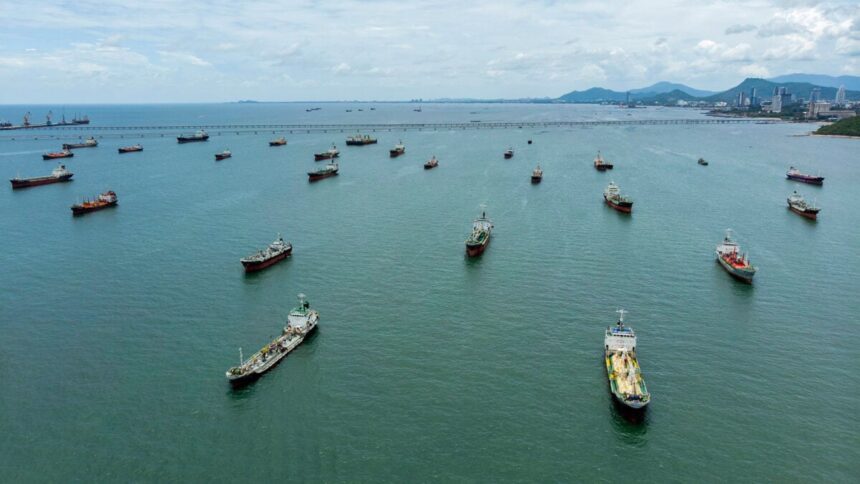
According to reports out of Iran, the country is launching an insurance program for vessels traveling through the Strait of Hormuz that will pay out claims via Bitcoin. This follows a previously announced plan to collect toll payments in Bitcoin for safe passage and the U.S. government’s seizure of $344 million of the USDT stablecoin connected to the Iranian regime.
The use of Bitcoin in the insurance scheme is of particular note following the seizure of the USDT stablecoins, as it may indicate that Iran has learned its lesson in terms of not using digital currencies that reintroduce the sort of counterparty risk Bitcoin was originally intended to avoid. Blockchain analytics firm Elliptic previously reported that the Iranian central bank had used USDT to support the Iranian rial and settle international trade payments. Use of USDT by the Maduro regime in Venezuela was also reported by the Wall Street Journal around the same time as another major USDT asset freeze conducted by Tether.
According to a document obtained by Fars News Agency, Iran’s new insurance plan operates through a platform called Hormuz Safe, backed by the country’s Ministry of Economy and the Persian Gulf Strait Authority. The service targets cargo shipments moving through the Persian Gulf and Strait of Hormuz, and issues policies and liability certificates that cover lower-risk events such as vessel inspections, detentions, and confiscations. Shippers pay premiums in Bitcoin or other cryptocurrencies and receive signed receipts with encrypted verification upon confirmation. Claims settle directly on the blockchain for speed and transparency. Iranian officials project the program could generate more than $10 billion in annual revenue while offering an alternative to support shipping amid ongoing sanctions and recent regional conflicts.
The plan has already drawn considerable criticism. Many shipping companies see it as another form of transit charge or a roundabout way of implementing the previous toll plan, which had involved fees of up to $2 million per voyage or roughly $1 per barrel of oil. Under the United Nations Convention on the Law of the Sea, unilateral levies on ships passing through international straits are not permitted. There are also doubts about whether Iran even has enough bitcoin on hand to finance such an insurance scheme.
Abdul Khalique, who is the head of the Liverpool John Moores University Maritime Centre, told Al Jazeera that “marine insurance requires large reserves and international reinsurance support to cover catastrophic losses, yet sanctions severely restrict Iran’s access to global financial and insurance markets.” He added that “without credible reinsurance, shipowners may doubt whether claims would actually be paid after accidents, spills, or seizures.”
Additionally, Rob Hamilton, CEO of bitcoin insurance firm AnchorWatch, posted on X that Iran’s crypto on-chain activity reached about $7.8 billion in 2025 but that its actual bitcoin holdings remain opaque. He noted that a single loaded VLCC tanker can exceed $300 million in value and questioned whether the country could underwrite the risks. Hamilton also described the arrangement as Iran acting as both the arsonist and the fireman and added, “There is no world where the US lets Iran charge an ‘insurance premium’ for passage when it’s just a dressed-up ransom payment.”
That said, the focus on Bitcoin rather than other, more centralized forms of crypto (namely stablecoins) indicates the global market’s collective understanding of this technology is improving. Within the crypto industry itself, there has been increased tension between those who are building tools that actually empower users to take full control over their digital finances and those who are fine with taking centralization shortcuts via stablecoins and other methods to simply increase mainstream appeal.
However, there are some situations where decentralization is simply not an optional feature. North Korea seems to have understood how this technology works for some time as they’ve been found to convert some of their more than $6 billion in alleged crypto hacking proceeds to bitcoin rather than keep them in assets that could be seized by the U.S. Notably, North Korean agents allegedly used Thorchain in the aftermath of the Bybit and KelpDAO hacks to convert their illicitly-gained funds to bitcoin, and Thorchain itself is currently dealing with a security incident that led to an estimated $10 million loss.
Despite the use of bitcoin by the likes of Iran, Venezuela, and North Korea in the past, it’s also seen as a legitimate reserve asset by the U.S. federal government, multiple individual states, and many traditional financial institutions.
Read the full article here