A group of environmental advocacy organizations is claiming that the race to build data centers in Earth’s orbit is not only potentially harmful to the environment, but it might also be illegal.
In a petition filed jointly by the non-profits Public Employees for Environmental Responsibility, Environment America, and DarkSky International, the groups are asking the Federal Communications Commission to pause its licensing of orbital data center projects until “the completion of a rigorous examination of the risks, alternatives, needs, costs, and impacts of this sudden transformation of Earth’s exosphere.”
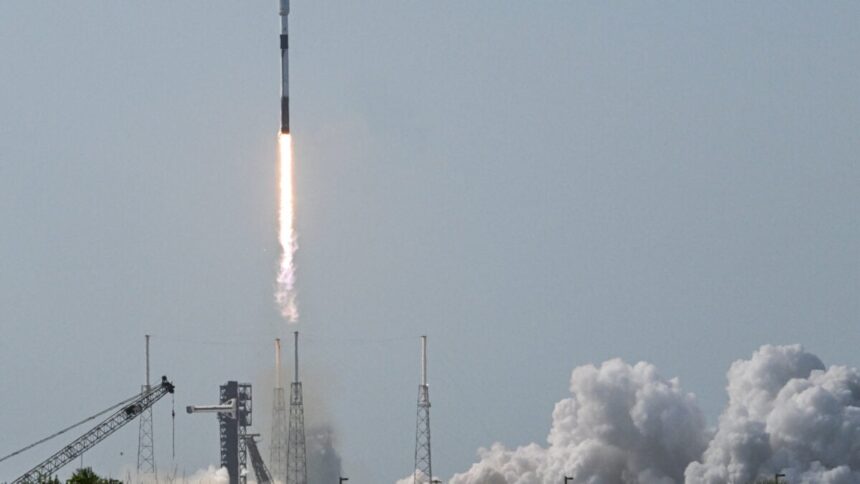
Artificial intelligence hype has spurred demand for more data centers, which in turn has created an unprecedented data center buildout that has drawn ire for its negative economic, health, and environmental impact on local communities. The solution Silicon Valley has proposed in response to mounting public outrage against data center projects is to move them up to space. Elon Musk’s SpaceX alone is planning to launch an orbital data center constellation of up to 1 million Starlinks. There are tons more big tech giants like Jeff Bezos’ Blue Origin and startups such as Starcloud that are eyeing ambitious plans in this new-age space race.
“The proponents of these proposals describe their plans in grandiose, civilization-changing terms. But these same proponents have refused to embrace any inquiry into the impacts of their self-claimed epochal technology on the environment, science, economy, or other values,” the petition claims. “This is not just poor planning and a missed opportunity: it violates federal law.”
The law the organizations are referring to is called the National Environmental Policy Act, which, among other things, requires federal agencies to evaluate the environmental and related social and economic effects of any proposed action before issuing permits. The permit approval process is even more important when it comes to orbital data centers. Since outer space is considered “the province of all mankind,” under the United Nations’ Outer Space Treaty, by law any launch should receive further scrutiny for its potential impact on humanity
The “virtually countless” proposed data center projects could degrade the ozone layer, change the quality of the night sky and alter the chemistry of the stratosphere, the groups warn in the petition.
The biggest threat these satellites pose is during rocket launches and when they eventually become defunct and fall back into the atmosphere. The launch process releases pollutants like soot particles. Meanwhile, scientists believe that increased re-entry of defunct satellites has contributed to an eight-fold increase in harmful oxides in the Earth’s atmosphere over six years. The chemicals could alter Earth’s climate, scientists warn, and deplete the ozone layer.
“Assuming an average five-year lifespan per satellite, SpaceX’s proposal countenances as many as 200,000 satellites re-entering the atmosphere and another 200,000 satellites being launched, each year, for the indefinite future,” the petition estimates. “The launches and reentries necessary to sustain a million or more satellites therefore promise to release pollutants at a scale far beyond anything to which space and Earth’s atmosphere have previously been subjected.”
Millions of data centers could also change how much of the night sky we can actually see from the ground. That pollution not only impacts everyday people but also can impede the scientific work of astronomers and even disrupt the lives of nocturnal wildlife.
“Every platform that goes up into orbit is reflecting and making the sky lighter; you just can’t see as much,” Michelle Hanlon, a space lawyer and executive director of the University of Mississippi’s Center for Air and Space Law, told Gizmodo last year. “We’ll be seeing data centers instead of stars.”
The organization argues that nighttime light pollution isn’t just an aesthetic concern but a potential public health problem.
“Nighttime light exposure can disrupt sleep by suppressing melatonin production, result in visual discomfort or retinal damage, and possibly even increase risks of cancer,” the petition says. “Given the scale of proposed mega-constellations and their resulting brightness, it is important that FCC consider the potential human health impacts resulting from artificial light at night.
Read the full article here