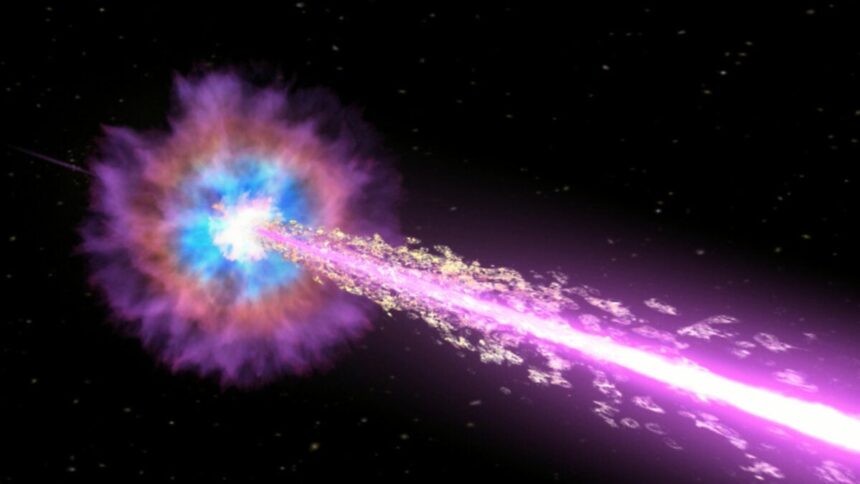
In 2022, astronomers detected an absurdly bright and long-lasting gamma ray burst, GRB 221009A—nicknamed “BOAT,” for “Brightest of All Time” (seriously). The shower of photons was so old and powerful that, theoretically, it shouldn’t have reached Earth. And yet, it clearly has. But how?
In a paper published yesterday in Physical Review Letters, a pair of physicists offer a puzzling solution to a puzzling problem: hypothetical particles from the cosmic dawn. Specifically, the researchers propose that photons could temporarily transform into axion-like particles, which are extremely light, paired with a separate tweak to account for photon behavior at extreme energies.
It’s this second piece that technically violates something called Lorentz invariance, a key tenant of Einstein’s special relativity. But here’s the thing—using this model, the pair predicted a secondary effect that would arise from the photon’s journey. And, it turns out, a completely unrelated observatory actually had observed exactly this. In other words, there’s actually empirical support for this theory.
“We started from a very simple question: how did this photon survive a journey that, according to known physics, should have destroyed it?” Giorgio Galanti, the study’s co-author and an astrophysicist at the Italian National Institute for Astrophysics, said in a statement. “We therefore looked for a theoretical scenario capable of consistently describing what we observe, without resorting to arbitrary corrections to the equations.”
‘B.O.A.T.’
Because GRB 221009A was so powerful, it “temporarily blinded most space-based gamma-ray instruments,” according to a NASA explainer—hence the nickname, “BOAT.” But the signal was also exceptionally long, at about 10 minutes. The flash remained detectable for the next 10 hours, and soon astronomers were able to lock down some key statistics of the BOAT.
Originating roughly two billion light-years from Earth, it exerted energies around 300 teraelectronvolts (TeV). For context, 1 electronvolt is the kinetic energy of 1 electron in a 1-volt vacuum; 1 teraelectronvolt is equivalent to 1 trillion electronvolts. At the time, experts with NASA surmised that the burst of light came from the birth of a new black hole, and subsequent investigations of the signal deemed that such luminous events would occur once in every 10,000 years.
A broken signal?
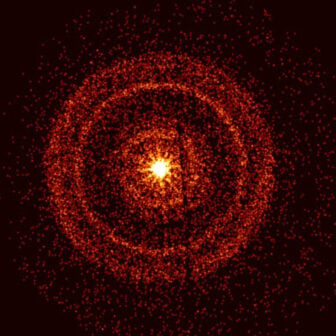
Then, astronomers had to reckon with the elephant in the room: the logistics of GRB 221009A’s journey to Earth. In the paper, Galanti and co-author Marco Roncadelli, of the Italian National Institute for Nuclear Physics, explained that GRB 221009A was “in tension” with conventional physics. According to the physics rulebook, photons at similar energy levels should have collided with the cosmic microwave background—traces of radiation from the universe’s earliest days—and been annihilated in the process.
In the statement, the team likened this to “shooting an arrow through an extremely dense forest stretching for two billion light-years and expecting it not to hit a single tree.” So, if the signal got here—and we know it did—the photons must have found a way either to dodge all of these trees or disregard them altogether.
The pair believes the answer is the latter. Some models of quantum gravity allow for slight flexibility in one of the fundamental rules of Einstein’s special relativity for matter at the highest energy levels. The pair coupled this mechanism with axion-like particles. As a result, what you get are what the researchers call the universe’s “fast lane,” through which super light, very powerful particles zip through obstacles as if they didn’t exist.
Cheat code
Understandably, this might sound like an ad hoc solution to the problem; after all, it’s not like we have concrete proof that axion-like particles exist. The team recognized this in the paper, explaining that its proposal is just one out of many ideas to probe this unexplained signal. That said, the latest calculations predicted a one-hour gap between a shower of lower-energy photons and the 300 TeV photon’s arrival on Earth. And, remarkably, this was precisely what one Chinese observatory caught at the time.
“The most interesting aspect of our work is that, for the first time, it brings together two ideas that until now had been developed separately,” Roncadelli said in the statement. “If future observations confirmed this scenario, the universe would become a natural laboratory for studying quantum gravity at energies enormously higher than those achievable by any accelerator built on Earth.”
Read the full article here