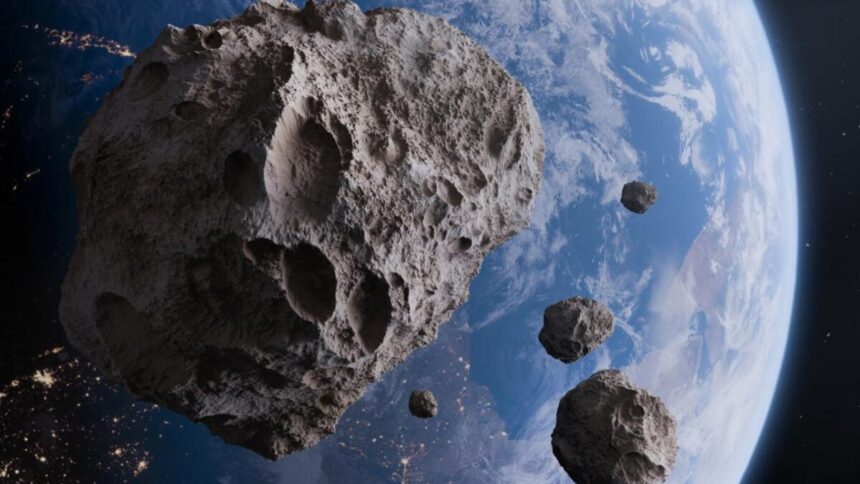
The tiniest life forms are also among Earth’s toughest, from near-invincible tardigrades to extremophilic microbes that thrive near volcanoes and hydrothermal vents. But could some of these itsy-bitsy creatures survive a journey through space tucked inside an asteroid—and then take root on another world? A wild new experiment suggests the answer is yes.
In a PNAS Nexus study published today, Johns Hopkins University researchers discuss the results of a microbe-launching experiment to test the lithopanspermia hypothesis. This well-known theory dares to suggest that life arrived on this planet from elsewhere, in the form of microbes hitching rides aboard asteroids or comets. To test this theory, the astrobiologists behind the new study created an apparatus to replicate how much pressure and physical stress a microorganism would have to endure while riding on an asteroid long enough to reach another planet.
This meant subjecting microbes to minimum pressures equivalent to ten times those of the Mariana Trench, the deepest part of Earth’s oceans—which, for the record, the microbes survived. Truly, they “proved very hard to kill,” the researchers recalled in a statement.
A different set of rules
To be clear, extremophiles aren’t invincible—they can definitely be killed. Still, extremophiles are remarkable in that they survive and enjoy conditions that, generally speaking, kill most life forms, such as extreme temperatures, pressures, or radiation exposure, or conditions without much sunlight or oxygen.
It might be more accurate to say that extremophiles simply require a different set of resources to thrive—an idea with key parallels to the search for extraterrestrial life. So understandably, extremophiles have been a vital part of astrobiological research on the origin of life, both on and off Earth.
Stronger than steel, literally
Then again, the microbes in this particular experiment, Deinococcus radiodurans, may as well have been invincible. For their test, the researchers simulated the pressure of an asteroid strike and ejection from Mars by firing high-speed projectiles at the microbes, sandwiched between metal plates.
Here’s where things get wild. The projectiles hit the plates at speeds up to 300 miles per hour (483 kilometers per hour), which adds up to about 1 to 3 gigapascals of pressure. And from all of this, the only thing that “died” was the steel plates, which eventually fell apart from so much slamming.
“We expected it to be dead at that first pressure,” admitted Lily Zhao, the study’s lead author and a graduate student at Johns Hopkins University. “We started shooting it faster and faster. We kept trying to kill it, but it was really hard to kill.”
Indeed, the microbes brushed off nearly every test at 1.4 gigapascals of pressure. Increased pressure did cause some internal damage and ruptured membranes here and there, but they were, for all intents and purposes, alive.
Extraterrestrial origins?
In interviews with Johns Hopkins and The New York Times, the authors suggested that the earliest lifeforms may have originated from Martian microbes “planet-hopping” aboard an Earth-bound asteroid. Of course, the researchers stressed that, for now, these questions remain in the realm of stimulating hypothetical thought experiments.
More importantly, the experiments demonstrate that it’s not totally impossible for life to spread between planetary bodies. For future space missions, this would warrant greater caution with regard to the potential “exchange” of life between Earth and other planets like Mars to avoid contamination.
Some food for thought
Of course, the study isn’t without its limitations. It’s a simulation—a compelling and fascinating one, sure—but with limited implications for what really happens to microbes during and after asteroid impacts. The researchers also note that various factors regarding the composition or trajectory of each asteroid may result in different reactions or survivability rates. Lastly, the experiment focused on just one type of extremophile, so the team says it plans to expand to other known extremophiles for future investigations.
In the end, the lithopanspermia hypothesis remains unproven. But you have to admit that the idea of teeny bacteria outlasting steel plates is so impressive that it’s almost ridiculous. And if that’s how tenacious life can get, maybe the evidence to prove this theory isn’t far out of reach.
Read the full article here