
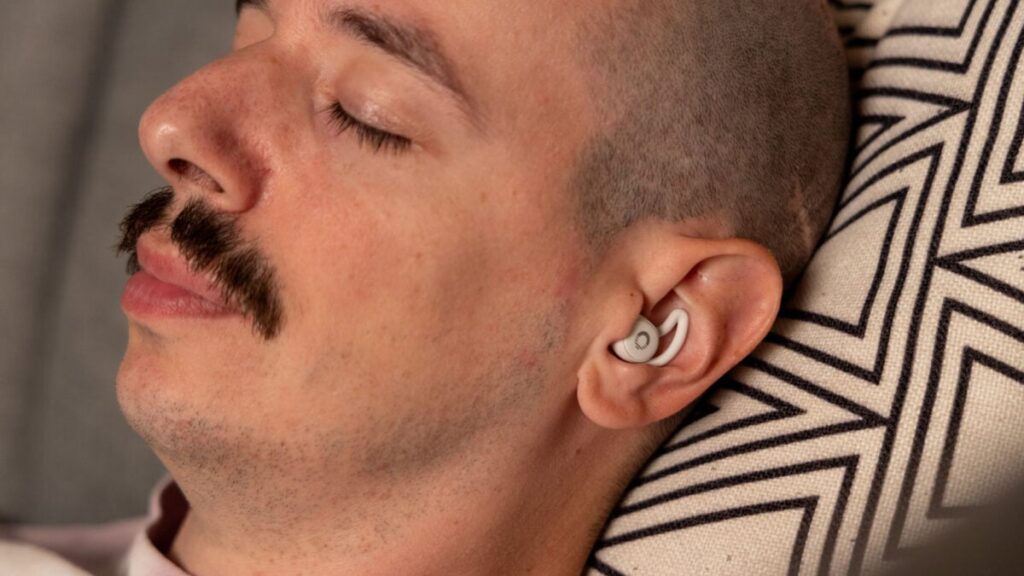
If there’s one thing I love more than audio that doesn’t suck, it’s a proper night’s rest. That’s why the idea of sleep-focused wireless earbuds—a growing category that I’ve covered a few times over the past year—speaks to me inherently.
Ozlo, a company that makes a pair of sleep earbuds aptly called the Sleepbuds, has a new pair on the market: the $280 Sleepbuds 2. Given my penchant for both audio and sleeping, I was eager to try them out, and luckily my sleepiness was rewarded.
Ozlo Sleepbuds 2
The Ozlo Sleepbuds 2 are solid wireless earbuds for sleep, though their price is prohibitive.
- Very comfortable
- Battery is great
- Versatile with lots of modes and sleep metrics
- Too pricey
- No ANC
- Sensors inside the charging case feel a little tacked on
A perfect fit
One of the things that caught my attention is that Ozlo is advertising the Sleepbuds 2 as “the world’s smallest earbuds designed for sleep,” which is a lofty claim. They are indeed small, though, weighing just 1.6g, about half the weight of the Soundcore Sleep A30.
What sleep-focused wireless earbuds really need to be, aside from light, is flat. That’s what separates sleep-focused wireless earbuds from the rest of the regular earbud pack—they’re designed to be slept on without hurting your ears, even if you’re a side sleeper like me.
In my experience, the Ozlo Sleepbuds 2 pass this test with flying colors. As comfortable as Soundcore’s Sleep A30 are, the Sleepbuds 2 raise the bar a bit. They come with four different ear tip sizes, but the default size ended up fitting my ear perfectly. After a few nights of lying with my head flat against a pillow while wearing these wireless earbuds for 7+ hours at a time, I have no complaints.

One thing I really appreciate is how soft the materials are. The ear tip is impossibly squishy, and the wing around the ear tip that’s meant to stabilize the buds and keep them in your ears is very malleable. That all adds up to a very light footprint once they’re actually inserted and doing their thing. Throughout the night, I almost forgot I was wearing them.
I don’t really have any complaints about the Soundcore Sleep A30 as far as comfort goes, but I do think the Sleepbuds 2 beat Soundcore’s excellent earbuds in the comfort department, if only by a small margin.
The case is smarter than it looks… sort of
Software-wise, the Sleepbuds 2 are pretty satisfying. There’s a wide array of free sleep sounds to choose from; some of them are noise-masking, and others are more soundscape-y, and you can download audio onto the earbuds to play locally and conserve battery life. I liked the rainfall sound, but you’ll have your own favorites—maybe you’re more into desert sounds or more of a nature ambiance. The app is easily navigable, too, which makes everything feel a little bit smoother.
Sound quality is fine for soundscapes and ambient noise but it’s slightly less satisfying for podcasts. I listened to my favorite Buffalo Bills show as a test (go Bills), and the audio felt somewhat unbalanced and dark, even when I had the Sleepbuds 2 set to “Spoken Word,” which is a preset audio tuning meant specifically for audiobooks and podcasts. It’s not that they’re unlistenable or anything, but I wouldn’t expect the same experience that you’d get with a premium pair of non-sleep wireless earbuds.

There are different modes to choose from depending on what you want/need out of your Sleepbuds. There’s Simple mode, which plays the sleep sound you have downloaded on your Sleepbuds automatically and then turns off Bluetooth after 10 minutes. There’s “Auto” mode, which will switch from the audio you were playing on your phone to a sleep sound after you fall asleep—this is for people who fall asleep listening to podcasts and such. Then, there’s “Sensing” mode, which streams external content and will transition to sleep sounds once the wireless earbuds have detected that you’ve fallen asleep. Finally, there’s “Manual” mode, which lets you trigger your sleep sound in the app or via the case.
Simple mode will likely be the go-to for most people, since it starts playing automatically and there’s little effort to actually trigger it, but you should know that if you use the Sleepbuds 2 in this mode, you won’t get one of the main features: sleep tracking. I’m telling you this now so you don’t lose a night’s worth of sleep data as I did. To get my precious sleep data, I used Manual mode, and the results were… interesting.

Once permissions are granted in the app under the “Sleep” tab, the Sleepbuds 2 track a few metrics, including awake time, REM sleep, core sleep, deep sleep, and, of course, how much you actually slept. These are logged via an accelerometer, which is different from other sleep-tracking earbuds like those made by NextSense, which come with small EEGs. To get the data, you’ll have to remove the Sleepbuds 2 and place them in the case the following day, where it’ll be transferred and recorded in the app. This whole process takes about 1-2 minutes, which isn’t ideal, to be honest, but it’s not deal-breakingly burdensome.

A couple of interesting sleep tracking features are actually enabled by the charging case. Here, there are sensors that detect light, noise, and temperature to give you a sense of external conditions while you sleep. The case records levels of both of those things, too, though I suspect the noise sensor is more sensitive than the light and temperature side of things.
I was able to see some noise crescendos throughout the night, showing me the dB of noise events (probably one of my cats screwing around), but the light stayed almost flat despite the fact that my room definitely got brighter as the sun came up, as did the temperature sensor even though I’d closed my door partway through the night to trap cool air from my AC.

All of these metrics are distilled into graphs inside the app, where you’ll be able to look at timelines showing changes in sleep stages, noise, temperature, and light. I can’t imagine checking those often, but it’s useful if you want to get really nerdy about everything that happened while your eyes were closed.
The good news is, even if the metrics are imperfect, I’m not entirely sure sleep data is all that important in the scheme of things. If you’re sleeping poorly, you probably know it already, and while metrics can give some insight into what the extent of that poor sleep is, they can’t really correct it for you. Knowledge is power, sure, but I’m not sure we need a pair of wireless earbuds to tell us something we already know.
A worthy guard against noise even without ANC
If there’s one thing that the Sleepbuds 2 are lacking on paper, it’s active noise cancellation (ANC). Soundcore’s Sleep A30 wireless earbuds have ANC, and it’s an absolute beast. If you’re trying to guard against some heavy snoring, Soundcore’s earbuds will rise to the challenge—I can say that from experience.

While the Sleepbuds 2 aren’t quite as formidable in that department, they’re still pretty good at blocking out most external noise. With the volume at 60%, I didn’t hear my cats complaining throughout the night that they’re bored, nor did I hear anyone begging for food. I can’t say that all of the sleep sounds are equally as good at blocking out noise, but the ones the two I used that were specifically for noise masking definitely did the trick (rainfill and jade static, in case anyone is wondering).
The bright side about not having ANC is that it does benefit the battery life. Ozlo says you’ll get up to 14 hours of battery life with the Sleepbuds 2, and that estimate tracks in my testing. Both nights, I got about 7.5 hours of sleep with the Sleepbuds 2 in, and when I awoke in the morning, the battery of both earbuds had drained from 100% to 60%. I should note that if you’re using the wireless earbuds with Bluetooth, that battery life won’t be nearly as high. Playing local sounds on the wireless earbuds greatly increases battery life.
Solid sleep is costly, apparently
If there’s one thing I can really knock the Ozlo Sleepbuds 2 for, it’s the price. For most people, $280 is a lot of money to pay for wireless earbuds that you’ll probably only use when you’re sleeping. It’s even a bigger hit when you realize that the Sleepbuds 2, unlike the $200 Soundcore Sleep A30, don’t have ANC, which could be the deciding factor in whether you can hear your partner or roommate’s incessant snoring.

That being said, most features on the Sleepbuds 2 are refined and well-executed. These sleep earbuds get extra points for comfort, and I like the inclusion of sleep-tracking metrics even if I don’t find sleep data to be the most useful. These are good sleep-focused wireless earbuds, even if I’m not convinced that they’re the best value out there.
Read the full article here