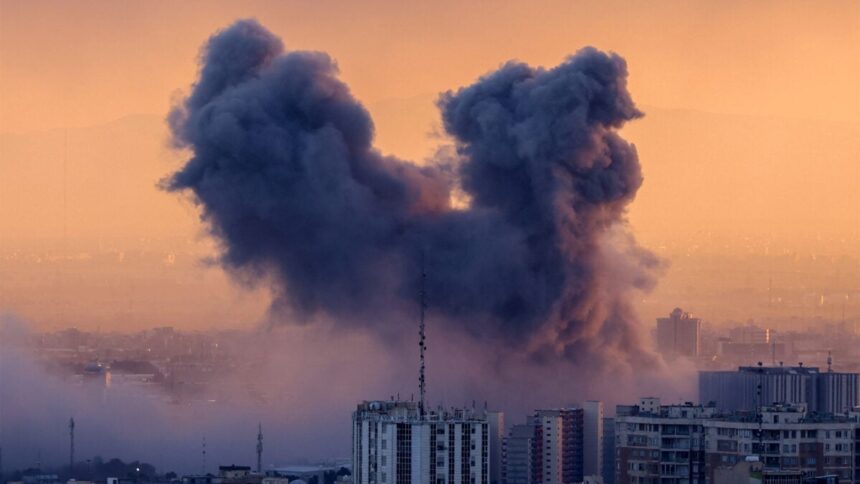
Human rights groups and United Nations researchers called it “black rain.” The surprise joint U.S.-Israeli airstrikes on Iranian oil facilities last March propelled toxic and highly acidic clouds of soot and aerosolized oil into the region’s cloud cover in the wake of the attacks, casting a literal black pall across the land.
Experts with the U.N.’s World Health Organization urged Tehran’s roughly 10 million citizens to stay indoors and wear masks following Israel’s particularly devastating strike against three fuel depots and the Tehran Oil Refinery just outside the nation’s capital on the night of March 7. Medical professionals understood almost immediately the potential risk for lung damage and skin burns following the bombing. But it has taken a detailed new study—marshaling Chinese and European satellite data—to finally put the full scope of this wartime environmental and public health disaster into context.
Meteorologists and atmospheric scientists in China have now determined that the impact rivaled days of volcanic activity. The March 7 airstrikes, they found, ejected a total of 29,800 tons of toxic sulfur dioxide pollution into the atmosphere above Tehran—equivalent to the volume typically expelled across several days by an eruption of Hawaii’s most active volcano, Kīlauea.
“Local reports indicated that some residents experienced headaches, a bitter taste in the mouth, eye and skin irritation, and breathing difficulties,” the researchers wrote in their new study, published Tuesday in the journal Advances in Atmospheric Sciences.
While the team intended to help assess the damage done in this specific case, it also said it hopes the study will serve as a proof of concept—demonstrating how atmospheric and climate research satellites can be redeployed for “environmental emergency monitoring” anywhere, the authors wrote in their paper.
‘Wind and cloud’
Proud owners of diesel-engine vehicles or fans of Nixon-era environmental reforms probably won’t need an introduction to sulfur dioxide. It’s a byproduct of certain kinds of petrol combustion that’s been strictly regulated in the United States since 1970 for its harmful impact on both humans and the environment, particularly its lead role in corrosive acid rain.
Study coauthor Peng Zhang of the China Meteorological Administration’s Meteorological Observation Centre said Middle East regions, despite their prominence in oil production, have tended to lack high-quality or real-time atmospheric monitoring of these airborne pollutants.
“We aimed to demonstrate that satellite remote sensing can fill this gap by providing wide spatial coverage and frequent observations to monitor atmospheric pollutants over large areas,” Zhang explained in a press statement.
Zhang and his colleagues turned to the China National Satellite Meteorological Center’s FengYun-3 series of satellites (which means “Wind and Cloud”) and the European Space Agency’s Sentinel-5P atmospheric monitoring satellites to determine what their ongoing data collection could mutually confirm. Taken together, the Ozone Monitoring Suite-Nadir instrument onboard China’s FengYun-3 satellite FY-3F and the Tropospheric Monitoring Instrument onboard Sentinel-5P delivered cross-validated readings on the airstrikes’ billowing cloud of sulfur dioxide.
They found that sulfur dioxide concentrations more than doubled, rising to 2.5 times their atmospheric concentration before the airstrikes detonated the Fardis, Shahran, and Aghdasieh oil depots alongside the Tehran refinery that night.
By two days later, on March 9, 2026, this toxic plume had spread over a distance of nearly 1,243 miles (2,000 kilometers), the researchers said, “affecting a broad downwind region across the Middle East towards East Asia.”
A new era of pollution monitoring
According to Zhang, he and his colleagues hope to next bring a newer sensor onboard the FengYun 3E and 3F into more formal use, the second-generation Hyperspectral Infrared Atmospheric Sounder (HIRAS-II) and its sulfur dioxide index. While the researchers had used HIRAS-II alongside the satellites’ other tools for this latest study, the hope is to ensure stronger validation for rapid-response data collection during future pollution events, whether in a war zone or not.
“We aim to refine these algorithms to provide precise, quantitative mass concentrations of various trace gases under diverse atmospheric conditions,” Zhang said. “Our ultimate goal is to build a fully integrated global monitoring system using dawn-dusk, mid-morning, and afternoon sun-synchronous orbits.”
Read the full article here