
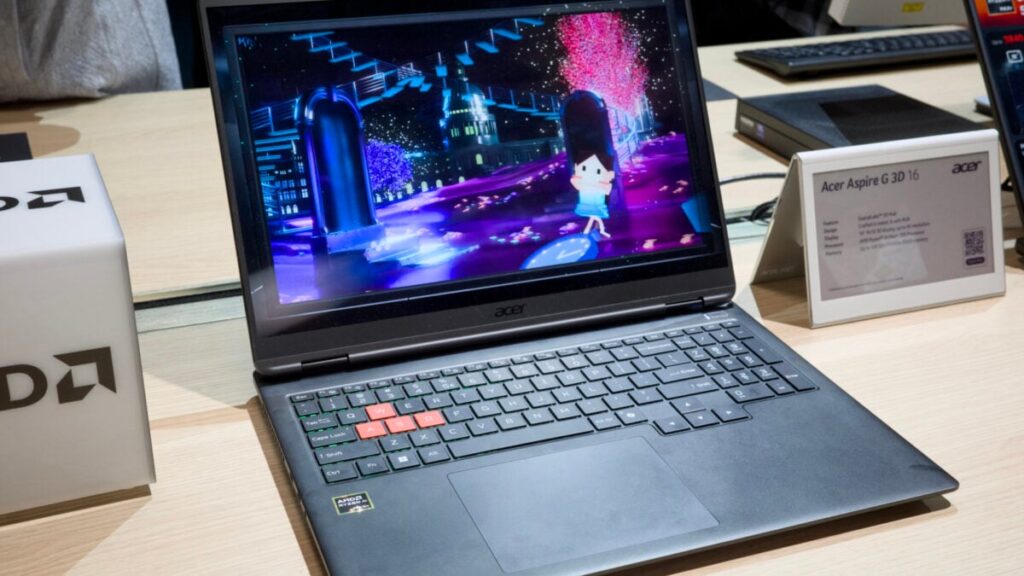
Samsung has been busy these last two years trying to force you to care about stereoscopic 3D displays. As shown at IFA 2026, Acer thinks it can make them more mobile with an Aspire G 3D 16 laptop. Even if you can’t stand the idea of a large-scale Nintendo 3DS, there may be other reasons to care about this laptop beyond the faux-3D.
The 16-inch laptop features a display with stereoscopic capabilities. When looking at the screen, dual eye-tracking forward-facing cameras help the screen showcase different images to each eye, creating a kind of 3D effect where certain objects seem to pop out of the image. It’s a subtle effect that adds a sense of depth to an image, and the added eye-tracking overcomes one of the Nintendo 3DS’ biggest flaws: the need to look at the screen straight on.
This IPS display is also able to output in 4K (3,840 x 2,400 pixel) resolution. However, you won’t actually be able to see the 3D content at that top resolution. Enabling the 3D features shrinks the output to 1,920 X 2,400 pixels. So you’ll be able to watch your full 4K Netflix stream, but you won’t be doing so in 3D.
However, Acer claims you’ll have plenty of options for the stereoscopic display through the pre-installed SpatialLabs 3D Hub app. This allows you to access some of the already-supported 3D content and games, plus use the special 2D-to-3D feature, which adds a filter on top of content like YouTube videos to add a subtle depth effect. Acer has been working on this software for a while now with several “SpatialLabs” monitors, including a gaming-focused Predator screen. This laptop is Acer’s attempt to take the tech mobile.
The upcoming Aspire G 3D 16 is designed as a semi-gaming, semi-entertainment device that really splits the difference between both use cases. Sure, it includes the typical RGB backlights you find on all those overtly gamer-fueled devices, but it’s still an “Aspire” device lacking any of the decals or design language of Acer’s Nitro or Predator lines. It also features bright red keycaps around PC gamers’ beloved WASD keys. The laptop has an all-metal chassis, helping it feel a little more premium.

And if you were hoping to game on this device, you should know that this isn’t your typical gaming PC. Instead of using a discrete GPU, Acer opted for an APU (accelerated processing unit with CPU and GPU capabilities on a single chip), namely the AMD Ryzen AI Max+ 395. I’ve seen this chip run on smaller-scale laptops like the Asus ProArt PX13, and it’s certainly a powerful chip. But it won’t equal the performance of other 16-inch gaming laptops. Additionally, the laptop can support up to 128GB of LPDDR5x-8000 RAM.
The bigger question for gamers is how much content you can actually play in 3D. It was one of the main issues with the original Samsung Odyssey 3D monitor from 2025, which sports a very similar stereoscopic screen. At Gamescom last month, Samsung showcased its own upcoming sequel 3D screen running Cyberpunk 2077 and Cronos: The New Dawn. Acer could not confirm whether or not these same games work with 3D through its own software.
My concern with a mobile 3D screen is performance with the 3D filter enabled. I’ve gone hands-on with the obscene yet obscenely innovative Abxylute 3D One, an 11-inch gaming handheld PC with a 3D display. In games that support 3D, I could not manage a playable frame rate, no matter which settings I used. That handheld was making use of an older Intel Lunar Lake chip—a lightweight laptop chip—while the AMD Strix Halo processor is certainly beefier on the GPU side.
Acer hasn’t released any information about the Aspire G 3D 16’s pricing. And here’s some sad news: The company told me it probably won’t come to the U.S., either. At this point, it’s better to consider this device as an early concept for what may—potentially—become a usable laptop you can buy. If you honestly had “4K-capable Nintendo 3DS” on your bingo card, you can go ahead and cash that in while you wait for this laptop to become a reality.
Read the full article here