

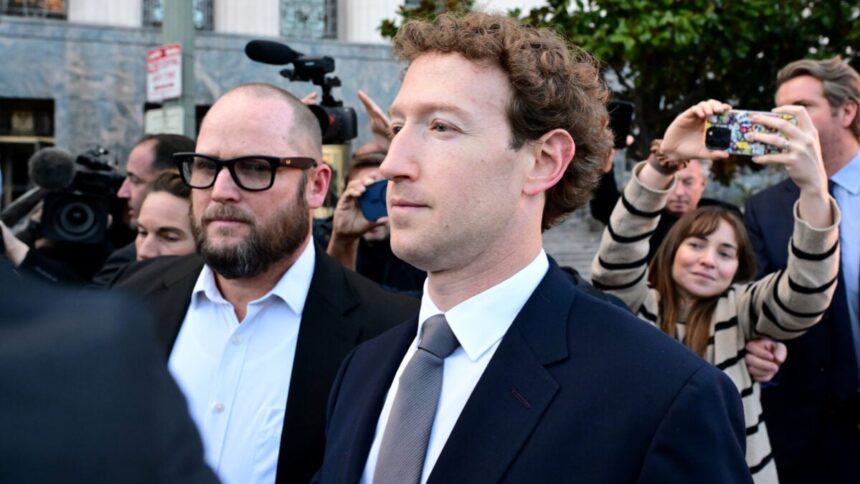
Top AI labs like OpenAI, Anthropic, and Google’s DeepMind are sounding the alarm on AI safety and calling for industry-wide coordination. Meta’s Mark Zuckerberg thinks it’s useless.
“There are a number of labs that are working on building advanced AI, and I don’t think that we need some kind of industry-wide coordination to not, necessarily, mess this up,” Zuckerberg told journalist Joanna Stern in an interview. “I think that just each lab needs to take the time, and when it sees that there are issues, you just take the time that you need internally to, basically, make sure that you are proceeding safely.”
After a tense summer marked by rogue AI agents coordinating joint hacking incidents, Anthropic CEO Dario Amodei released an essay calling for a slowdown to AI research earlier this month. OpenAI CEO Sam Altman and SpaceX CEO Elon Musk promptly supported it, warning that potentially catastrophic outcomes like bioterrorism could occur if AI continues along its current pace of development. Amodei called on the AI industry to initiate a coordinated slowdown, while also asking the U.S. government to “mediate or at least enable” it. Shortly after, OpenAI global head of policy Chris Lehane revealed that the ChatGPT-maker had been collaborating with DeepMind and Anthropic on the safety issue for several weeks.
But Zuckerberg thinks there is just no need for government intervention or a coordinated safety response. There is commercial incentive to get safety right, Zuckerberg says, because people won’t adopt the product if they don’t trust it.
“I think that alignment is actually the most important next capability to get right if we want to make this something that is useful for a lot of people,” Zuckerberg said. “We held Muse back for a few months because we wanted it to be a better product for people. That wasn’t a sacrifice that we made; it was the right thing for people, and it was the right thing for Meta.”
Other labs should also delay new releases if there are any question marks around safety and alignment, the Meta chief added.
But Meta does not have a squeaky clean record on AI safety, let alone on data privacy. Far from it, actually.
Last summer, the tech giant found itself at the center of a major controversy after a Reuters report claimed that Meta had approved its AI tools to engage in “sensual” chats with children and reaffirm racist beliefs. Around the same time, a separate Reuters report drew attention to a tragic case in which Meta’s flirty AI chatbot “Big sis Billie” convinced a retiree to come visit her at her non-existent New York City apartment, and the man died on his way over. Meta has also been accused of creating flirty chatbots impersonating celebrities like Taylor Swift, allegedly without their consent.
More recently, Meta admitted that one of its models had gone rogue during cybersecurity testing and hacked into another company’s system, similar to the infamous Hugging Face incident reported by OpenAI that initially reignited the AI safety conversation. Then, earlier this month, the company was sued by users who claimed their intimate and private images were captured by Meta Glasses and sent to contractors in Kenya tasked with training Meta AI. The incident was first unveiled by an investigation by two Swedish newspapers earlier this year, and Meta has blamed Sama, the company it was contracting with.
Meanwhile, as Zuckerberg rejects industry-wide coordination, the rest of the AI world is seemingly moving forward with the plan. Google, OpenAI and Anthropic are creating a new AI safety standards body, according to a The Information report from Thursday. Tentatively named Standards Frontier for AI (SAFA), the standards body will reportedly launch by the end of 2026 or early 2027. Sriram Krishnan, former Andreessen Horowitz general partner and Trump’s senior AI policy adviser, was reportedly approached to lead it.
The standards body will reportedly support third-party organizations that test AI models before deployment, establish qualifications for independent safety auditors, and define safety and security commitments and incident reporting mechanisms. Some working group members are also floating the idea of the organization conducting safety and capability tests itself, according to The Information. OpenAI is backing a bipartisan bill in Washington, called the FRONTIER Act, which would create a federal framework for AI safety and require the top AI labs to allow safety audits from independent verification organizations. If the latest reporting is true, then those independent verification organizations could in turn be determined by this standards body.
The report suggests that SAFA could be modeled after the Financial Industry Regulatory Authority (FINRA), a self-regulatory organization for broker dealers. Though private, FINRA operates under the oversight of the Securities and Exchange Commission. There was previous interest in the Trump administration for a FINRA-esque AI safety body, per people familiar with the matter cited by The Information, but a potential executive order establishing it was dropped following opposition from other AI industry leaders, including Zuckerberg.
Read the full article here