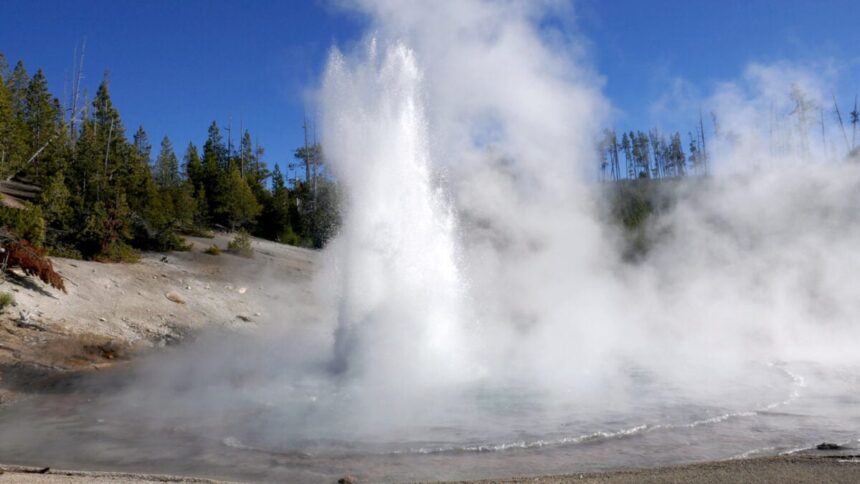
Yellowstone’s Norris Geyser Basin is home to some of the most fascinating geysers in the world. There’s Old Faithful, a geyser with 90-minute eruption patterns true to its name, and Steamboat, the world’s tallest active geyser, spewing water plumes more than 300 feet (91 meters) midair. But these renowned geysers have Echinus, the most acidic sibling of all—which recently awoke from a long slumber.
In a U.S. Geological Survey (USGS) blog post Monday, Michael Poland, a scientist with Yellowstone, shared that, since February 7, Echinus Geyser has been erupting at repeated intervals. First, the eruptions took place days apart but later occurred every 2 to 5 hours. Each eruption lasted a couple of minutes and reached about 20 to 30 feet (6 to 10 m) in height. This is the first time since 2017 that Echinus has shown such consistent activity, Poland wrote.
A bubbly, steaming ecology
Located in Wyoming, Montana, and Idaho, Yellowstone National Park is the first—and perhaps the most iconic—national park in the United States. Yellowstone also lies over one of the largest volcanic systems in North America, meaning unique volcanic activity governs the premises.
That includes geysers, or natural hot springs that spurt tall plumes of steaming water above ground. According to the U.S. National Park Service, geysers are a product of highly pressurized underground gases and require “plentiful water, tremendous heat, and a unique plumbing system.”
On the other hand, Norris Geyser Basin, sitting at the intersection of two major faults, boasts an exceptionally hot, dynamic environmental profile. These include dramatic changes to the physical or chemical composition of hot springs and geysers, such as unusual boiling or increased acidity, the Yellowstone Volcano Observatory explained in a USGS article.
The rarest of them all
Acidic water tends to break down the rocky plumbing systems of geysers, which is why acidic geysers are rare. Echinus Geyser, however, demonstrates a near-miraculous combination of natural forces that allow it to exist at all. At Echinus, neutral waters stifle the influence of acidic gases, keeping the plumbing channels relatively intact.
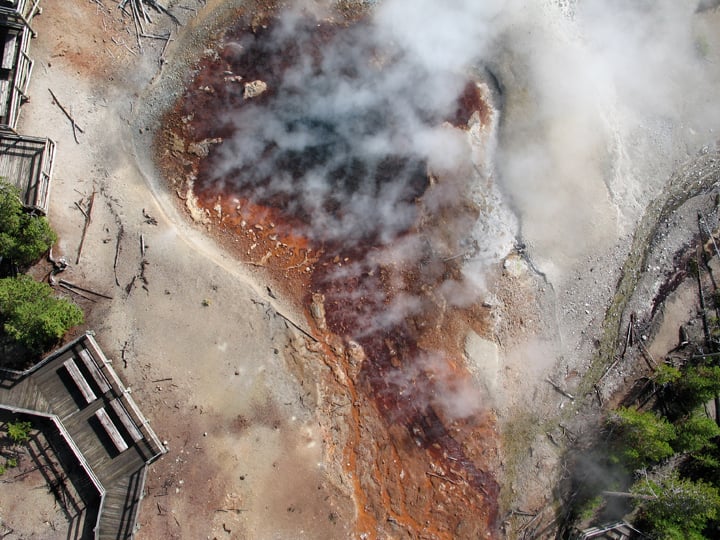
This “somewhat unique water chemistry” is what forms the red, silica-covered spiny rocks at the rim of the geyser pool, which is about 66 feet (20 m) across, Poland explained. But the acidity of the pool isn’t too concentrated, he added, as it is closer to “orange juice or vinegar” than to anything that’ll burn your skin off on contact.
Speaking from experience
Echinus used to be much more active in the late 20th century, with some eruptions lasting more than 90 minutes in the 1980s and 1990s and “could be regular enough that the park would sometimes post predictions,” according to Poland. But the geyser’s activity dwindled by the early 2000s, with only a few occasional eruptions, until a brief yet intense series of eruptions occurred in 2017.
However, Yellowstone experts aren’t sure how long Echinus will be active this time around. Historically, Echinus has tended to sprout some water for a month or two before falling back into dormancy. And regular eruptions subsided in the last few days of February, so it’s uncertain whether they’ll continue into summer, when the park is busiest with visitors.
I grew up on the West Coast, and Yellowstone was my family’s go-to place during winter break. Here’s the funny thing: I recall that my father did wonder aloud about a seemingly random boardwalk encircling a pool of water. I was maybe a little older than 10 and honestly wouldn’t have known whether that was Echinus, although I’m fairly certain we were hiking along the Norris Geyser Basin.
But assuming we were looking at Echinus, Poland’s blog post unexpectedly closes this circle: in the latter half of the 20th century, “the geyser was a consistent performer, and visitors could get closer to an eruption there than almost anywhere in the park.”
Having said that, I hope that Echinus will stay awake a little longer so that visitors can hike down the boardwalks as intended. Poland doesn’t seem to think this is out of the question, either. As he concludes in his post, “But change is constant at Norris Geyser Basin, so perhaps the show will continue into the summer! Fingers crossed…”
Read the full article here