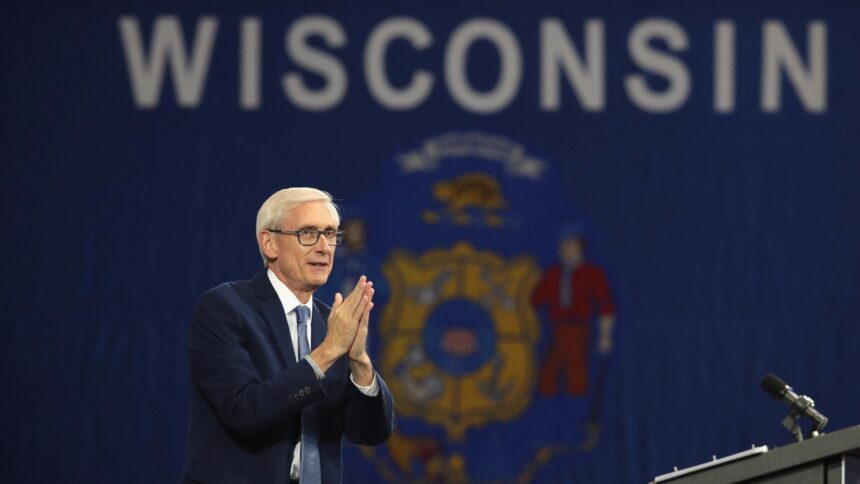
As states around the country have passed legislation that require citizens to provide government identification in order to access pornographic material, Wisconsin Governor Tony Evers bravely stood in front of the Republican-controlled state Assembly and said the right to goon shall not be infringed. Last week, the governor vetoed a bill that would have required residents to comply with age verification requirements in order to view sites that host adult material.
Wisconsin Assembly Bill 105—which passed with a vote of 69-22, with 22 Democrats opposing and 20 joining 49 Republicans to support the legislation—would have restricted businesses from publishing “material harmful to minors” without performing a “reasonable age verification method to verify the age of individuals attempting to access the website.” In other words, porn sites (among others) would need to implement age assurances in order to continue to operate in Wisconsin.
It’s a bill that has been passed, often with near-identical texts, in more than 25 states already, according to the Age Verification Providers Association, with another 13 states debating such a law. In most cases, the implementation of these bills requires residents to submit to rather invasive verification methods, including uploading a copy of their government-provided identification, submitting to a biometric face scan, providing sensitive documents like credit card or bank information, and other verification methods.
It’s on those grounds that Evers, the outgoing governor who has opted to step down instead of seeking a third term, decided to overrule the legislature. “I am vetoing this bill in its entirety because I object to this bill’s intrusion into the personal privacy of Wisconsin residents,” Evers wrote in a letter to lawmakers, according to 404 Media. “While I agree that we should protect children from harmful material, this bill imposes an intrusive burden on adults who are trying to access constitutionally protected materials.”
The governor’s decision to axe the proposed law comes after lawmakers stripped a previous version of the bill of text that would have included a ban on the use of VPNs to get around ID checks. But that change wasn’t enough to assuage Evers’ concerns over privacy violations or the risk of sensitive data ending up in the hands of third parties who are less scrupulous with how they handle it. You’ll remember that more than 70,000 Discord users had their IDs leaked following a breach of the company the platform trusted to do age verification checks.
While Wisconsin stands as one of the last states to not give in to the wave of age verification laws that have flooded the country, you probably don’t want to count on the Badger State becoming a bastion of privacy. While Evers did decide to veto this iteration of the age verification bill, his veto did include a call to “work with tech companies to implement device-based age verification that takes place on a user’s phone or computer, which can be a more secure and effective method.”
The device-level verification approach has been criticized by digital rights advocates because, while it eliminates the shady ecosystem of third-party vendors handling information, it also undermines a user’s privacy and permanently links an identifying data point to them that will be shared with just about every site, app, and platform they interact with.
Even if Wisconsin continues to resist these verification systems, it appears that a federal age-assurance standard may be coming. The Kids Online Safety Act has moved forward with bipartisan support, though some Democrats have started to question the legislation. Between that, a growing number of states passing such laws, and other countries like the UK embracing age verification, it feels like digital IDs are creeping toward inevitability if there isn’t a meaningful effort to push back.
Read the full article here