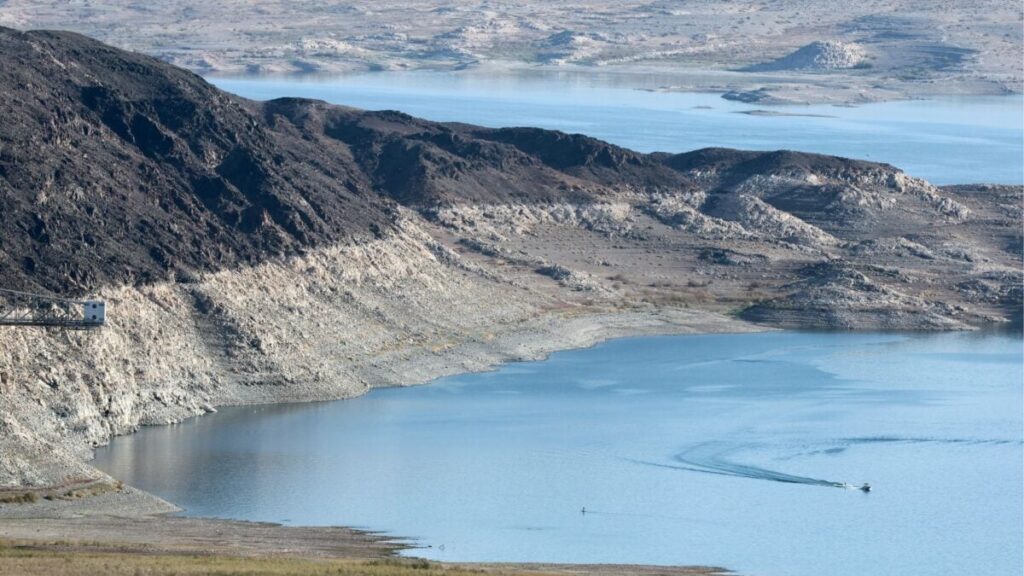
A literal watershed moment in the Colorado River crisis came Friday when Lake Mead, the largest reservoir in the United States, fell to its lowest level on record. Its water level dropped even farther over the weekend, and experts say it could continue to fall through the rest of the year.
On Monday, the U.S. Bureau of Reclamation recorded a water level of just 1,040.09 feet (317.27 meters) above sea level at Lake Mead. That’s nearly 4 inches (10 centimeters) below the level observed Friday that broke the record low set on July 28, 2022, according to the agency.
“It’s extremely significant and extremely concerning,” J.B. Hamby, chairman of the Colorado River Board of California and a board member of the Imperial Irrigation District, the largest user of the river’s water, told the Associated Press. “You have three-quarters of the population of the Colorado River Basin, some 30 million people, who are directly impacted by risks to Lake Mead.”
The disappearing Colorado River Basin
In 1936, completion of the Hoover Dam blocked the flow of the Colorado River and created Lake Mead, which is considered at full capacity when its water level reaches 1,220 feet (371.86 meters) above sea level, though it can hold a maximum of 1,229 feet (374.6 meters). The reservoir is now at its lowest level ever recorded in the 90 years since it was filled.
This marks a critical moment in the historic, extended drought that has been sucking the Colorado River Basin dry since 2000. During this time, the Basin has seen its lowest 16-year period of inflow in more than a century of record keeping, and reservoir storage in the Colorado River system has plummeted from nearly full to about half capacity, according to the U.S. Geological Survey.
Lake Powell, the second largest reservoir in the U.S., is also critically low. In July, a group of Colorado River experts found that the combined volume of water stored in Lake Powell and Lake Mead was the lowest it’s been since 1957, when the Glen Canyon Dam that creates Lake Powell was still under construction.
And that’s not all. Of the 54 Western reservoirs monitored by the Bureau of Reclamation, nine recently recorded their lowest levels in the last three decades, the AP reports.
The consequences of a record-warm winter
As with most environmental crises, there is no single force driving the Colorado River drought. Rather, a combination of chronic water overconsumption and climate change has set the stage for the record lows we’re now seeing.
These current conditions stem largely from a historic snow drought that deprived the basin of meltwater this past spring. Over 70% of the Colorado River’s natural flow originates from snowmelt, but in March, Colorado’s snowpack sat at just 40% of normal levels.
“It’s now safe to conclude that this has been the worst year for Colorado snowpack in recorded history,” Colorado State University climatologist Russ Schumacher wrote in a blog post on April 2.
Research published in July found that the western snow drought was about four times more likely due to climate change. In the Upper Colorado River Basin specifically, climate change made the snow drought 14 times more likely.
As global temperatures continue to rise, experts predict flows in the Colorado River could drop another 30% by 2050. In the near term, a potentially unprecedented El Niño could help alleviate Colorado’s drought conditions and recharge the Basin and its reservoirs, but that remains to be seen.
Read the full article here