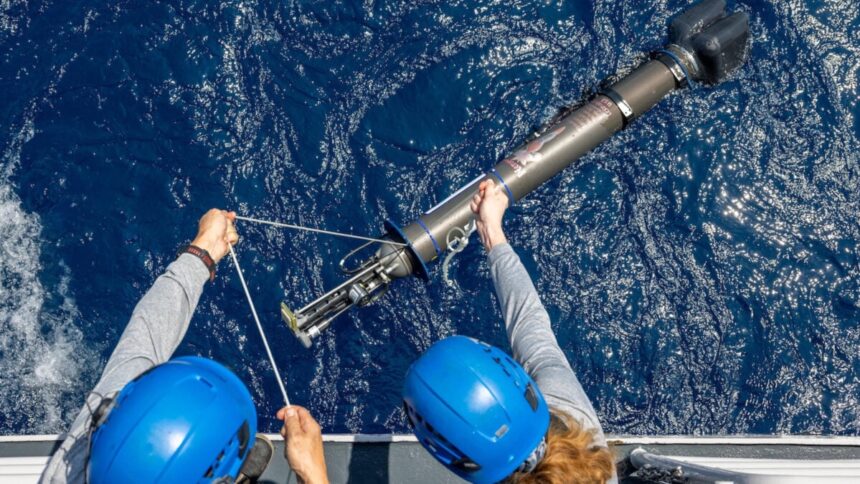
Practically all of the ocean floor remains a mystery to humans, but robotic floats may soon change that shortcoming. In a groundbreaking discovery, a small robotic float brought back data from deep beneath the North Pacific—leading to the discovery of hidden chemicals in the ocean’s most elusive regions.
Oxygen minimum zones (OMZs) refer to layers in the ocean’s water column with low oxygen concentrations. For a long time, scientists believed that these areas were generally stagnant with low levels of both oxygen and nitrogen, another element critical to the marine ecosystem. However, a detailed dataset on the chemical profile of OMZs, collected by a robotic float over three years, revealed that things were far more complex—these so-called anomalies also showed a robust, dynamic interplay between organic and inorganic components in the seafloor.
The researchers behind the study, a team of marine biologists based in the U.S., published their findings yesterday in Communications Earth & Environment.
“This research showed us that nitrogen cycling in parts of the ocean with very little oxygen is far more dynamic than previously thought,” Ken Johnson, the study’s senior author and a researcher at the Monterey Bay Aquarium Research Institute (MBARI), said in an institute statement. “We now have an important new perspective on the ocean’s hidden chemistry, which will help scientists assess and track ocean health.”
A sea of floats
Here’s something you probably didn’t know. Since 2016, an international collaboration of scientists has been planting an entire fleet of autonomous robotic floats in the Northeastern Pacific Ocean. The Biogeochemical Argo mission, or BCG-Argo for short, sends these tiny floats roughly 6,600 feet (2,000 meters) underwater.
Every 10 days or so, the floats send back data samples of ocean temperature, salinity, oxygen, acidity, and more. Over the past decade, this has amounted to hundreds of thousands of data points about the overall health of our oceans.
Flagging the nitrogen rift
On the other hand, scientists long understood the importance of OMZs with regard to nitrogen loss. According to Mariana Bif, the study’s lead author, nitrogen levels “govern ocean productivity, the global carbon cycle, and even atmospheric greenhouse gas balance.”
Bif, a marine biologist at the University of Miami, wrote in an Eos column that, as “vast midwater deserts,” OMZs eventually transition into ODZs, or oxygen-deficient zones, as microbial life that thrives on low oxygen gradually fill up the region with carbon dioxide, consuming what little oxygen was there before.
ODZs are the “hotspots” of nitrogen loss from the ocean, Bif added, and both OMZs and ODZs are expanding and intensifying with rising ocean temperatures. Scientists are vying for data to help predict how such dynamics work, but the “invisible chemistry that drives them” has been “nearly impossible to measure across seasons, years, and vast areas of the ocean,” Bif wrote.
Send in the floats
On that front, the numerous BCG-Argo floats offered a unique opportunity for probing these elusive regions. The floats are equipped with an ultraviolet spectrophotometer, an advanced sensor that flags slight changes in ultraviolet light to identify a variety of chemicals dissolved in seawater.
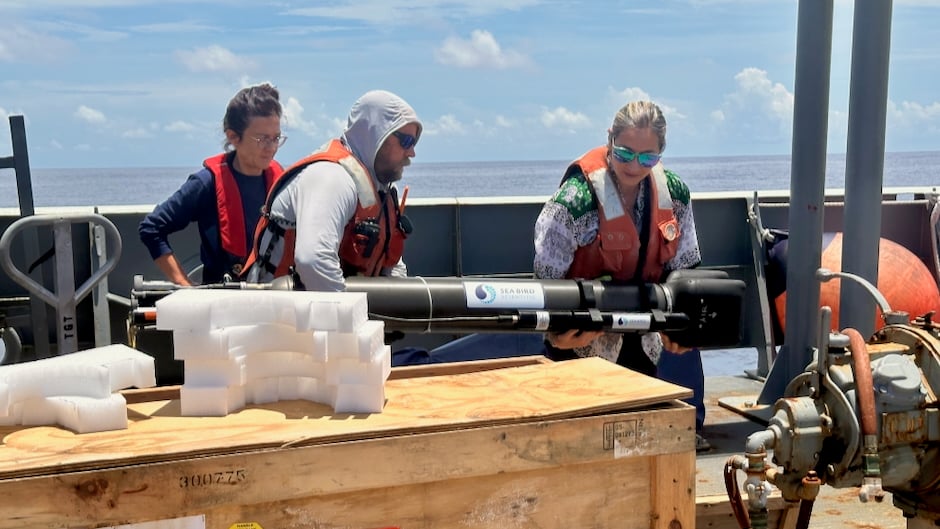
“This is one of those fortuitous circumstances that moves science forward,” Johnson said. “These floats are able to gather high-resolution data across larger areas and for longer time periods than the sporadic shipboard snapshots used in the past.”
In a previous study, Bif’s statistical analysis of the sensor’s functionality convinced her that the float could do more—for example, detect nitrite compounds to help characterize nitrogen pathways in and out of OMZs. Her intuitions were on the mark; the float brought back detailed information that enabled the team to track nitrogen cycling and quantify microbial dynamics in low-oxygen waters, according to a University of Miami statement on the findings.
Nature rarely disappoints
The new analysis confirmed something that was both expected and surprising at the same time. The results demonstrated that, even in relatively low-resource areas like OMZs, nature’s dynamics are rarely static in space and time. At the same time, it also makes sense that marine ecosystems are generally governed by larger ocean conditions—and, by extension, broader climate dynamics.
“It’s an exciting new look at the dynamic interplay between microbial processes that cannot be captured by traditional sampling approaches,” Johnson said. “This work underscores how GO-BGC and other collaborative efforts are advancing our ability to monitor ocean health and reveal hidden, but important, processes across the global ocean.”
Related post: Tiny Robot Lost Under Antarctic Ice for 8 Months Comes Back With Rare Data
Read the full article here