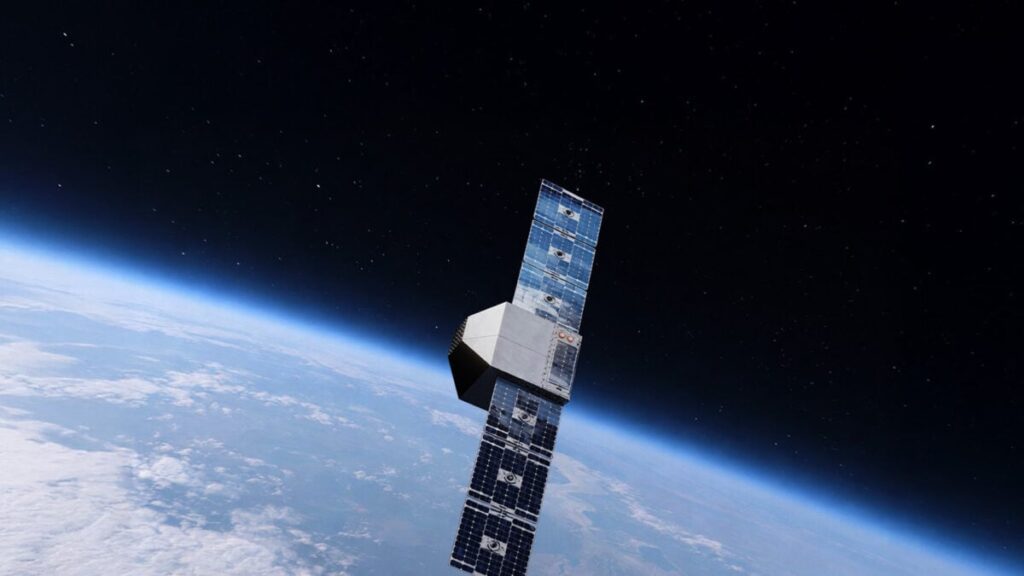
A new type of propulsion system could allow satellites to fly closer to Earth than ever before without being dragged down by the planet’s atmosphere.
Spanish startup Kreios Space developed an air-breathing electric propulsion system that collects residual gases from the atmosphere, like oxygen and nitrogen, and uses them as propellant for a satellite’s thrusters. The new technology would allow satellites to stay in very low Earth orbit (VLEO), circling our planet at roughly 60 miles to 250 miles (100 to 400 kilometers) above the surface.
The air-breathing system will be put to its first test in space during an upcoming mission in 2028, Kreios recently announced.
Breathe in, breathe out
Satellites flying in very low Earth orbit face severe atmospheric drag, rapidly decaying their orbit and pulling them down to a fiery death. For satellites to remain in VLEO, their propulsion systems would require large amounts of propellant to counter atmospheric drag. That’s not ideal for space missions, as it creates a satellite that is too heavy and expensive to launch.
For Kreios’ air-breathing electric propulsion, the idea is to maintain that low altitude without the need for any propellant on board the satellite. Instead, the propulsion system scoops up air from Earth’s upper atmosphere, heats it up to ionize it, and expels it to generate thrust.
The company has tested a prototype of its new propulsion system in a lab in 2021. For its first in-orbit demonstration, Kreios is using a microsatellite bus by Lithuania-based Kongsberg NanoAvionics to carry the air-breathing propulsion system to space.
The upcoming mission is designed to validate the new technology, take measurements of the surrounding environment, and capture sub-meter resolution images in the visible and near-infrared (VNIR) spectral range.
How low
There are several advantages to satellites flying in VLEO as they can gather sharper, higher-resolution images of Earth, offer stronger signals, and require smaller parts for the same level of performance as those operating in low Earth orbit. VLEO is also significantly less crowded than low Earth orbit, with fewer satellites and less space debris zipping around at high speeds.
“Kreios is building the satellites that make sustained operations in Very Low Earth Orbit possible,” Adrián Senar, CEO of Kreios Space, said in a statement. “By enabling satellites to fly lower, longer, and more efficiently, we are enabling higher-resolution Earth observation, much better satellite communications, more responsive and accurate missions, and a more sustainable orbital infrastructure.”
China has also shown recent interest in VLEO, establishing a national industry alliance designed to demonstrate sustainable operations of satellites closer to Earth.
Read the full article here