Meta might be turning its back on VR to prioritize smart glasses, but if Pimax is any indication, headsets are about to be more mind-blowing than they ever were.
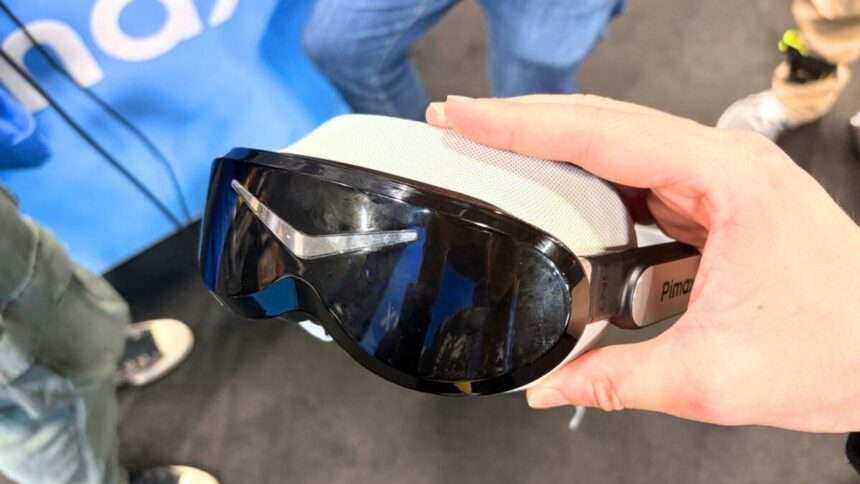
At CES 2026, I got a chance to try out Pimax’s Dream Air, an impossibly light wired PC VR headset that weighs just 170 grams (that’s 7 grams lighter than my iPhone 17). On top of that impressive weight (or lack thereof), the Dream Air still somehow manages to pack in a display with 8K resolution. That all sounds almost too good to be true, right? I thought the same—until I put the headset on.
Pimax’s Dream Air is genuinely about as good as it gets in the PC VR world. In a demo, I strapped the headset onto my face and started piloting a Blade Runner-esque ship in Low-Fi, a cyberpunk RPG made for VR. Did I immediately get nauseous? Yes, I sure did. Did I want to keep playing anyway? Also, yes. I’m not kidding when I say that the clarity and smoothness of this headset’s display were arguably the most impressive I’ve seen in VR to date.
That’s because the Dream Air’s micro OLED display is no joke, boasting a resolution of 3,840 × 3,552 pixels per eye. It’s a stark comparison with the Quest 3 and its LCD display with 2,064 x 2,208 pixels per eye, though that comparison, in Meta’s defense, is a little unfair.
The Dream Air is PC VR, meaning it relies entirely on a connected PC to do all the computing—in my case, a high-end gaming laptop with an Nvidia 50-series GPU. That offloading of the computing experience and reliance on wires gives the Dream Air quite a few advantages. For one, the Dream Air doesn’t use a battery, which drastically reduces weight. It also doesn’t have to fit a computer inside the headset, which, again, brings the weight way down.
It’s not just offloading the computer and battery that makes the Dream Air so light; it’s the choice of lens. Unlike other headsets with pancake lenses, which are flat, the Dream Air uses concave lenses (similar to the Vision Pro). This allows the display inside the headset to sit closer to the wearer’s eyes and reduces the thickness and weight of the headset. What’s even more impressive on this front is that the Dream Air manages to squeeze out an even higher field of view than the Vision Pro with this concave lens design, boasting 110 degrees as opposed to the Vision Pro’s 100 degrees.
The result of those choices is an experience that’s far less burdensome than other micro OLED headsets like the Apple Vision Pro, which is an absolute unit that weighs about 600g to 650g. I only got to use the Dream Air for a few minutes, but I could see myself using the headset for much, much longer, which is more than I could say for the Vision Pro or even Meta’s Quest 3, which weighs less than the Vision Pro at 515g.

While the Dream Air felt like a very real future in my demo, it’s worth noting that the headset has faced significant delays since its announcement last December and just recently started to ship in small batches. That’s a bummer, to be sure, but I can imagine that making a headset this light and with this nice a display is pretty complex and costly, so I can’t say I’m surprised.
As you may have already guessed, nothing about the Dream Air will come cheap. The Dream Air starts at $2,000, (still cheaper than the Vision Pro), though there is a Dream Air SE that can be preordered right now for $900 and is slated to ship in February. The SE version has a lower resolution screen and a smaller field of view, which is where that price reduction comes from.
Delay or not, the Dream Air definitely restored my zest for VR, and while I’ve never been much of a wired headset guy, there’s clearly a lot to be excited for in the space.
Gizmodo is on the ground in Las Vegas all week bringing you everything you need to know about the tech unveiled at CES 2026. You can follow our CES live blog here and find all our coverage here.
Read the full article here