
By using this site, you agree to the Privacy Policy and Terms of Use.
Accept
Tech Consumer JournalTech Consumer JournalTech Consumer Journal
  • News
  • Phones
  • Tablets
  • Wearable
  • Home Tech
  • Streaming
  • More Articles
Reading: These Transistors Engineered With Bacteria Are Literally Alive, if a Little Slow
Share
Sign In
Notification Show More
Font ResizerAa
Tech Consumer JournalTech Consumer Journal
Font ResizerAa
  • News
  • Phones
  • Tablets
  • Wearable
  • Home Tech
  • Streaming
  • More Articles
Search
  • News
  • Phones
  • Tablets
  • Wearable
  • Home Tech
  • Streaming
  • More Articles
Have an existing account? Sign In
Follow US
  • Contact
  • Blog
  • Complaint
  • Advertise
© 2022 Foxiz News Network. Ruby Design Company. All Rights Reserved.
Tech Consumer Journal > News > These Transistors Engineered With Bacteria Are Literally Alive, if a Little Slow
News

These Transistors Engineered With Bacteria Are Literally Alive, if a Little Slow

News Room
Last updated: August 20, 2026 8:20 pm
News Room
Share
SHARE

At its core, a lot of modern technology depends on relatively simple patterns to receive and relay information. Incidentally, living things have also functioned this way for billions of years—a comparison that hasn’t gone unnoticed by engineers.

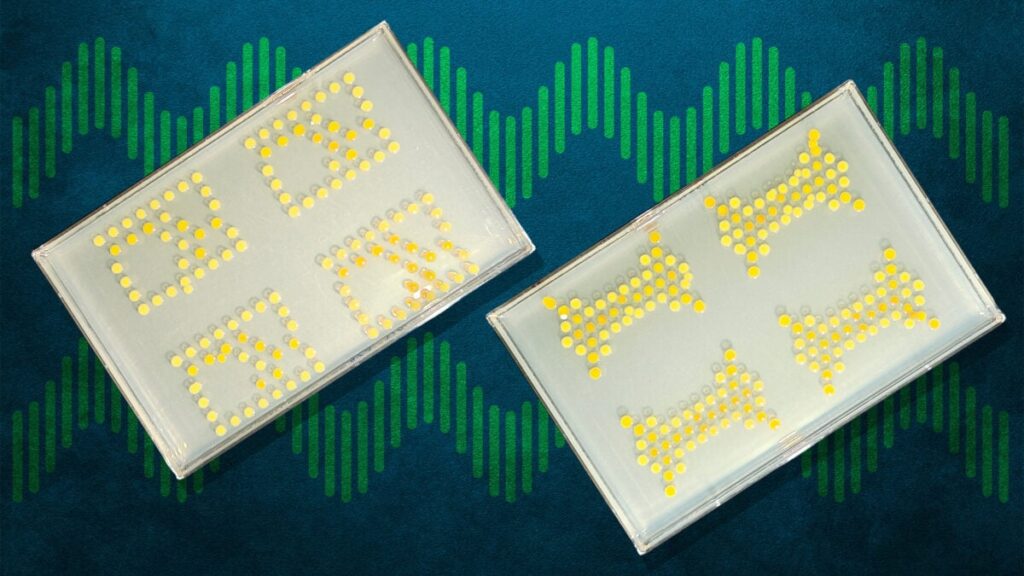
In electrical circuits, transistors switch or amplify electric signals, but researchers at the Massachusetts Institute of Technology have swapped in electrical signals for biological ones, using three strains of the bacteria Pantoea agglomerans to “carry” signals across circuits. It takes the cells a lengthy eight hours to perform each calculation, but the findings, published this week in Nature Chemical Biology, demonstrate the potential of biotechnology in unexpected ways.

“We’re not trying to replace computers, but rather put computational control into biology,” Christopher Voigt, head of MIT’s Department of Biological Engineering and the study’s senior author, told MIT News. “If you have bacteria on the root of a plant, or the plant itself is doing the computing, running a simple calculation overnight is fast enough relative to a growth season.”

Organic limits

According to the paper, similar approaches in the past primarily focused on using enzymes to run (relatively) large, singular cells hosting an entire circuit. But it’s been very tricky to get a tiny cell to perform calculations in the exact way researchers want, which puts a strict limit on the level of complexity that is allowed.

On the other hand, transistors “do not define circuit logic” but “conditionally enable signal propagation,” the researchers wrote. If they could make these transistors work, then it would be possible to combine the bio-transistors in different arrangements to create more diverse circuits.

To create their prototype, the researchers printed colonies of bacteria onto tiny plates, with each colony living around 5 millimeters apart from each other. The mechanism behind these transistors involved a family of molecules used in biochemical research. One molecule served as the switch, another as a “target” molecule indicative of whether the switch is active. If the target molecule is present, the transistors produce an output molecule.

Finally, the signal representing the output molecule relays it to another transistor, effectively creating a chain of transistors that relay information. Test runs of the transistor revealed that it could perform a fair number of logical operations using only five strains, with the largest circuit holding up to 24 bacterial colonies wired together.

That said, the team noted several limitations on the maximum size of these circuits. For one, these are living organisms, so they’re bound to grow and change over time. The circuit’s speed is also generally slow, as the setup depends on the natural molecular diffusions between colonies. Overall, these limitations make it so that the “living computer” operates for around three days.

Not coming to a computer near you

Then again, the researchers aren’t trying to make living computers for an office setting, though such designs could be useful in agriculture. For instance, the circuit could sit near the roots of plants to detect different stresses or autonomously respond to the presence of pests or other environmental threats.

“This work shows that we can get toward more complicated functions by linking up simpler functions in individual cells,” Voigt added. “Computationally, there’s nothing that your iPhone can do that these circuits couldn’t do.”

Read the full article here

You Might Also Like

Dave Bautista Is Kratos in ‘God of War’

Netflix’s Anime NYC Line Up Is Ridiculously Stacked

There’s Life Before Watching ‘Bone Tomahawk,’ and Then There’s Life After Watching ‘Bone Tomahawk’

Bruce Campbell Has Been Retired as Ash for a While, Actually

Bigfoot-Like Ancient Apes Might Have Been Closer to Humans Than We Realize

Share This Article
Facebook Twitter Copy Link Print
Previous Article The Best Tech and Gear for Back to School 2026
Next Article Bigfoot-Like Ancient Apes Might Have Been Closer to Humans Than We Realize
Leave a comment

Leave a Reply Cancel reply

Your email address will not be published. Required fields are marked *

Stay Connected

248.1kLike
69.1kFollow
134kPin
54.3kFollow

Latest News

The Best Tech and Gear for Back to School 2026
News
The Creepy ‘Never After Dark’ Trailer Might Keep You Up at Night
News
Darth Vader Speaks at City Council Meeting
News
DOJ Throws Support Behind xAI’s Fight Against Minnesota AI Nudification Ban
News
NASA’s Swift Is Doomed to a Fiery Death After Rescue Mission Fails
News
This Robot Vacuum Has a Brush and Mop Pad That Can Reach Places Others Can’t
News
SpaceX Finally Recovers Starship After 24 Days of Tugging It Through Rough Waters
News
‘The Odyssey’ Is Now the Highest-Grossing R-Rated Film of All Time
News

You Might also Like

News

This Electric Shock Glove Was Invented for Police in the 1930s to ‘Incite Fear’

News Room News Room 6 Min Read
News

OpenAI’s CFO Reportedly Downplays Importance of IPO to Staff

News Room News Room 3 Min Read
News

Mars’ Potato-Shaped Moon May Have Gotten Its Youthful Look From a Single Impact

News Room News Room 5 Min Read
Tech Consumer JournalTech Consumer Journal
Follow US
2024 © Prices.com LLC. All Rights Reserved.
  • Privacy Policy
  • Terms of use
  • For Advertisers
  • Contact
Welcome Back!

Sign in to your account

Username or Email Address
Password

Lost your password?