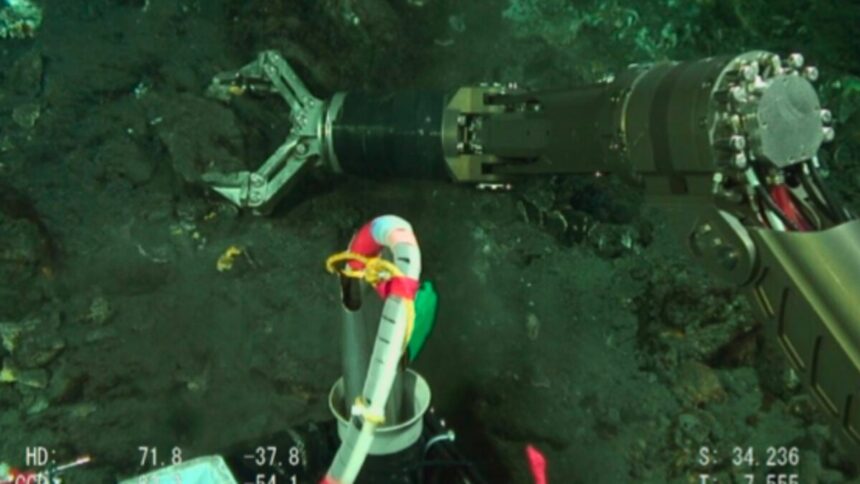
Japanese scientists discovered the undersea fields of Higashi-Aogashima Knoll Caldera’s hydrothermal vents over a decade ago, but the mineral-rich deposits from these fissures continue to reveal bizarre surprises. In the years since, Japan has devoted both private and government resources toward recovering the many millions of tons of metallic ore once hidden within this seafloor—but I don’t think any of those expeditions ever expected to find this.
Geologists working with the crew of the Research Vessel (R/V) Shinsei Maru have uncovered an unusually potent deposit of actual elemental gold deeply interlaced within pyrite, commonly known as “fool’s gold,” in record-breaking concentrations as high as 1.9% by weight. Yes, that’s right—they found actual gold within fool’s gold, the latter of which is famous for resembling the precious metal despite having little intrinsic value. The bona fide gold was found locked within the crystalline structure of these pyrite deposits along the volcanic caldera roughly 2,300 feet (700 meters) below sea level.
Sulfur is a geologically common nonmetallic element leaked from hydrothermal vents, one that is integral to their alien ecosystems, and an essential component in fool’s gold, iron sulfide. The study’s first author, geologist Yuichi Morishita, and his colleagues theorize that the formation of this pyrite alongside arsenic contaminants is what facilitated the entry of this hidden gold into this crystalline mineral.
“Pyrite is a ubiquitous sulfide mineral in the most hydrothermal systems, and arsenian pyrite is a common host for ‘invisible gold,’” the researchers explained in their new study, currently undergoing editorial review for the Nature journal Scientific Reports.
Gold bonds
For context, this 19,231 parts-per-million (ppm) concentration of reverse-double fool’s gold (i.e., real gold) is more than 440 times the concentrations currently found in other known deep-sea gold deposits globally, which tend to contain concentrations somewhere between 0.01 and 43 ppm. But not all of the Higashi-Aogashima Knoll’s hydrothermal pyrite contained gold in these rich amounts.
The so-called Central Cone Site contained pyrite with the highest concentrations, with a special formation of the crystalline mineral, known as colloform pyrite, containing the most gold. This colloform pyrite formed when superheated sulfurous emissions from the hydrothermal vents rapidly cooled as they mixed with cold seawater—leading to chemical additions that may have facilitated the pyrite’s gold-trapping internal structure.
“Colloform pyrites with high lead and/or copper concentrations in addition to arsenic concentration […] might have induced the high gold concentration in pyrite,” the researchers wrote. “[But] elucidating the mechanism remains a topic for future study.”
Very fine gold
One aspect of these gold deposits that surprised Morishita and his coauthors was how thinly interlaced they were within the pyrite, not in gold nuggets so much as woven in at an atomic level (more like “gold capillaries” than “gold veins,” I guess you could say). The discovery, in fact, was only possible through a highly detailed analysis of the pyrite’s chemical makeup using secondary ion mass spectrometry (SIMS).
“We first found ‘invisible gold’ in pyrite from the sulfide mound and active chimney of the deposits through the SIMS analysis,” Morishita and his colleagues wrote.
The unique chemistry of the Higashi-Aogashima Knoll Caldera’s hydrothermal vents, with its imposing black smoker chimneys pumping out sulfide, might prove to be a model that helps researchers find other gold deposits just like it elsewhere in Earth’s oceans. But, at roughly 2,690 feet (820 meters) below sea level, the caldera’s “invisible gold” may nevertheless prove to be uniquely close to the surface compared to other truly deep-sea hydrothermal vents.
“Future commercial development challenges are expected to be less difficult than other deeper deposits,” the researchers noted.
Read the full article here