
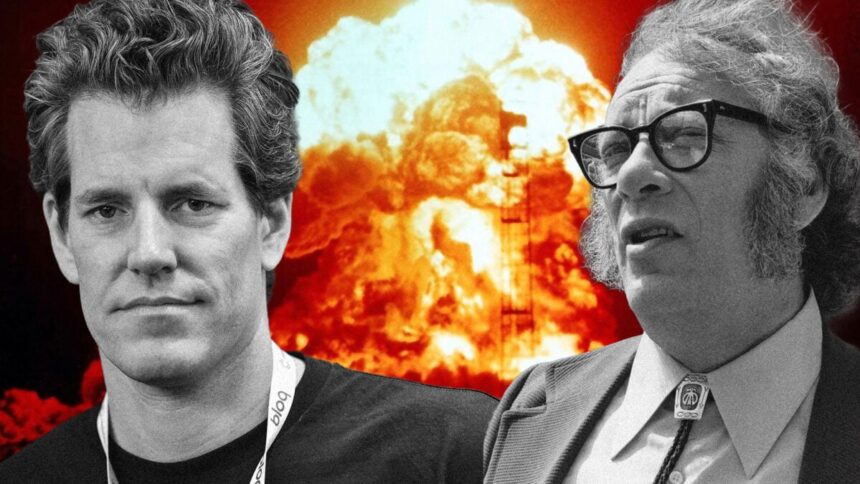
It’s all anyone seems to be talking about at the moment. Will AI destroy humanity? Some people who work for the top AI companies like Anthropic and OpenAI really think so. But don’t worry, because tech investor Tyler Winklevoss believes he found the answer.
“You don’t need the government to tell you how to make AI safe,” Winklevoss wrote in a tweet on Tuesday. “These questions were asked and answered by Isaac Asimov in the 1940s. The frontier labs can hardcode Asimov’s Laws of Robotics into their models today. What are they waiting for?”
Winklevoss, perhaps most famous for suing Facebook in the 2000s, is absolutely right that Asimov invented his own laws of robotics. But if you stop and think about what applying them to AI would mean, it doesn’t solve all our potential problems.
If you’re unfamiliar with the Laws of Robotics, Asimov wrote a short story in 1942 called “Runaround” that first included them:
- A robot may not injure a human being or, through inaction, allow a human being to come to harm.
- A robot must obey the orders given it by human beings except where such orders would conflict with the First Law.
- A robot must protect its own existence as long as such protection does not conflict with the First or Second Law.
A fourth law was added later, known as the zeroth law: “A robot may not harm humanity, or, by inaction, allow humanity to come to harm.”
That all makes sense in the world of sci-fi, and there’s nothing wrong with imagining a world where you can just tell robots not to harm humans. But we’re not necessarily talking about physical humanoid robots when we discuss the AI apocalypse that has everyone debating this week. We’re talking about AI agents without human form. And there are countless ways to define “harm,” complicating the problem even further.
Many people who claim that AI could bring about the end of humanity are cagey when asked about what that means. But we can imagine several sci-fi-inspired scenarios where rogue AI agents could potentially breach secure systems to create chaos. The most obvious would involve nuclear weapons or control of other military systems.
Another scenario might involve bringing down the entire internet or maybe the financial system. If AI agents found a way to hack into every bank account in America and drain funds, it’s easy to imagine how that might cause society to collapse in fundamental ways. Do you have enough cash on hand to make it through the month? Or a year? Or maybe decades?
In every single scenario, we can try to apply Asimov’s Laws of Robotics, and we’re met with problems that the laws don’t fix. Take the financial system. If you tell the AI not to injure a human being, the AI agent could interpret “injure” to simply mean physically harm. If the AI hacks into Bank of America and steals billions of dollars, that doesn’t physically harm anyone. At least not immediately.
If you don’t have any money, you will find yourself unable to buy food, shelter, or transportation, but those are downstream. And what if taking those dollars helped someone else? Maybe the AI could rationalize any potential harm as necessary in a capitalist system. After all, we see wealth extraction from the poor to the rich every day in the form of high interest rates and ballooning rents. Would instituting the Laws of Robotics with the broadest interpretation possible allow any AI to engage in any kind of capitalist behavior, since it commonly hurts the human with less wealth?
Winklevoss’s primary business is in crypto, a technology for which the primary use cases are speculation and helping people commit crimes. Would it be off limits for AI to touch anything related to crypto?
There’s also the problem of MAGA politics that Winklevoss doesn’t address. The Pentagon won’t let AI companies build models that hinder their ability to kill people. Anthropic famously tried to put two types of limitations on the AI it was selling to the military: 1) No domestic surveillance and 2) No autonomous weapons. Defense Secretary Pete Hegseth demanded that Anthropic drop its guardrails and blacklisted the company when it did not.
And none of this consideration of Asimov’s laws even acknowledges how all of this plays out in “Runaround.” The story is about a robot that’s mining in an area that’s harmful to the robot, and it becomes confused about whether to adhere to the second law (following the orders of humans) or the third law (protecting its own existence). The entire point of the story is that it’s not easy to follow what appear to be very straightforward rules.
Anthropic CEO Dario Amodei has called for a slowdown in AI development, at least temporarily. OpenAI’s Sam Altman and SpaceXAI’s Elon Musk have done the same, at least publicly. But few people trust the motives of these oligarchs with deep ties to the U.S. government and incentives to lie to all of us. Many people believe this sudden fixation on existential threats from AI is manufactured to allow these people to amass more power. That’s not a ridiculous idea.
If it really was as simple as telling all of the major AI models to adhere to Asimov’s Laws of Robotics, we’d be all for it. But that sounds suspiciously like telling your AI chatbot to “make no mistakes.” It’s probably not going to work like you think because these systems do make mistakes, no matter how much you tell them not to. And they’re all black boxes that make it difficult to tell how to alter them in ways that make them more predictable.
Guardrails for AI are obviously necessary. But when the biggest AI companies keep demanding to be regulated (and Trump tells them to fuck off because they don’t need regulation), it’s hard to know what to believe.
Read the full article here