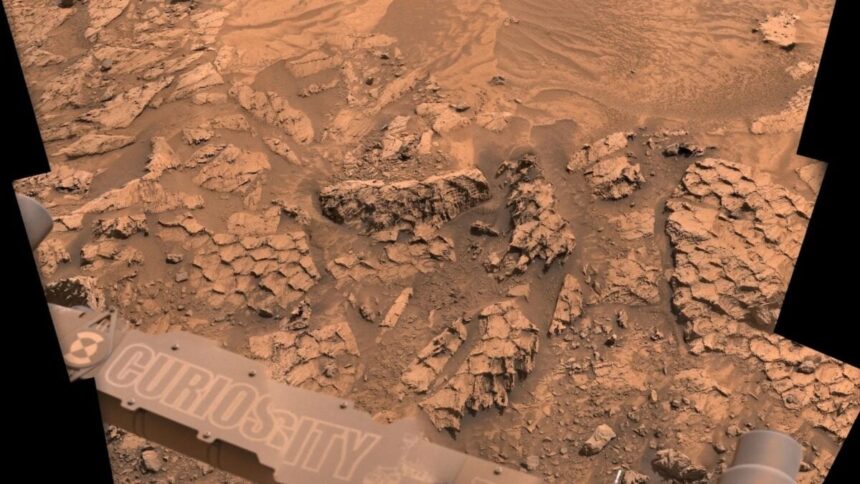
While scouring a 50-million-year-old crater on Mars, the Curiosity rover stumbled upon a polygon-shaped pattern that sort of looks like a giant reptile had shed its skin across the planet’s surface. The rover’s recent find adds to the long list of weird and eerie images of the alien world.
NASA’s six-wheeled robot captured the photo of the strange rocks on April 7 while driving toward a small crater named Antofagasta. “Many of the rocks we’ve driven over have these incredible textures—thousands of honeycomb-shaped polygons crisscross their surface,” Abigail Fraeman, deputy project scientist at NASA’s Jet Propulsion Laboratory, wrote in a blog post.
Curiosity used its two-camera Mastcam instrument to capture the above image of the Martian terrain, revealing the planet’s ancient rocks donning a strange, fish-scale-like appearance.
Tipping the scales
The peculiar, honey-comb pattern drew the attention of NASA scientists for its sheer quantity, stretching across the planet’s dusty surface for as far as Curiosity could see. “We’ve seen polygon-patterned rocks like these before, but they didn’t seem quite this dramatically abundant, stretching across the ground for meters and meters in our Mastcam mosaics,” Fraeman noted.
The team behind the Curiosity mission is still trying to figure out how the pattern formed on Mars’ rocks. “This week we continued to collect lots of images and chemical data that will help us distinguish between different hypotheses for how the honeycomb textures formed,” Fraeman wrote.
On Earth, polygonal patterns form on the surface through the repeated expansion and contraction of ground material, which is mainly driven by cycles of freezing and thawing in cold or arid environments. Mars may be a dry, desert-like world today, but scientists believe the planet once possessed a thick atmosphere and liquid water on its surface in the form of lakes and rivers, and possibly even an ocean.
The polygonal pattern of these rocks therefore may be an indication of Mars’ ancient waters and a clue to the planet’s earlier history.
Rover explorer
Before reaching the Antofagasta crater, Curiosity was treading across a region filled with delicate zigzag ridges in Mount Sharp. The spiderweb-like features, known as boxwork formations, likely came to be when groundwater deposited minerals in cracks that later hardened, suggesting water flowed in this part of Mars later than scientists expected.
Earlier this month, the rover moved onto the small crater that was named after a region and major city in Chile next to the Atacama. NASA scientists believe Antofagasta is a relatively young crater, which formed less than 50 million years ago. Therefore, there may be material in or around the crater that was exposed to the harsh radiation environment on Mars more recently.
The Curiosity rover recently made a major discovery, detecting more than 20 organic molecules in clay-rich Martian sandstones. Scientists believe some of these organic molecules may have been ingredients of life on Earth, adding to the growing body of evidence that suggests Mars’ ancient habitability.
Read the full article here