By using this site, you agree to the Privacy Policy and Terms of Use.
Accept
Tech Consumer JournalTech Consumer JournalTech Consumer Journal
  • News
  • Phones
  • Tablets
  • Wearable
  • Home Tech
  • Streaming
  • More Articles
Reading: NASA Backs Wild Plan for a Laser-Powered Drone to Explore Giant Caves Below the Moon’s Surface
Share
Sign In
Notification Show More
Font ResizerAa
Tech Consumer JournalTech Consumer Journal
Font ResizerAa
  • News
  • Phones
  • Tablets
  • Wearable
  • Home Tech
  • Streaming
  • More Articles
Search
  • News
  • Phones
  • Tablets
  • Wearable
  • Home Tech
  • Streaming
  • More Articles
Have an existing account? Sign In
Follow US
  • Contact
  • Blog
  • Complaint
  • Advertise
© 2022 Foxiz News Network. Ruby Design Company. All Rights Reserved.
Tech Consumer Journal > News > NASA Backs Wild Plan for a Laser-Powered Drone to Explore Giant Caves Below the Moon’s Surface
News

NASA Backs Wild Plan for a Laser-Powered Drone to Explore Giant Caves Below the Moon’s Surface

News Room
Last updated: August 4, 2026 1:56 pm
News Room
Share
SHARE

Just under the surface of the Moon, subterranean caverns stretch out thousands of feet (hundreds of meters) in diameter—some as much as 1,000 times more vast than similar lava tubes carved out by volcanic activity here on Earth. Scientists have long schemed about refurbishing these lunar caves into sites for exploratory bases on the Moon, given the caves’ natural protection from cosmic radiation beneath thick layers of regolith and cooled magma.

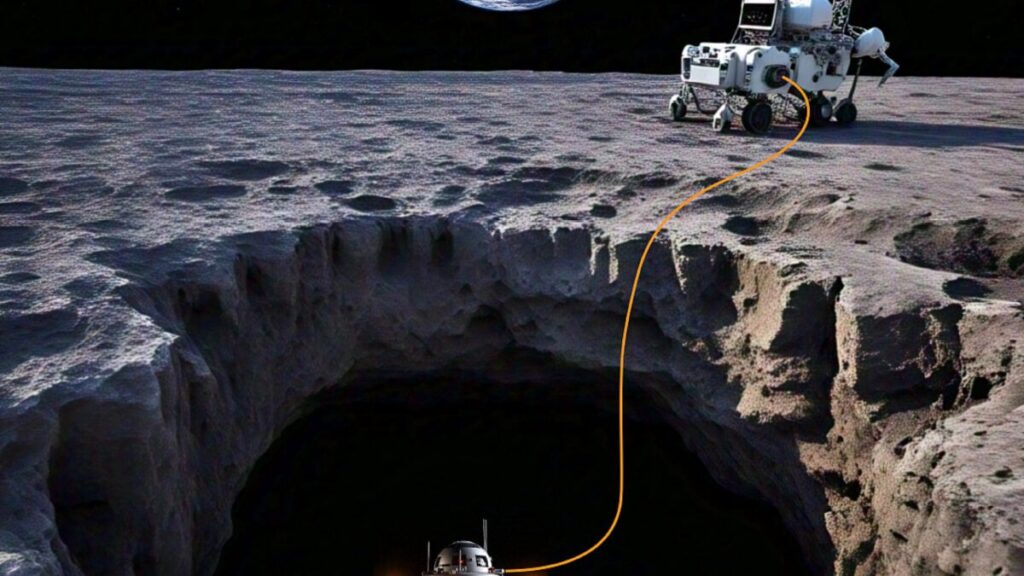
And now, after decades of more speculative and long-distance research, it looks like NASA is putting its money where its mouth is. The U.S. space agency announced that it will fund research by Austin-based Stone Aerospace, Inc. to develop a tethered lunar-spelunking drone—powered via laser light that will be beamed through a system of fiber optic cables conjoining it to a lunar rover on the Moon’s surface.

This power-over-fiber (PoF) design, according to NASA’s announcement, will manage the neat trick of meeting three critical needs for this mission: It will act as a typical broadband fiber-optic cable, assuring high-speed data transmission around otherwise impenetrable rock; it will provide onboard electrical power; and it will provide laser-enhanced thrust for the drone’s “non-polluting cold-gas propulsion system.”

“The proposed study could enable the first off-world cave exploration,” Stone Aerospace’s physics lead Gilly Elor noted in a statement. “Additionally, our technology has broad dual-use potential for terrestrial applications, enabling long-range continuous optical power transmission to mobile platforms on land, in air, or underwater.”

Pitch black

Like Earth’s lava tubes—including those recently studied by NASA astrobiologists in Hawaii—the Moon’s version of these geological formations were created as ancient rivers of lava plowed through the lunar landscape, cooling faster near the surface and leaving behind long, hollow tunnels.

As part of the proposed Lunar Underground eXplorer (LUX) mission, Stone Aerospace’s hovering robotic explorer will descend into the Mare Tranquillitatis lunar skylight, a yawning chasm about the size of two football fields roughly 250 miles (400 kilometers) away from where Apollo 11 landed. The Mare Tranquillitatis skylight is known to be about 436 feet (133 meters) deep and was only recently discovered to be the portal to a cave network, thanks to radar data collected by NASA’s Lunar Reconnaissance Orbiter in 2010 but only just analyzed by Italian geologists in 2024.

Elor—who was once a visiting research scientist at Lawrence Berkeley National Laboratory and a veteran explorer of deep caves like Sistema Cheve in Oaxaca, Mexico—emphasized that there would be “serious challenges” navigating the depths of Mare Tranquillitatis.

“[It] will be energetically demanding (due to complete darkness),” Elor wrote. There will be no GPS navigation to assist with the “completely un-mapped” 3D environment, she added. And, on top of that, “the system must be non-polluting so as to not affect sensor measurements of the pristine environment,” she said.

The descent

NASA awarded Elor’s team $175,000 for preliminary research into this mission as part of the $3.2 million in total that it dispersed via its NASA Innovative Advanced Concepts (NIAC) Phase I awards this July.

“NASA has outlined an ambitious vision for the future of space exploration, we’re returning the Moon to stay, advancing to Mars, and pushing to deepen our understanding of space,” NASA’s director of its Advanced Research and Technology division, Greg Stover, said in a statement.

“Achieving that will require more than incremental technological advancement,” Stover said. “It means we need great leaps. These awards are the kinds of innovation the world needs NASA to help foster.”

According to Elor, Stone Aerospace’s PoF drone designs will prove capable as NASA missions advance onward to the Red Planet as well.

“While other lunar lava tube mission proposals exist, none have the unique combinations of enabling elements of our concept,” Elor said. “Taken together we posit that these will significantly enhance the range, duration, and quality of science and exploration for subsurface lunar (and eventually Martian) exploration.”

Read the full article here

You Might Also Like

The Next Xbox Could Be Every Xbox Ever Rolled Into One

The Explosive Diarrhea Outbreak Has Turned Deadly

Rosamund Pike Rumored to Join ‘Ghost Rider’

Rays Found in Polluted NYC Creek Might Be Sign of Environmental Hope

Plans for World’s First Octopus Farm Scrapped Over Ethical Concerns and Regulatory Hurdles

Share This Article
Facebook Twitter Copy Link Print
Previous Article Rosamund Pike Rumored to Join ‘Ghost Rider’
Next Article The Explosive Diarrhea Outbreak Has Turned Deadly
Leave a comment

Leave a Reply Cancel reply

Your email address will not be published. Required fields are marked *

Stay Connected

248.1kLike
69.1kFollow
134kPin
54.3kFollow

Latest News

Anthropic Says the House Is on Fire. China Says AI Will Set You Free
News
Rubin Gets a Closer Look at the COSMOS Field, Revealing More Than 650,000 Galaxies in One Image
News
Liquid Fluoride Can Stop Cavities Without Drilling, Major Trial Finds
News
SpaceX Is About to Find Out How Many Insiders Want to Hit the Eject Button
News
No One Knows What the Hell Elon Musk’s AI Graph Means
News
The Tariff Refunds Are Rolling in—but Gadget Prices Aren’t Dropping
News
The CEO of Bluesky Says He Wants Less of a Focus on Liberal Politics (and More Sports)
News
Even Black Holes Can Get Indigestion. Unsurprisingly, Their Farts Are ‘Massive’ Expulsions of Gas
News

You Might also Like

News

Trump Admin Has the Concept of a Plan for AI Safety Rules (Maybe)

News Room News Room 4 Min Read
News

A16Z Brags That Its AI Is Great for Poisoning the Internet With Fake Tech History

News Room News Room 5 Min Read
News

Dave Bautista May Take Over Kratos Role in ‘God of War’ TV Series

News Room News Room 3 Min Read
Tech Consumer JournalTech Consumer Journal
Follow US
2024 © Prices.com LLC. All Rights Reserved.
  • Privacy Policy
  • Terms of use
  • For Advertisers
  • Contact
Welcome Back!

Sign in to your account

Username or Email Address
Password

Lost your password?