By using this site, you agree to the Privacy Policy and Terms of Use.
Accept
Tech Consumer JournalTech Consumer JournalTech Consumer Journal
  • News
  • Phones
  • Tablets
  • Wearable
  • Home Tech
  • Streaming
  • More Articles
Reading: Mars’ Potato-Shaped Moon May Have Gotten Its Youthful Look From a Single Impact
Share
Sign In
Notification Show More
Font ResizerAa
Tech Consumer JournalTech Consumer Journal
Font ResizerAa
  • News
  • Phones
  • Tablets
  • Wearable
  • Home Tech
  • Streaming
  • More Articles
Search
  • News
  • Phones
  • Tablets
  • Wearable
  • Home Tech
  • Streaming
  • More Articles
Have an existing account? Sign In
Follow US
  • Contact
  • Blog
  • Complaint
  • Advertise
© 2022 Foxiz News Network. Ruby Design Company. All Rights Reserved.
Tech Consumer Journal > News > Mars’ Potato-Shaped Moon May Have Gotten Its Youthful Look From a Single Impact
News

Mars’ Potato-Shaped Moon May Have Gotten Its Youthful Look From a Single Impact

News Room
Last updated: August 20, 2026 8:49 am
News Room
Share
SHARE

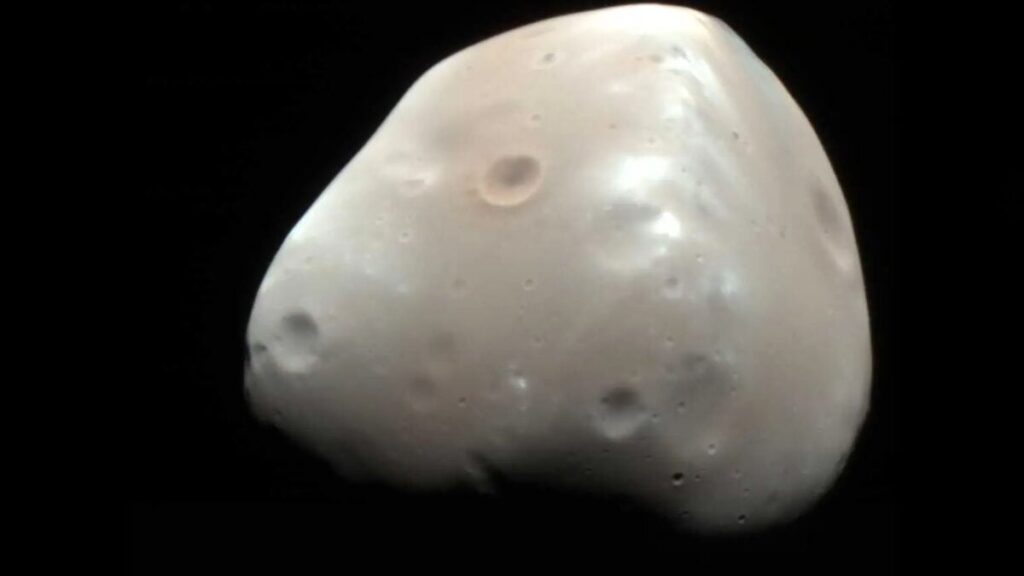
Decades ago, a NASA spacecraft swooped past Mars’ smaller moon, Deimos, revealing a smooth, dust-strewn world covered in a thick layer of regolith. Since then, scientists have wondered how the Martian moon got its youthful look compared to its larger counterpart, Phobos. Now, a recent flyby of Deimos may have traced the cause to a violent collision during its early past.

Using images gathered by the European Space Agency’s (ESA) Hera mission, a new study suggests that a single asteroid strike may have dramatically reshaped Mars’ outer moon. The findings, published in Nature Astronomy, show how the impact could have tossed large amounts of material across Deimos’ surface, giving it its surprisingly smooth appearance.

The results imply that Deimos is a rubble pile, similar to asteroids, that may have formed from material kicked up from Mars by surface impacts, according to the researchers behind the study.

Lunar fillers

Deimos is the smaller of Mars’ two moons, orbiting Mars every 30 hours. Measuring at 9 by 7 by 6.8 miles in size (15 by 12 by 11 kilometers), its tiny body is lumpy and heavily cratered.

In 1977, NASA’s Viking 2 orbiter pulled off a historic flyby of Deimos, capturing high-resolution images of the moon’s surface. Deimos turned out to have a much smoother, dustier surface than the other Martian moon, Phobos. The flyby also revealed a 6-mile-wide (10-kilometer) basin around its southern pole.

In March 2025, ESA’s Hera mission performed a flyby of Mars, coming as close as 3,106 miles (5,000 kilometers) to the planet. During the brief rendezvous, Hera caught a glimpse of the tidally-locked Deimos.

An animated modeling of the proposed impact with the yellow indicating the reaccumulated material. © S.D. Raducan / ESA

The team of researchers combined the flyby images with an impact code called Smoothed Particle Hydrodynamics to model a hypothetical impact and its aftermath. “Our Bern Smoothed Particle Hydrodynamics, SPH, impact code works by recreating bodies of interest into millions of adhering particles whose interplay is governed by various programmable variables, including gravity levels, material strength and cohesion,” Sabina Raducan, a researcher at the University of Bern and one of the chairs of the Impact Physics Working Group for the Hera science team, as well as lead author of the new study, said in a statement.

“We created a detailed shape model of Deimos out of SPH particles, having filled in the southern depression to leave it ready for the impactor to strike. Then we ran about a hundred simulations – each one taking about a week at a time to complete – to experiment with various impactor masses and angles of approach,” Raducan added.

A violent past

Out of the hundred scenarios, the best fit turned out to be a slanting, 45-degree impact from a relatively small, 1,049-feet-wide (320-meter) asteroid that struck Deimos at high speeds. The catastrophic impact did not completely destroy the moon, instead it created a broad depression at its south pole.

The violent collision also threw large amounts of material across the moon’s surface, and much of the debris fell back to form a global blanket of loose regolith that covered much of Deimos. Beneath this layer of dust, the outlines of the moon’s ancient craters remained visible.

“We began this simulation campaign before Hera’s Mars flyby, but with the hope that Hera’s observations would help constrain the results even more,” Raducan,said. “This indeed turned out to be the case, as the side of the moon imaged by Hera turned out to show additional buried craters.”

The presence of the pre-impact craters suggests that Deimos is rather fragile in nature. If a similar asteroid impact would have struck a more solid body, it would have created shock waves that would have disrupted or erased older features.

“This simulation therefore implies that Deimos is a rubble-pile body, akin to many asteroids,” said Michael Kueppers, ESA’s Hera project scientist. “This does not necessarily mean the moon is in fact a captured asteroid – it might well have formed out of material kicked up from Mars by surface impacts – but more that it may have formed in a similar way and therefore shares comparable properties.”

Read the full article here

You Might Also Like

OpenAI’s CFO Reportedly Downplays Importance of IPO to Staff

Don’t Panic, the Pixel Watch 1 Isn’t Losing Google Health Support

People Scalping Movie Tickets Sucks, but Don’t Be Too Worried

FBI Warns That Hackers Are Targeting Siemens Equipment Amid Recent Water Plant Breaches

An ‘Exercise Pill’ Just Cleared Its First Human Test

Share This Article
Facebook Twitter Copy Link Print
Previous Article Don’t Panic, the Pixel Watch 1 Isn’t Losing Google Health Support
Next Article OpenAI’s CFO Reportedly Downplays Importance of IPO to Staff
Leave a comment

Leave a Reply Cancel reply

Your email address will not be published. Required fields are marked *

Stay Connected

248.1kLike
69.1kFollow
134kPin
54.3kFollow

Latest News

New NASA Images Reveal Crater Left Behind by SpaceX Rocket Impact on the Moon
News
What If This Was How You Found Out The Singularity Has Begun?
News
We Think We Found ‘Human Printer’ Natalie Harp’s Printer Setup. It’s Bulky
News
Still Growing Into Their AI Shoes
News
‘Doctor Who’ Writer Mark Gatiss Says What We’re All Thinking About the Show’s Future
News
Comfy Sleep Earbuds With an Uncomfortable Price
News
‘Lanterns’ Season 2 Is Already in the Works Whether It Happens or Not
News
Physicists Think They’ve Discovered a New Type of Quantum Matter
News

You Might also Like

News

Glass-Filled Popsicles Are the Perfect End to Pestilence Summer

News Room News Room 5 Min Read
News

Flock’s New AI Tool Does Much More Than Track License Plates

News Room News Room 5 Min Read
News

Millions of Comcast WiFi Routers Can Now Tell When You’re Moving Around the House

News Room News Room 4 Min Read
Tech Consumer JournalTech Consumer Journal
Follow US
2024 © Prices.com LLC. All Rights Reserved.
  • Privacy Policy
  • Terms of use
  • For Advertisers
  • Contact
Welcome Back!

Sign in to your account

Username or Email Address
Password

Lost your password?