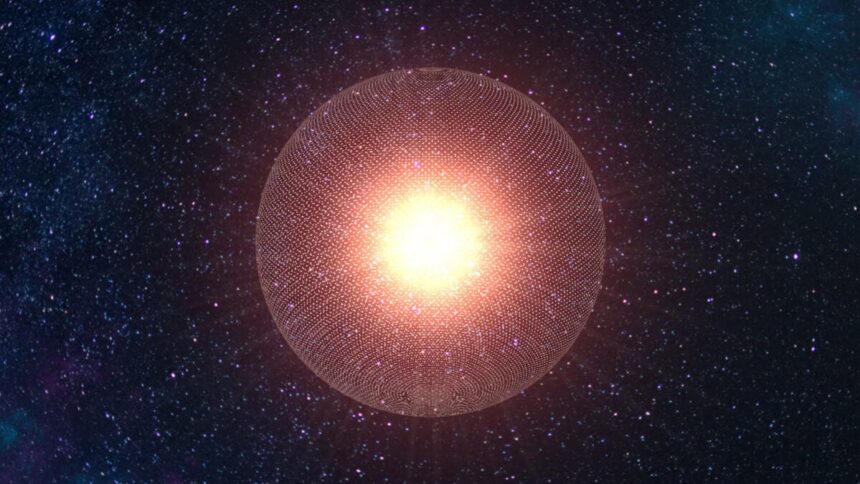
Assuming aliens do physics like us but are actually much better at it, perhaps they would identify a way to directly harness a star’s energy output—instead of, say, attempting to replicate stellar dynamics and confining it in some pressurized power plant. As speculative new research suggests, aliens might want to build their star-powered energy farms around a certain kind of star.
We’re talking about Dyson spheres. Physicist Freeman Dyson proposed this super-futuristic concept—a vast swarm of structures orbiting a star to harvest its energy. In the new work, accepted for publication in the journal Universe, astronomer Amirnezam Amiri of the University of Arkansas presented a theoretical calculation of Dyson spheres around low-mass stars. The paper, currently available as a preprint on arXiv, assessed the feasibility of a Dyson sphere around white or red dwarfs and, if so, what an outside observer would see.
Some assumptions
To be fair, assuming Dyson spheres exist is a big leap—especially since it already requires believing that intelligent aliens with advanced knowledge of physics are out there. In fact, even Freeman Dyson himself didn’t seem all that committed to his own proposal. For instance, Dyson admitted to journalist Robert Wright that the spheres were a “little joke.” In 2018, he retracted that stance somewhat, saying that he thought Dyson spheres were “correct and uncontroversial.”
Of course, Dyson’s own indecisiveness hasn’t stopped astronomers from seriously exploring the feasibility of Dyson spheres. Some experts have even considered whether humanity could one day build a Dyson-like structure using self-replicating robots. So let’s take that leap, at least for the purposes of this post.
Potential scenarios
Dyson spheres should absorb stellar radiation and re-emit energy at longer wavelengths. According to the new paper, previous studies have suggested that an ideal location for Dyson spheres would be around low-mass stars that are luminous enough to have habitable zones—regions around a star with suitable thermal conditions.
For instance, assume a civilization builds a Dyson sphere around a typical red dwarf, a small, slow-burning star commonly found in the Milky Way. For these stars, the habitable zone generally spans between 0.05 and 0.3 AU, which corresponds to about 5 to 30% of Earth’s average distance from the Sun.
This would allow a “compactly” built Dyson sphere at “moderate material cost,” Amiri explained. Similar ideas would apply to white dwarfs, highly compressed stars that also slowly radiate over a long period of time. Both white and red dwarfs “demonstrate energetically stable, long-term power supplies for megastructures,” Amiri said.
Detecting the next-level energy farm
Most importantly, the paper considers what it would take to spot these Dyson spheres around red or white dwarfs. To an outside observer oblivious to the presence of a Dyson sphere, an object resembling a star would appear dimmer and colder than the star truly is. The sphere would also presumably make the star’s radius look bigger, according to the paper.
But there could be other telltale signs of a Dyson sphere. For example, the environment surrounding a star shielded by a Dyson swarm would show considerably less of the dust commonly seen around stars. It’s also likely that the sphere as a whole would have small gaps or varying thickness, resulting in unusual radiation signals that an observer could track back to something artificial.
What’s more, Dyson spheres themselves would “exhibit smooth, nearly blackbody spectral energy distributions” that would fall right into detection range for instruments like the James Webb Space Telescope. That is, humanity’s existing observatories should be enough to spot Dyson spheres, as long as we know what we’re looking for.
Taking the leap
I’ll be honest; my excitement for alien encounter scenarios tends to be more on the moderate-to-skeptical side, at least compared to some of my colleagues. Of course, it makes much more sense to assume that humans can’t be the only intelligent beings in this vast, vast universe. But there are so few, if any, definitive statements we can make about what life is like beyond Earth and what alien civilizations might be like, if these beings are advanced enough to build something humans would recognize as a “civilization.”
Having said that, the new paper is certainly thought-provoking. If Dyson spheres are out there, the study’s suggestions could even be part of the theoretical foundations astronomers can use to identify these megastructures. But as I’ve mentioned before, this is all contingent on (1) aliens existing, (2) aliens being intelligent, (3) their scientific capacity allowing them to pursue planet-scale projects, and—most importantly—(4) we humans definitively recognizing that these are Dyson spheres, not some other trick of the light.
Then again, who’s to say this is impossible? Freeman Dyson, I’m sorry for calling you indecisive.
Read the full article here