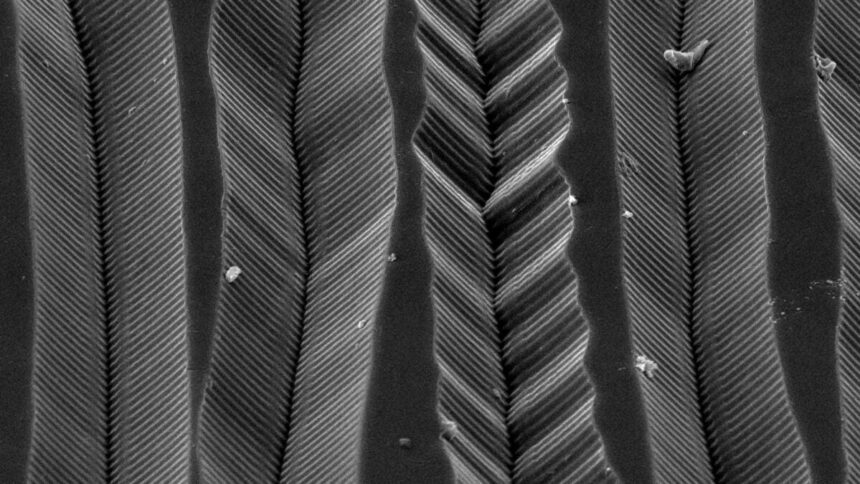
Quadraphonic sound was perhaps the first serious attempt to bring surround sound to home audio systems. The format was introduced in the 1970s and worked by adding two extra sound channels to the left and right channels of a stereo signal. These extra channels were referred to as “rear channels”, and the idea was that they would run to speakers placed behind a listener, creating an immersive encounter that would simulate the experience of being in a concert hall.
Unfortunately, the concept never really caught on, not least because both quadraphonic systems and quadraphonic recording equipment were expensive—and the former wasn’t much use if no one was making quadraphonic records, while the latter wasn’t much use if no one was buying such records. If you think about it, though, the format does raise one interesting question. During the 1970s, the vinyl record was far and away the most popular audio format. So how do you fit four audio channels into one vinyl groove?
A YouTuber who goes by the rather utilitarian name of “Microscopy Specialist” has the answer. Mr. Specialist’s bio explains that his name is Eric and he is, yes, a specialist in microscopy, which explains why he has a freaking scanning electron microscope set up in his living room.
In one of his previous videos, Eric looks at how stereo vinyl records work. To understand this, you need to grasp the basic principle behind all analogue records, which is that the waveform of the sound is quite literally etched into the vinyl groove. In the simplest case—a mono record—the etched waveform pushes the needle in a direction perpendicular to the groove. This results in the needle tracing the waveform’s geometry as the record spins, and the cartridge to which the needle is attached acts as a transducer, converting this physical movement into an electrical signal. Run the resultant signal through sufficient amplification, and bam, you’ve got sound.
With this in mind, if you’re very clever, you might already be able to guess how a stereo record works. A stereo recording has two channels, and the groove has two walls. If you ensure that these walls are orthogonal to one another—i.e., at a 90º angle—then at any given moment in time, the distance the needle is offset from the left wall encodes the height of the waveform for one channel, and the distance it’s offset from the right wall encodes the other. In a stereo system, the cartridge contains two magnets, which are also at right angles. Each of these generates its own signal, giving you two separate channels. Amplify each of these, and run them through their own speakers, and bam, you’ve got stereo sound!
This is already pretty ingenious, but quadraphonic sound adds an extra layer of complication: it has four channels, and the record still only has one groove. So where do the two extra channels (called the “rear channels”) go? Well, as Eric explains, there were two different approaches to this challenge: one called CD-4 and the other called Stereo Quadraphonic (SQ).
Both of these approaches relied on the idea that you can encode more information into the groove than just the analogue waveform, but the fundamental differences between them become clear under the microscope. CD-4 manages to etch two waveforms into each wall—one of the two conventional stereo channels, but also a much finer and higher-frequency waveform. This second waveform contains the information for one of the rear channels, but converted into a signal whose frequency is high enough to make it ultrasonic (i.e., beyond the range of human hearing). This means that on a normal stereo system, a CD-4 disc sounds like a conventional stereo record. A specialized CD-4 system, however, contains a decoder that can take each of the high-frequency signals and convert them back into audible waveforms.
SQ, meanwhile, gets really complicated. The microscope reveals none of its secrets. As Eric explains, it looks like a normal stereo record because it is like a normal stereo record—but with each of the two extra channels encoded as a phase-shifted component of one of the two “normal” channels. Again, on a conventional stereo system, an SQ record sounds just like a normal stereo record because the two phase-shifted signals cancel each other out. On a system equipped to play SQ sound, however, a decoder can extract the phase-shifted signals from each channel and convert them back into audible waveforms.
In each case, if you amplify both the decoded signals and route them to the rear speakers of a quadraphonic system, then… bam, you’ve got four-channel sound!
However, as Eric explains, each approach has its downsides: CD-4 requires a specialized needle able to handle the high-frequency channel, and because it’s so small and its detail so intricate, that channel wears away quickly. SQ, meanwhile, apparently struggles with channel separation.
Of course, in this era of 5.1 surround sound and home theaters, etc., the idea of four sound channels probably doesn’t sound nearly as exciting as it did a generation or two ago. Still, as an exercise in meeting technical challenges within the limits imposed by analogue technology, quadraphonic sound remains as fascinating as it is ingenious—a fact rather driven home by looking at its intricacies close up.
Read the full article here