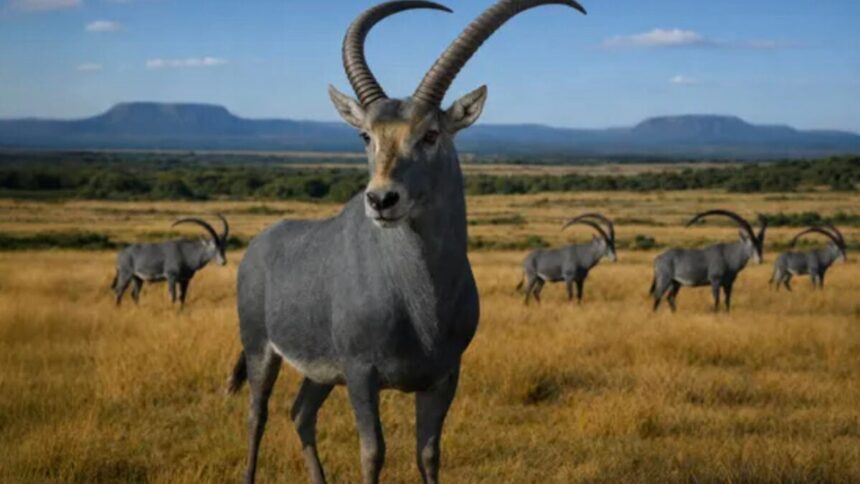
European colonists drove South Africa’s bluebuck antelope to extinction by the end of the 18th century (although the buck’s larger and more hardy competitor, the roan antelope, had been chipping away at its turf for millennia). Historical accounts marvel at the long-lost antelope’s regal bluish-silver coat and its long curved horns.
Now—for the first time since the advent of the motion picture camera—the chance to see a living, glimmering bluebuck alive and kicking has miraculously improved, to judge from an announcement by the self-described “de-extinction company,” Colossal Biosciences. The Dallas-based biotech firm said Thursday that its new bluebuck de-extinction project would add the antelope to its roster of vanished species slated to reappear, alongside the woolly mammoth, the dodo, the Tasmanian tiger, and the dire wolf.
But the project’s genetic innovations, according to the company, would also translate well to badly needed conservation projects for the world’s roughly 93 other antelope species, dozens of which are currently endangered.
“African antelopes have long been neglected in global conservation,” Colossal’s chief science officer Beth Shapiro said in a statement. “While other megafauna benefit from advanced reproductive technologies and extensive genomic research, antelopes—despite being among the most diverse and rapidly declining large mammals on Earth—have been left behind.”
Bucking extinction trends
Colossal said that its project to bring back a version of the bluebuck has been quietly underway since 2024, with several major technological advancements already achieved.
The company’s scientists have reportedly reconstructed a 40-fold genome of the historic bluebuck (Hippotragus leucophaeus), a robust marker of so-called “fold coverage” promising breadth and redundancy for the firm’s genomic sequencing data on this extinct species. Colossal also said it managed to produce induced pluripotent stem cells (iPSCs) from roan antelope, meaning that the creature that once market-corrected the bluebuck in Africa’s grassy southwestern ecosystem has now been enlisted to help bring it back from extinction.
According to Colossal, its scientists are now in the genome editing phase, attempting a mix of approaches to one day engineer bluebuck variants into roan antelope iPSCs.
“The bluebuck sits within the bovid family, allowing us to extend our mammalian work into a new group of animals with different reproductive biology, size, and gestation timelines,” Colossal Biosciences CEO and co-founder Ben Lamm said in a statement.
“Every reproductive technology, genome editing protocol, and conservation tool we develop through this effort is designed to scale—directly benefiting the 29 antelope species currently at risk,” Lamm continued. “By focusing on the bluebuck, we’re not only working to restore a lost species, but also building solutions that can help protect entire ecosystems.”
Buck rewilding
One critical innovation that the company hopes will translate to other conservation projects is Colossal’s ovum pickup (OPU) techniques for antelope species, which promise to harvest oocytes, or immature egg cells, from live antelopes in a purportedly minimally invasive and scalable way.
Colossal reported that its team engineered new ultrasonographic visualization tools and hormone stimulation methods that allowed them to accomplish OPUs successfully for two antelope species, the roan antelope and scimitar-horned oryx. The team has posted the details on this technique, as applied to bovids, like bison and antelopes, and equids, like horses, in a preprint journal article at bioRxiv now undergoing peer review.
“The specialized ovum pickup protocols we’ve developed for antelopes are game-changers for conservation breeding,” Colossal’s chief animal officer Matt James said in a statement.
“Previously, collecting viable oocytes from wild bovid species was nearly impossible and lacked scalability, limiting abilities to develop conservation technologies to support dwindling antelope populations,” according to James. “These new techniques dramatically expand our conservation toolkit and are exactly the kind of technological spillover we aim for in our de-extinction work.”
The company said it was “rapidly scaling” this technology to cover additional, still living, but critically endangered antelope species in an effort to build out the infrastructure needed to aid these species in the future.
Read the full article here