

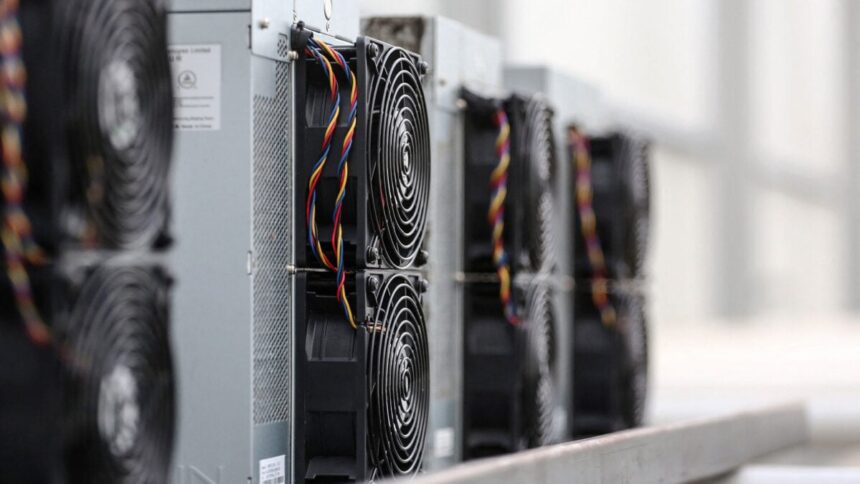
The amount of computing power pointed at the Bitcoin network has seen a heavy decline since October, with the 7-day average network hashrate falling from an all-time high peak of 1.151 zetahashes per second on October 18th to the most recent estimate around 0.888 zetahashes per second, according to data from Blockchain.com. It’s no coincidence that October was also the month that the bitcoin price hit its all-time high of around $125,000. While the roughly halving of that price in recent months certainly affected bitcoin miners’ profitability, reports indicate those tasked with effectively operating as the accountants of the Bitcoin network have also been diversifying into and chasing profits in the AI infrastructure industry.
The decline in Bitcoin’s collective computing power can be inferred from network data. Although the specific amount of computing power at any one time is not available, estimates can be drawn based on Bitcoin Difficulty and the amount of time that has lapsed between each recently-found block. The Bitcoin Difficulty is basically a measure of how hard it is for miners to find a valid block. The protocol adjusts Difficulty every 2,016 blocks, roughly every two weeks, to try to keep blocks arriving about every ten minutes.
Notably, the Bitcoin Difficulty Adjustment of -10.09% that occurred on Saturday was the 11th largest downward adjustment in the network’s history, according to Galaxy Research. Galaxy said the likely driver of this adjustment was the recent bitcoin price drop, which led to squeezed margins for miners. This was the second largest adjustment seen this year, although the previous drop in February was due to the effect of Winter Storm Fern on local electrical grids.
A report from CoinShares in late March covered the impact AI was having on the bitcoin mining industry. “The migration of Bitcoin miners toward AI and high-performance computing is accelerating rapidly,” read the report. “Based on recent company announcements, listed miners could derive as much as 70% of their revenues from AI by the end of this year, up from roughly 30% today. What began as a marginal diversification strategy is increasingly becoming the core business.”
CoinShares also warned that, while most of these deals involve new data centers, “some cannibalisation and shutting down of existing mining facilities will occur.”
Gizmodo previously covered some of these diversification efforts, such as Cango selling $305 million worth of their bitcoin holdings to cover their AI pivot and Bitdeer telling the bitcoin market not to worry after dumping the entirety of its holdings. Bitdeer’s most recent update from Friday shows that the company still does not hold any bitcoin on its books.
Everyone’s pivoted to AI so where does that leave Bitcoin mining?
“I think that in the medium term we could see a situation where mining economics appreciate materially because you have so much power capacity that is tied to AI… You can’t easily pivot that power capacity.”… https://t.co/vwA3cIahoT pic.twitter.com/izF0RgQZk2
— Blockspace (@blockspace) June 13, 2026
What happens next will largely depend on whether the $60,000 level was the near-term bottom for the bitcoin price. The price rose above $67,000 on Monday after news broke over the weekend of a preliminary U.S.-Iran peace agreement. That said, this could be a sign that bitcoin is very much still acting as a risk-on asset, which was what billionaire Mark Cuban recently pointed to as his reasoning for seeing the crypto asset as failing to live up to its “digital gold” use case and selling nearly all of his holdings.
In a recent Blockspace interview, Nakamoto Director of Corporate Development Brandon Bailey indicated there is a potential bottoming-out occurring in the profitability of bitcoin mining as well, saying, “We have so much power capacity that is now leaving the bitcoin mining space that is being allocated to high-performance computing. I could be wrong here, but I think that, in the medium term, we could see a situation in which mining economics actually do appreciate materially just because you have so much power capacity that is tied to a different use. [If] bitcoin starts to recover in price, you can’t easily pivot that power capacity and you end up in a situation where you see rising hashprice.”
The data centers are simply going to use their infrastructure for whatever the market dictates.
Read the full article here