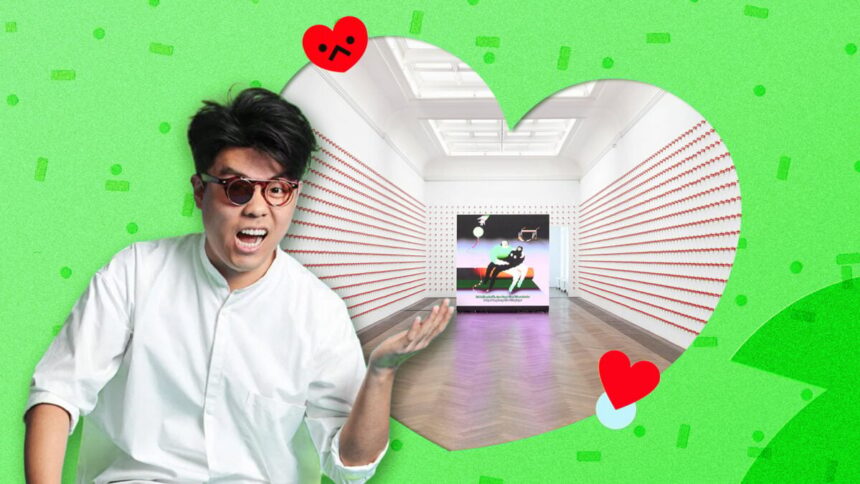
Wong Ping really knows how to light up a room. His neon-bright, saccharine-sweet animations with otherworldly characters naturally break dimensional barriers. Sometimes they get eaten by bugs; other times they fall victim to the pitfalls of owning an obsolete porn collection.
Born in 1984, Wong studied media design in Australia before picking up animation software on the side while working at a day job in Hong Kong. During the day, he’d put in his hours and then spend the night making movies in his bedroom. That bedroom operation would eventually become the Wong Ping Animation Lab.
Wong’s stories address taboo topics like shame, sex, retribution, and desire through the lens of a saccharine-sweet, candy-coated shell of color. Sometimes, his surreal stories spill out of the frame and into the real world.
“I’m not that interested in animation, actually,” Ping told M Magazine in a video interview in 2023. “I seldom watch animation movies. It’s just that animation is a means for me to express everything inside my head.”
Fables 1 is one of many works that provide a look into Ping’s brain. It’s a series of warped morality tales starring anthropomorphic animals. Through patterns reminiscent of Windows 95 screensavers and interconnected comic-book panels, Ping presents three disparate tales in which an intellectual elephant suddenly develops a second sight; a cop accidentally murders his entire family; and a long-bus passenger is tasked with facing his biggest fears.
With its radiant energy, vibrant colors, and sharp juxtapositions, Ping says around 60% of his work reflects his upbringing in Hong Kong and the country’s tumultuous history.
“The paradox of Hong Kong is its intensity,” Ping added in the interview. “This intensive style of life is convenient and kind of warm, but it also impedes daily life. Even though I’m alone while I create, the city is very dense. So when I go out into the crowded streets, I still feel very warm.”
In Wong’s hands, technology is a piece of the puzzle. He relishes the tedious parts of the process: conceptualizing, storyboarding, hand-drawing scenes frame by frame, and editing ad nauseam—all of which he views “almost like a meditation.”
Technology also enables him to own the production process from beginning to end, allowing him to write, animate, draw, add sound, and do the voice-overs himself.
Wong once hired a real animator to take some of the load off, but felt like the results came back too polished, too fancy, and stripped of the awkwardness that defines his art. He’d rather do it himself, the slow way. It’s the difference, he explains, between flying to New York and walking there—the flight is faster, sure, but you miss everything worth seeing along the way.
AI hasn’t changed the game yet. He assumes AI will eventually produce something technically flawless—he’s watched it attempt stand-up comedy and tell jokes like “a person from another planet”—but he figures it’ll catch up. He’s betting instead on the thing it can’t fake: the reason you love one person and not another, or an emotion you can’t quite name.
Because great art, he’ll remind you, was never the perfect version anyway.
“We’re not actually looking for perfect things,” the animator says.
Gizmodo spoke with Wong about why he values a slow, tedious approach to art-making, the interplay between writing and animating, and the future of human-made art.
This interview has been edited for length and clarity.
Gizmodo: Why is animation the right medium for telling the kinds of stories you tell?
I think I started using animation without any thoughts about using it as a medium for myself, because I think at that time it was the only thing that I knew a little bit. I learned the software at work, actually. I didn’t give much thought to, “Oh, is it right or wrong?” It just became very handy for me to create in my bedroom after my day job.
In a really practical way, animation is really easy, especially in Hong Kong. These days I like to do live shooting, like film or live action, but it’s kind of impossible in Hong Kong. You need a team; you need some budget. But with animation, I can do pretty much everything—from writing, animating, design, drawing, sound. I’m still using my voice as a voiceover. So pretty much the whole process can be 100% me doing it.
Your work can be funny, disturbing, and deeply sad all at the same time. So how do you find that balance?
I think it relies on the writing process. My process is to write for several months and not think about the animation part—the actual making part. When I’m about 80% done with the writing, I jump to the animation process by myself, starting from sketching and drawing, and then I do the animation.
So when you talk about the balance, I think it’s in the writing process. But my goal is not to find that balance. I think what I find challenging is how to push that balance.
Is your process the same now versus when you started?
I think my writing has evolved over the last 10 years. I don’t really have a solid or straightforward storytelling method in my work. Rather, I put in bits and pieces, like small things, like maybe hundreds of little things in my diary over time.
How does technology shape the way you tell stories?
I think one important thing is that it slowed me down, actually, rather than making me faster. When I write, my head is just spinning, running all day. But the animation process takes a long time and is pretty repetitive.
I have to draw the walk cycle for everyone. I have to design just a table, a chair—stupid things like this. It’s really a slow process. But I actually really need that moment. It’s almost like a meditation, where you’re just doing repetitive work, almost like a machine.
It made me adjust my writing and think about how to collaborate with my animation process. So I think that’s a huge advantage for me—being able to slow down my process.
AI can now make animations and images from simple instructions. Does that change how you think about your own creative process?
I think AI hasn’t changed me yet. Making my shorts is pretty organic and simple, but I need to walk through the process. That’s what actually matters. Because it’s about selecting and working through my own limitations.
It’s like traveling. Let’s say if I had a flight to New York, it would only take me like 10 hours. It would be easier, but I would miss out on the whole journey. But if I walked to New York, I would bump into a lot of fascinating experiences. It might be harder, slower, and clunkier, but I think that’s what I need.
What does the rise of AI make you think about the value of art made by humans?
I think it relates to the question of what it means to be an artwork.
Let’s say you catch up with a friend, and they tell you what’s going on in their life. But if an AI generated hundreds of “what’s going on these days” for you, you wouldn’t even care. If a real person, or a friend, tells you what’s going on, it’s almost like a writer or an author that you like—you read the latest novel from them and you would care more than if they told you it was generated by AI.
I think that’s the challenge these days. It’s a good challenge. We need to redefine what’s important in our heads. Right now, I think we’re still rearranging what we need from art at its core.
Jeremy Glass contributed to this story.
Read the full article here