Robot mowers have come a long way in the last couple of years, but they’re still guaranteed to be compromise machines. One might be great at navigation, but only if it has good satellite reception in your yard. Another might fit in tight spaces but be two-wheel-drive and unable to deal with difficult terrain. Some automowers have great all-around performance—but they aren’t very affordable.
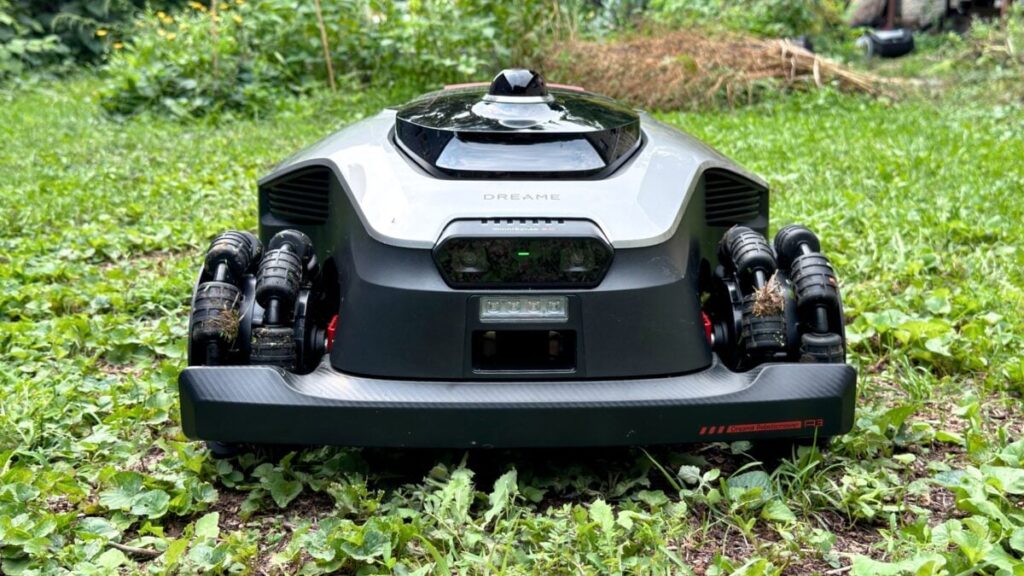
The $3,200 LiDAR-based Dreame A3 AWD Pro, which I tested for about a week, fits in that latter category. It’s got great satellite-free navigation. But although its all-wheel-drive nature means it can handle lumpy yards and steep inclines, it’s more prone to carving bald spots and wheel ruts in your yard than the comparable but cheaper Segway Navimow X430. And unless you have a very big lawn—I tested the A3 AWD Pro 3500, the middle of three range-differentiated models, which can handle more than three-quarters of an acre—it’s hard to justify its hefty price tag.
Assuming the A3 AWD Pro fits your circumstances and budget, it’s a capable automower with creature comforts not found on many competitors. Plus, since it uses LiDAR navigation, satellite connectivity is a complete nonissue. The device has its drawbacks for sure, but once you work through them and set a mowing schedule, things should be smooth sailing. Mostly.
Dreame A3 AWD Pro
Dreame’s imperfect, but capable robomower shows just how good LiDAR is—if you can afford it.
- Satellite-free navigation
- Automatic mow-deck lifting
- Navigates narrow spaces with ease
- Security patrol feature
- Imperfect object avoidance
- Created some bald spots in my grass
Automatic mapping that actually works

Many robomower makers—Mammotion, Segway, and others—seem to have decided that their devices should all look like tiny cars. Usually race cars, although I think the A3 AWD Pro has a sort of overwrought luxury SUV vibe. A red LED strip on the back is probably meant to drive that feeling home, but it really just reminded me (and several people who were at my house one night during testing) of the Cylons, Battlestar Galactica’s race of murderous, sentient robots.
Without satellite navigation, the Dreame A3 AWD Pro is way less of a pain in the ass to set up than satellite-dependent competitors like the Navimow X430. LiDAR-based navigation lets you place its dock wherever works best for you, rather than wherever there’s a reliable satellite signal. Plus, you won’t have to install an RTK beacon in the middle of your yard. Once you’ve got the dock placed where you want it and the mower connected to the Dreame Home app (by scanning a QR code under the hood that covers its physical controls and hood), you can go straight to mapping.
Unlike with other automowers I’ve tested, automatic mapping is actually somewhat feasible in my cluttered area. All by itself, Dreame’s mower mapped the biggest open space in my backyard. It didn’t move beyond that on its own, but hey, I’ll take it. The other mowers I’ve tested either wouldn’t attempt automatic mapping at all—the X430 and its smaller sibling, the i2 LiDAR I didn’t review but have tested, algorithmically determine whether they can map an area themselves—or, in the case of the Roborock RockNeo Q110H, only managed a very small portion. I did the rest of the yard manually, walking behind the A3 AWD Pro and controlling it via the app.

Manual mapping was a bit frustrating at first. My phone’s Bluetooth connection to the mower was spotty, making driving the A3 AWD Pro sluggish and lurchy as the device kept losing signal, stopping, and restarting once it had reconnected. Thankfully, this got better later in testing; whether because of software updates or some mysterious wireless interference clearing up, Bluetooth became stable up to about 20 feet away, as long as I wasn’t manually mowing—the A3 AWD Pro won’t let you get farther than just a few feet before it stops its spinning blades and warns you in the app that you’re too far away.
The Dreame app shows a simple overhead map reflecting the contours of the boundaries you’ve set, and you’ll see the mower moving around on it as it works. There’s also a 3D button on this screen; tap that, and you can see and rotate a colorful point cloud visualization of your yard that shows just how far-reaching the A3 AWD Pro’s LiDAR sensor is. I could see the houses and cars across the street, my home’s roofline, and the shape of a tall tree in my backyard. It’s not an especially useful feature, but it’s fun to look at.
Great grass trimming, but it needs some babysitting

The A3 AWD Pro was about as good at navigating my yard as the Navimow X430, with some small but meaningful differences. Around the edges of my map, it had no qualms about running over slightly taller plants that Segway’s mower was more cautious around, which I liked but found to be a double-edged sword. For instance, the A3 mowed right over some daylilies in my front yard and got badly snagged on the same wire garden fence that gave the X430 trouble in my testing. Still, once I’d worked out the trouble spots by adjusting the map’s boundaries, it had no issues, even when mowing at night.
In the right conditions, the A3 AWD Pro’s grass-trimming performance was excellent. Being a robot mower, it’s designed to mulch already short grass rather than cut overgrown yards. After two or three passes, I found that it had left the vast majority of my lawn with a pleasantly even trim. Although its dual mowing discs move sideways to cut closer to the edges, they won’t eliminate the need to clean up afterward with a string trimmer.

Battery was never a concern during any of my testing, although I have a much smaller yard than the A3 AWD Pro is rated for. Between the front and back lawns, there’s only about 2,400 square feet of mowable area, and the device still had about 65% charge left after tackling it all in one job.
On the flip side, the A3 AWD Pro was more cautious than the X430 when maneuvering around obstacles inside of a mapped area. It gave raised garden beds about a foot of clearance, for instance, and as a result wouldn’t touch a strip between the beds and my house. That was a bit frustrating, because it could clearly manage tight spaces very well—it got farther into a corner of the backyard that always thwarted the X430 and easily drove through the gate to my front yard, despite just barely being able to fit through.

Physically getting around was a mixed bag. Leveraging its all-wheel-drive design and low center of gravity, the A3 easily went up and down the short, steep hill in my front yard. It rotates like a tank, with its wheels on the right rolling in the opposite direction of those on the left. The omnidirectional movement gives it this funky moonwalk quality as it turns. That all seemed to help with the tight spaces I mentioned above.
That may come at a cost: When the A3 turned around on uneven ground—either on low pavers or lumpy earth—I noticed it ended up pushing its own back wheels sideways when the front ones caught on something, which left ruts in places like the incline in my front yard. It also created a bald patch near its dock, where it repeatedly did 360-degree spins to confirm its position at the start of every mow. It was a rainy week, and I’m sure the soggy ground didn’t help matters.

The problems I mentioned above were likely more pronounced because I was constantly running the A3 AWD Pro and putting it in challenging situations that might not arise in normal use. If I owned the A3, I’d run it less frequently than I did in damp testing and not on damp ground, which would give thinner grass time to recover between runs. That said, it’s worth familiarizing yourself with Dreame’s 30-day return policy.
Woof woof, I’m a guard dog

Beyond mowing, the A3 AWD Pro can serve as an awkward guard dog. You can set it to detect human beings; if you do and it does, it will proclaim, “You are in a robot-guarded area; please proceed with caution,” a few times. I’m not sure how much that would deter potential trespassers, but it can be funny. I forgot to turn the feature off in my front yard once, and it hollered this warning at a couple of teenagers, one of whom I heard say, “Is that b***h talking?” (If you’re reading, neighbor teens, don’t worry. It won’t happen again.)

The feature isn’t totally impotent. In Dreame’s app, you can view live video from the A3 AWD Pro, which I firmly believe every camera-equipped robot should let you do—if you insist on putting cameras on my tech, at least let me see what they see. In this mode, you can manually control the robot (if you’re in Bluetooth range), take pictures and short videos, and set it on a patrol run of specific points or the outer edges of your mapped zones, during which it can, with your permission, also automatically capture and save images of people it detects. According to a privacy policy for “Sending Human Photos” linked in the Dreame app, captured images and videos are encrypted and stored on a German cloud server for 30 days or until you delete them, and Dreame doesn’t have access to them. Do with that information what you will.
The mower can also create basic shapes like hearts or stars in your yard by mowing around them and, ostensibly, create those fancy checkerboard patterns you see on athletic fields, although I couldn’t get that latter feature to work. I’ve asked Dreame why that might be, and the company suggested I had selected it while the A3 AWD Pro was already working—it won’t do it if you choose that mowing pattern while it’s mid-mow—but offered to look into it if that wasn’t the case. It wasn’t, and the jury is still out on that one, as of this writing.
The right mower for a huge, satellite-deprived lawn

If you’re looking for a capable automower and don’t have good satellite reception, finding the right product for your situation can be an involved process. I can say definitively that owners of smaller yards should stay away from this particular offering—as good as the Dreame A3 AWD Pro is, $3,200 is just too much to spend when you can get Roborock RockNeo Q110H or an on-sale Segway Navimow i2 LiDAR for almost $2,000 less; both devices mow almost as well, at least in a flatter, less complicated yard. Lawns with steep inclines might still benefit from the $2,000-and-up, non-Pro Dreame A3 AWD mowers, which generally match the A3 AWD Pro’s capabilities but are more compact and have a more limited range of at least a quarter of an acre.
If you have a Texas-style, suburban field of a lawn, the Dreame A3 AWD Pro 3500 could be a reasonable alternative to the Segway Navimow X430—but only as a last resort if you really can’t get the X430 to maintain a satellite connection. Otherwise, go for the X430, which is $700 cheaper and seemingly less likely to create bald patches and can cover more ground in a day (Segway says it can cover a full acre in 15 hours, versus the A3 AWD Pro 3500’s 0.87 acres).
Or, you could wait. Dreame has a habit of heavily discounting its products. As of this writing, the A3 AWD Pro 3500 is discounted to $2,700, and I wouldn’t be surprised to see that go even lower. I would recommend giving the market time to produce other LiDAR mowers as good as the X430, but with the U.S. robotics ban in place, well, nothing is certain. We could be stuck with the current crop of robomowers for quite a while.
Read the full article here