There’s a scene during the second season premiere of the magnificently over-the-top hip hop proto-Succession drama Empire wherein the Lyon clan marches into the company office for a board meeting. The camera pans across the group, lingering on each strutting Lyon, before arriving to settle on the youngest son, Hakeem, who is—gloriously—riding a shiny gold hoverboard. It’s the most 2015 moment imaginable, a callback to the last year of pre-Trump innocence, and it’s arguably also the apotheosis of the hoverboard, a fundamentally absurd device that’s nevertheless an iconic symbol of its brief era.
The association between the year 2015 and the hoverboard existed long before Empire, though—the two have been linked ever since 1989, when Back to the Future Part II saw Michael J. Fox traveling to a fictional 2015 and gliding along the street on a hot pink sci-fi skateboard. But the thing with the real-life “hoverboard” that enjoyed its brief moment in the sun during the 2010s was that it didn’t actually, y’know, hover. At the end of the day, it was basically a Segway equipped with a gyroscope that compensated for the rider’s weight. Such devices are more correctly described as “self-balancing scooters.” (Or, arguably, “self-igniting scooters”.) An actual hoverboard remains a staple of lists of things the future promised but didn’t deliver, alongside the flying car, world peace, and the four-day work week.
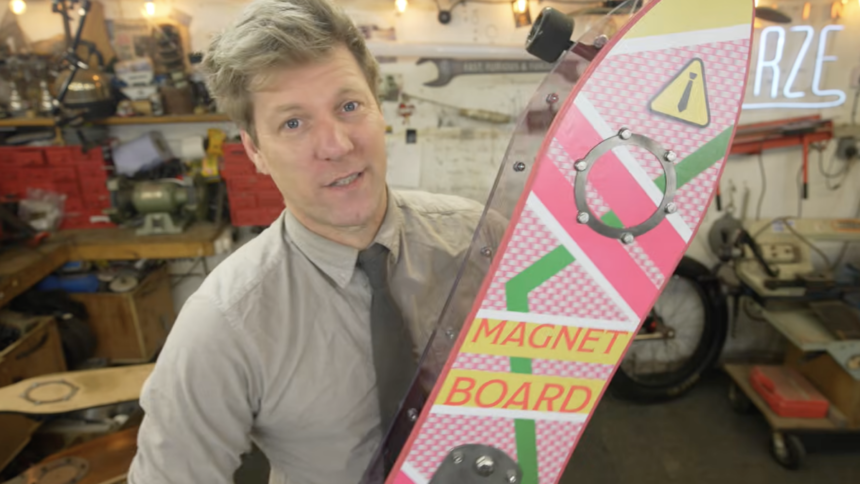
However, at least one man is still doing his best to make the genuinely-hovering hoverboard a reality: veteran YouTuber Colin Furze, who recently uploaded a video detailing his take on the idea. Furze’s approach is essentially a deconstructed skateboard: there’s a bottom part that’s a pair of trucks linked by a lightweight frame, and a top part that’s a conventional skateboard with the trucks removed. Each part is fitted with two powerful rare-earth magnets, arranged with matching poles facing one another to create a strong repulsion. The result is a sort of magnetic suspension system, similar to that used in maglev trains.
As for the skateboard, the main challenge is finding the best way to connect the two parts so the top board doesn’t simply shoot away. Furze experiments with various ideas—he starts with a couple of vertical sliding bearings, takes a lengthy detour into a rear-mounted hinge and various cable configurations, and eventually returns to the bearings.
The physical connection transfers some of the vibrations between the bottom board and the top one, so the device isn’t entirely frictionless. If you could figure out a way to keep the top board floating reliably atop the bottom part without a physical tether, you’d have something that would be getting pretty damn close to the Back to the Future II version. You might even have something to define the zeitgeist of 2035—if, of course, we aren’t all living in The Road by then.
Read the full article here