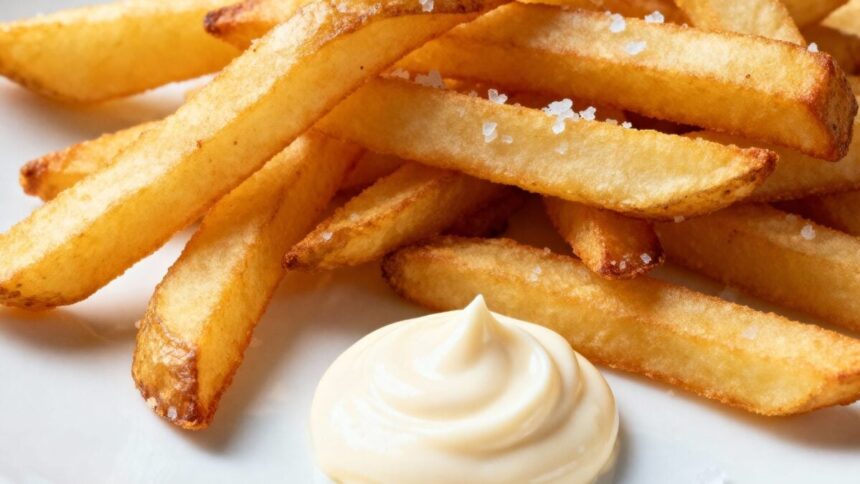
Buyer beware: Research out today finds that people are often getting more salt than they bargained for in their fast food.
Scientists in the UK examined takeaway meals bought from dozens of local and chain restaurants in the area. The foods routinely had a wide gulf between their actual and labeled amount of salt, with nearly half containing more than advertised. The findings suggest that menu labels should only be seen as a rough guideline for the levels of salt and other nutrients you’re likely to get from any particular meal, the researchers say.
“Consumers should be aware that labels are mainly indicative,” lead study author Gunter Kuhnle, a professor of nutrition and food science at the University of Reading, told Gizmodo.
Dietary discrepancies
Kuhnle and his colleagues have been studying how to accurately measure the nutrients we’re getting from the foods we eat for quite some time.
Their past work has illustrated that even naturally occurring compounds in foods can vary significantly in their composition, which can affect a food’s nutritional intake from one day to the next. Next, they wanted to see whether the same sort of discrepancy could be seen in more standardized foods like those provided at fast food restaurants. They focused on sodium intake since excessive salt is a known risk factor for health conditions like stroke and heart disease, and even a relatively small gap in the actual and labeled salt content of foods could have important ripple effects.
They purchased 39 takeout meals from 23 restaurants, including popular chains like McDonald’s and local eateries, across Reading, a borough in Berkshire, England. The meals included common items like pizza, hamburgers, pasta, and sandwiches. The foods were frozen, freeze-dried, and ground for laboratory analysis.
Not all of the restaurants included sodium labels for their menu items. But of those that did, many of their meals didn’t match what was on the label, and they usually had more salt than expected. All in all, 47% of labeled foods had higher levels of salt than declared, the researchers found. Some foods even had enough salt in a single serving to exceed the daily amount recommended by health authorities, especially pasta meals (the UK recommends no more than 5 grams of salt a day, while the World Health Organization advises less than 5 grams a day).
The team’s findings were published Wednesday in PLOS One.
What to do about inaccurate labeling
Kuhnle notes that he’s not familiar with U.S. food policies, including whether there are any important differences in how restaurant items are commonly prepared.
But the study did include meals from many popular chains available stateside, such as Burger King, Domino’s, KFC, and Subway. And his work has highlighted that nutrient variability in food is a widespread issue unlikely to be isolated to any single country. Slight differences in how the food is made or processed, the quantity of ingredients used for a particular meal, and portion sizes can all influence a food’s nutritional content. So these findings are only the latest to showcase that menu labels shouldn’t be seen as gospel.
“Food composition is very variable, and that means that labels and food composition tables can really only be used as guidance, but not to calculate intake accurately,” Kuhnle said. This isn’t just a problem for fast food lovers, he adds, but nutrition researchers, too. “So this information should be taken with the proverbial ‘pinch of salt,’ and consumers—and scientists—need to accept these limitations.”
Kuhnle and his team plan to continue studying this topic, with the hopes of finding a way to make menu labeling more in line with the real world. “The core question is how we can incorporate this variability in labelling, but also in research,” he said.
In the meantime, most people can probably benefit from trying to cut down on their salt and sodium intake. In the U.S. alone, it’s estimated the average American consumes over 3,300 milligrams of sodium a day, well above the 2,300 milligrams recommended by groups like the American Heart Association.
Read the full article here