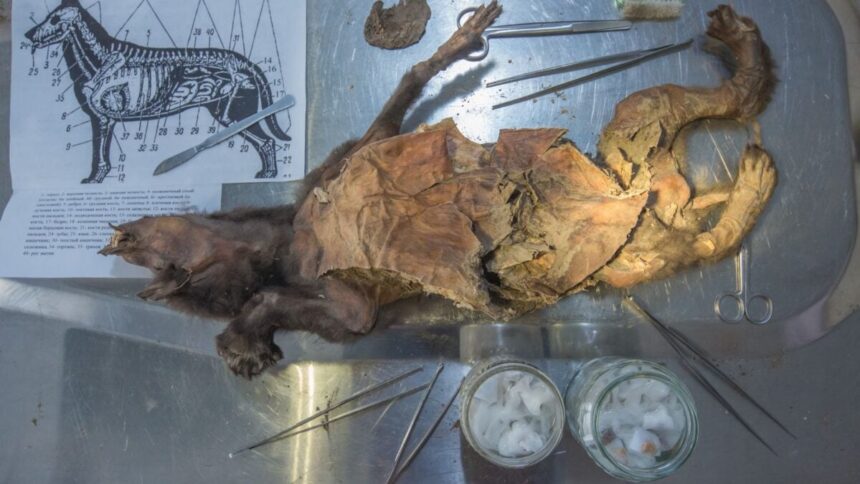
Yesterday’s lunch can sometimes be tomorrow’s scientific discovery, even if yesterday was actually 14,000 years in the past. Scientists have just made such a discovery inside the belly of an ancient Ice Age wolf—one that could reveal the ultimate fate of the now extinct woolly rhinoceros (Coelodonta antiquitatis).
Researchers in Sweden and elsewhere identified the remains of a woolly rhinoceros left behind in a permafrost-buried wolf. What’s more, they recovered and sequenced the rhino’s entire genome. Their findings provide strong evidence that these large animals suffered an abrupt extinction all those millennia ago, rather than a gradual decline in their numbers.
“By analyzing in detail the genome of an extinct animal very close to its demise, we were able to gain new insights about their extinction process,” senior study author J. Camilo Chacón-Duque, a researcher at the Center for Paleogenetics, told Gizmodo.
An unprecedented find
Successfully identifying, extracting, and reconstructing samples of ancient DNA has long been challenging. But recent advances in technology, along with hard-earned experience, have enabled Chacón-Duque and his colleagues to start recovering DNA from sources typically considered low quality.
The Center for Paleogenetics is a collaboration between Stockholm University and the Swedish Museum of Natural History. Chacón-Duque is also a researcher at Uppsala University and a member of the SciLifeLab Ancient DNA unit, an initiative that includes Stockholm University, the Center for Paleogenetics, and the Department of Organismal Biology at Uppsala.
“We happen to have the expertise, the infrastructure and the resources to maximize the recovery of useful DNA material from poorly preserved biological material,” said Chacón-Duque.
The fact that this latest sample was preserved in permafrost also greatly helped. “The permafrost is an invaluable resource for paleogenomics, given that samples remain almost frozen for tens of thousands and even hundreds of thousands of years,” Chacón-Duque added.
The wolf puppy containing the woolly rhino genome was found in permafrost near the village of Tumat in northeastern Siberia. When the scientists performed a necropsy of the wolf, they found a small piece of intact mummified tissue inside its stomach. Once analyzed, they were able to generate a complete genome of the woolly rhino that was the wolf’s lunch.
Though other woolly rhinos have been found and even genetically reconstructed, this is one of the youngest specimens ever recovered, dated to around 14,400 years old. The team says it’s also the first to recover a complete genome of an Ice Age animal from inside the stomach of another.
How the woolly rhino died out
Since woolly rhinos went extinct about 14,000 years ago, finding a specimen so close to its expiry date can provide vital clues as to how their extinction occurred. The team compared its Tumat rhino genome to two other genomes recovered from other specimens, dated 18,000 and 49,000 years ago, respectively.
Species tend to lose genetic diversity when their population numbers slowly decline over time, largely due to increased inbreeding. But this rhino—bearing the most recently recovered genome on record—exhibited no indication of genetic deterioration compared to its ancestors, the team found. That likely means these rhinos experienced a sudden extinction that wiped them out en masse (sudden in relative terms, since it might have still taken hundreds of years before the truly last woolly rhino died).
“Now we know that the final population decline happened only in a few hundred years and was probably mostly caused by climate change,” explained Chacón-Duque. The team’s findings were published Wednesday in Genome Biology and Evolution.
Further discoveries to be made
The team isn’t planning to specifically follow up on this research, since there aren’t many other “young” rhino specimens to study. However, they may further analyze what they’ve already recovered.
They also note the techniques outlined in this study should allow them and other scientists to continue making important discoveries from other challenging specimens. Though, Chacón-Duque adds, it would always be nice to unearth more lucky finds like the Tumat wolf.
“We would love to have access to population-level data, but the paleogenomics field works the other way around—we need to make the most out of very little!” he said.
Read the full article here