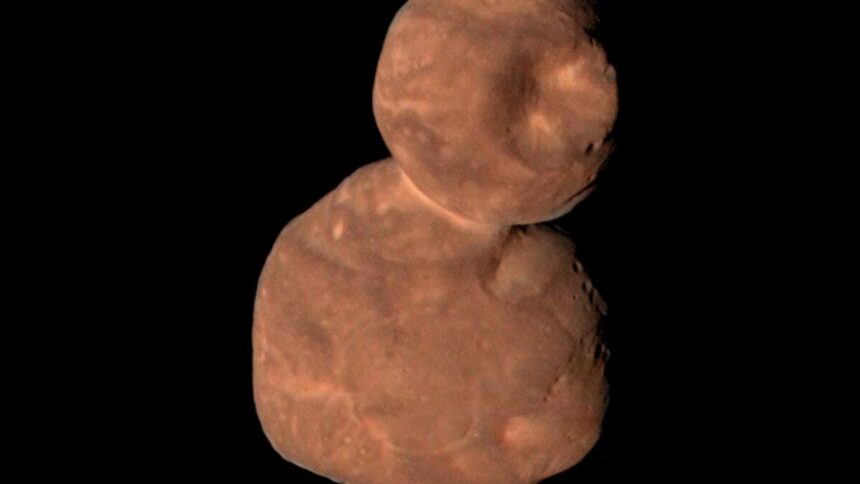
Arrokoth is a reddish, snowman-shaped asteroid in the Kuiper Belt and the most distant object explored by a spacecraft. You don’t need to be an astrophysicist to assume the asteroid formed via a slow, gentle collision—but the detailed physics involved aren’t that simple.
Astronomers had long struggled to fully explain the exact physical mechanism behind the formation and survival of multi-lobed objects like Arrokoth, formally known as contact binaries. A new paper published yesterday in Monthly Notices of the Royal Astronomical Society suggests contact binaries are born from gravitational collapse—a phenomenon more commonly associated with the creation of supernovae or black holes.
“It’s so exciting because we can actually see this for the first time,” Jackson Barnes, the study’s lead author and an astrophysicist at Michigan State University, told The Guardian. “This is something that we’ve never been able to see from beginning to end, confirming this entire process.”
A big cosmic crunch
Gravitational collapse refers to a process in which an object in space collapses in on itself due to its own gravity. As the object crumples, matter gradually accumulates toward the center, forming a dense pocket that can become a star or black hole.
Arrokoth is a different beast altogether. Scientists got their first look at the oddly shaped asteroid in 2019 when NASA’s New Horizons flew by. Astronomers estimate that peanut-shaped contact binaries like Arrokoth make up around 10% of the cosmic population in the Kuiper Belt, according to a Royal Astronomical Society statement. And as the researchers point out in their new study, these objects have a relatively crater-free surface, suggesting they formed around the same time and in a non-violent manner.
Gravitational collapse was the most likely theoretical explanation, but astronomers struggled to find a convincing way to test this hypothesis.
Not blobs, but particles
For the new study, Barnes and his colleagues ran 54 simulations of miniature pebble clouds comprised of 100,000 particles, each with a radius of 1.25 miles (2 kilometers). The simulations allowed the team to investigate whether and how gravitational collapse could naturally form contact binaries.
According to the researchers, the idea was to explore the interactions among individual particles in planetesimals, or clumps of ice, dust, and gas that clump together to form planets and asteroids.
This was in contrast to previous studies, which generally treated each colliding object as a fluid blob that merged into a sphere. The new approach instead produced a “realistic environment that allows objects to retain their strength and rest against one another,” the researchers added in the statement.
Each simulation began with a population of 834 planetesimals spiraling inward, reconstructing how large cosmic clouds rotate and collapse under their own gravity. The simulations produced 29 contact binaries resembling Arrokoth, formed through “very gentle” collisions, as expected, according to the paper.
Studying New Horizons
The results are “in agreement with previous work and support the hypothesis that Kuiper Belt object Arrokoth…is the result of gentle formation processes,” Alan Stern, New Horizons’s principal investigator who wasn’t involved in the new work, told The Guardian.
That said, there are still things to be done before astronomers can officially declare this case closed. The physics of their model does a fairly good job at demonstrating how gravitational collapse can naturally generate contact binaries. However, it’s worth noting that only around 3% of the planetesimals in the simulations produced a contact binary, which isn’t a lot.
The team acknowledges this limitation, noting in the paper that the next step will be to revise their current setup to better represent observational data. Regardless, the new model is a remarkable twist to the seemingly obvious—one that gives us a well-defined scientific account of how smooth, peanut-shaped space snowmen came to be.
Read the full article here