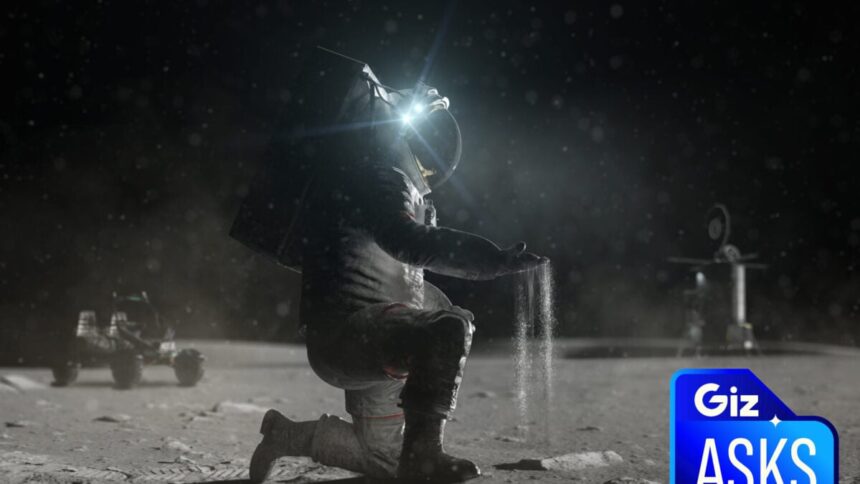
Ever since NASA astronauts Buzz Aldrin and Neil Armstrong became the first humans to step foot on the Moon, the U.S. has reigned as the world’s leading space power. Now, a new space race is underway.
To maintain U.S. dominance in space, the government insists that NASA must return astronauts to the Moon before China achieves its first crewed landing. This is central to NASA’s Artemis program, which ultimately aims to establish a sustained American presence on the Moon. Over the past year, however, the program has faced unprecedented challenges.
Under the Trump administration, NASA has been in turmoil—forced to navigate proposed budget cuts, sweeping staff reductions, and leadership shakeups. At the same time, the Artemis program has continued to struggle with delays and cost overruns tied to NASA’s Space Launch System (SLS) rocket and Orion spacecraft. Artemis 2, the first crewed test flight of these vehicles, was supposed to launch months ago. On top of that, the landers that will eventually carry Artemis astronauts to the lunar surface are still in development and way behind schedule.
In an attempt to course-correct, NASA recently overhauled the Artemis program, setting a goal to land astronauts on the Moon by 2028. It’s unclear whether the revamp will actually help the agency hit that target. Meanwhile, China appears on track for a 2030 landing—or perhaps even earlier.
For this Giz Asks, we asked spaceflight experts whether they believe the U.S. is at risk of losing the Moon to China, and the answer is: it’s complicated. They shared different perspectives on where NASA stands in the new space race and the challenges that stand in the way of returning American astronauts to the lunar surface.
Clayton Swope
Deputy director of the Aerospace Security Project and a senior fellow in the Defense and Security Department at the Center for Strategic and International Studies. Swope is an expert on national security issues related to space and emerging technologies.
Getting to the Moon again is way less important than staying there for the long run. We have to keep our eye on the prize—and that is the long-term strategic vision. The Moon is the gateway to the rest of the solar system and a natural waystation for future human travelers going to Mars and beyond. It also has natural resources that we will want access to.
One of the biggest schedule risks for an Artemis crewed lunar landing is making sure either the SpaceX or Blue Origin Human Landing System is ready. The HLS program is trying to do some really hard things and do those things differently than before, working with companies in novel ways. Some of the best minds in the space industry are working on these hard problems. SpaceX has a history of snatching victory from the jaws of defeat—let’s watch it do that this time too. Blue Origin is on a roll with the success of New Glenn. Let’s expect it to come through on HLS also. The key question, however, is when.
The revamped Artemis plan does not get us more time—the clock is still ticking. Time is what these companies and NASA need to get these systems ready. What the new plan does is create another opportunity to test and operate hardware in space before we send everything with a crew to the Moon. This makes sense and is how NASA approached the Apollo program.
We don’t know if China would move up its crewed lunar plans. We do know that China moved up its plans for a Mars sample return mission. We also know that China is making steady progress on its lunar plans. We could speculate that if things keep moving forward, China may be tempted to move up its timeline, like it did with its Mars mission (Tiawen-3).
China is going to the Moon even if there were no Artemis program—its simply very important to Beijing. Certainly, China would be happy to do that and do it before we return U.S. astronauts to the Moon. But I think NASA is going to get astronauts back to the Moon before China gets taikonauts there for the first time. NASA, SpaceX, Blue Origin, Boeing, Lockheed Martin, and a whole lot of other U.S. and foreign partners are putting their heads down to make Artemis succeed. And I think we will.
Greg Autry
Associate provost for space commercialization and strategy at the University of Central Florida. Autry is an expert on the commercial space industry and global space policy.
I believe the Chinese are ahead of schedule in getting to the Moon. Everything I’ve seen indicates that, and analysts I trust believe that to be true. I think they could achieve a crewed landing by 2029, or potentially 2028, so I think the race is neck-and-neck.
Some argue that because the U.S. has already been to the Moon, we have nothing to prove to China. But if they beat us, they will still rub our capitalist noses in it. China will seize the opportunity to undermine American space leadership and court international partners, some of whom are already unhappy with our churn on programs. Why wouldn’t they go to the Chinese who are probably going to execute on time?
I don’t think there’s an immediate national security risk associated with China beating the U.S. to the Moon, but in the long run, I believe the Moon is a very important strategic high ground. Whoever gains a first-mover advantage over the Moon and its resources could weaponize it in a variety of ways. If you look at what happened to the Soviet Union, you can see a direct link between its collapse and its failure to get to the Moon.
I’m concerned about every component of the Artemis program on some level. The Human Landing System seems to be the long pole in the tent, as they say, but consider the spacesuits. We only have one vendor working on them when we really should have two. I’m also concerned about the SLS’s cost and cadence. The rocket worked perfectly for Artemis 1, but it’s persnickety.
So, we’ve got a situation where all the components are difficult, but I think NASA Administrator Jared Isaacman is doing everything right. Beyond specific components, NASA also has systemic administrative challenges—Artemis isn’t the only program that’s behind schedule and over budget—but Isaacman is aware of these and is again doing what should be done. More importantly private industry, with NASA’s support, are building an incredible armada of commercial space vehicles and capabilities, which is our real advantage. I am hopeful of America success, even if we turn out to be a “fast follower” in Space Race 2.0.
Joan Johnson-Freese
Senior fellow with Women in International Security and professor emeritus at the U.S. Naval War College. Johnson-Freese is an expert on national security strategy and space policy who has written seven books on space security.
I think it’s likely that the next voice transmission from the Moon will be in Mandarin. That’s not because NASA lacks the capabilities to beat China, but because each president wants to restructure the space program so that it’s his success. Every four to eight years, there’s major changes. We currently have a president who governs by spectacle and at the same time tries to cut NASA’s budget by 24%. The agency is doing the best it can under horrible circumstances.
The U.S.-China Moon race is like the tortoise and the hare. NASA has the capabilities, but China has the persistence. How many times has our Moon program been revamped? Revamping rarely, if ever, results in a faster program. In the 1990s, the NASA motto was “faster, better, cheaper,” and what the agency consistently found was that you can achieve any two of those at the same time, but not all three.
The push to rely on commercial partners also overlooks the advantages of allowing NASA to do its own systems engineering—nobody in the world is better at it. The Artemis program is sprawling, and commercial providers aren’t talking to each other as much as they should. So it’s no surprise that technical issues—from heat shield malfunctions to lander delays and refueling problems—are coming up.
Apollo achieved its goals in less than a decade, but that was because NASA had the necessary funding, talent, and political will. It was a moment in history that is unlikely to be repeated. Since then, the U.S. Moon program has been in flux, and meanwhile China has been steadily developing its program since 1992.
Read the full article here