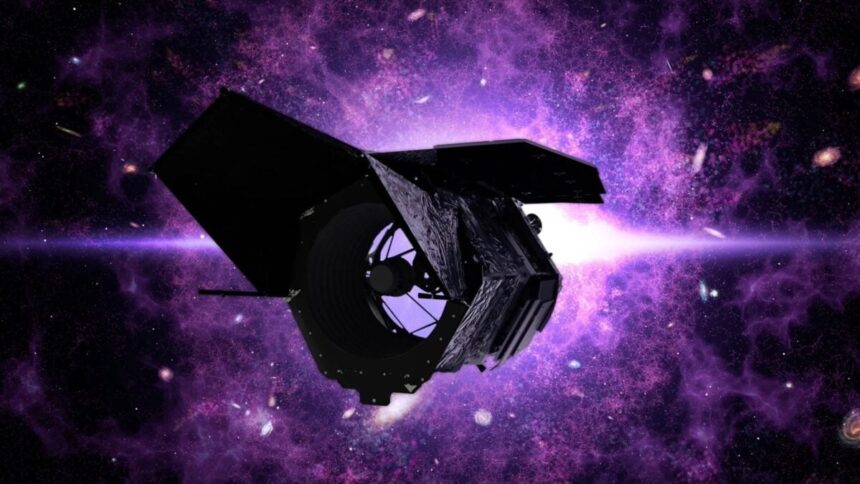
Earlier this year, leaked budget cuts cast a dark shadow over the future of NASA’s Nancy Grace Roman Space Telescope—a multi-billion-dollar instrument with the capacity of “200 Hubbles,” according to experts. Thankfully, Roman has (seemingly) weathered the budgetary storm and is now sailing toward its launch date in 2027. One of the telescope’s first tasks will be to stare into the void. Literally.
Voids are sparsely populated regions of the universe. Because they’re mostly empty, researchers suspect these regions are dominated by dark energy, a hypothetical force accelerating our universe’s expansion. Because dark energy is “dark,” it’s excruciatingly difficult for scientists to study how and why it affects things we can observe, like galaxies and star formation. But a recent paper published in The Astrophysical Journal lays out a detailed action plan to use Roman’s enhanced capacities to do just that—investigate the “dark” voids scattered throughout the universe.
The multi-billion-dollar telescope
Nancy Grace Roman was a pioneering figure in American astronomy in the late 20th century. Her contributions to the development and launch of the Hubble Space Telescope fundamentally changed the resolution at which humanity observes the cosmos. And the telescope that takes her name intends to do something similar, but even better.
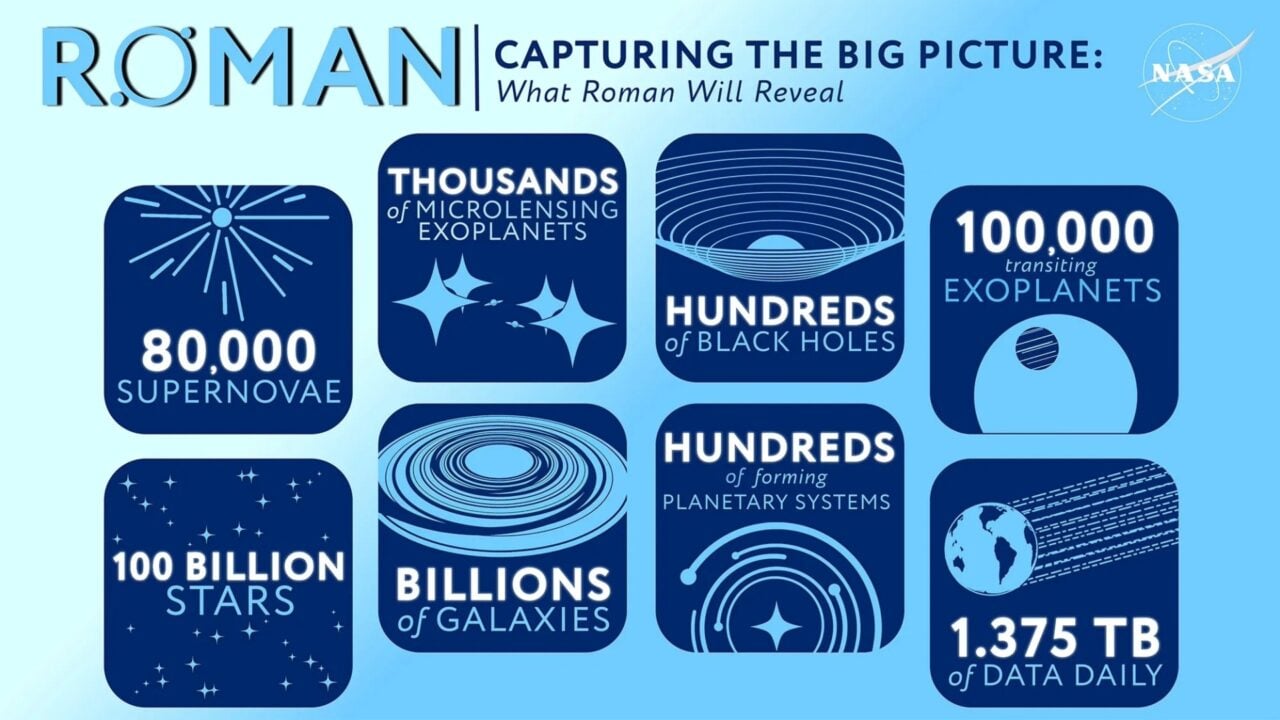
Like the James Webb Space Telescope, Roman captures the universe in infrared light and will have an observation range at least 100 times larger than Hubble’s. The telescope’s mission is divided into three programs, all designed to best exploit the huge instrument’s ability to investigate galaxies, exoplanets, supernovas, black holes, and more.
Studying the cosmic void will be Roman’s High-Latitude Wide-Area Survey (HLSS), which uses weak gravitational lensing and galaxy clustering to probe the origin of cosmic acceleration. During the telescope’s lifetime, Roman should be able to detect and measure tens of thousands of cosmic voids, the researchers explained in a statement.
“So to detect voids, you have to be able to observe galaxies that are quite sparse and faint,” Giulia Degni, study co-author and an astrophysicist at Roma Tre University in Italy, added in the statement. “With Roman, we can better look at the galaxies that populate voids.”
Peering into the void
Getting Roman data is the easy part. What comes next is a two-part analysis to reverse engineer the characteristics of dark energy, according to the researchers. Specifically, to determine the 3D shapes of the voids, researchers will tap into Roman data on the positions of galaxies and their cosmological redshift, or shifts in a galaxy’s wavelengths as it moves away from us.
Then, astronomers could make informed guesses about the strength and evolution of dark energy over astronomical time. The process is somewhat akin to piecing together an unknown cake recipe from the final product, Alice Pisani, study co-author and an astrophysicist at Princeton University, explained in the release.
“You try to put in the right ingredients—the right amount of matter, the right amount of dark energy—and then you check whether your cake looks as it should,” she said. “If it doesn’t, that means you put in the wrong ingredients.”
Have your cosmic cake
That may sound a bit arbitrary, but astronomers already rely on well-established mathematical models to guide them. According to such models, voids typically should be spherical, since the universe doesn’t have a preferred location or direction. To test that theory, the researchers will statistically combine, or stack, the images of cosmic voids collected by Roman to look for consistent patterns.
If the result isn’t spherically symmetric, there’s something wrong, either with the data or the “cosmic recipe.” And once researchers arrive at that contradictory conclusion, that’s when humanity will have learned something new about the universe.
That said, all this won’t be for a while, since Roman is still getting some final work done in Maryland, and it’ll be another few years before the data comes in. But now that we’re fairly certain that Roman isn’t canceled, I’d say we’re in for something exhilarating.
Read the full article here