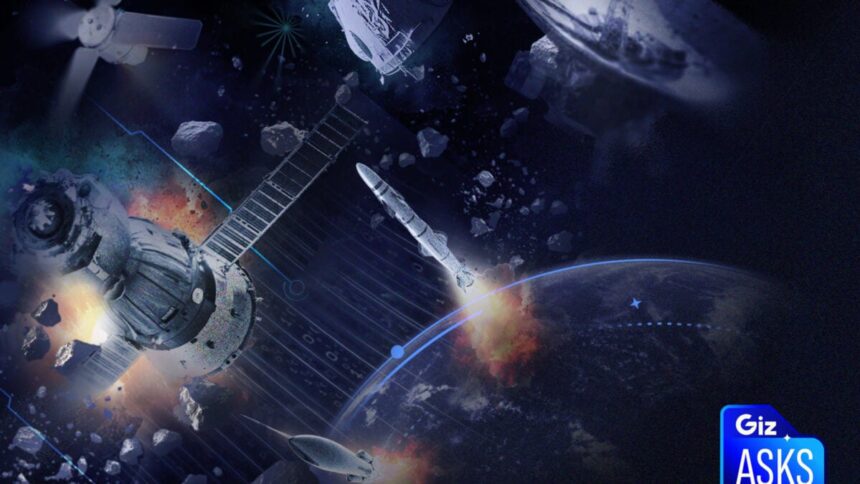
The idea of waging war in orbit is no longer a figment of science fiction. As satellite technologies and launch capabilities have rapidly advanced, military powers increasingly see space as the ultimate high ground. But if World War III really does spill off-planet, what will the outbreak look like?
For this Giz Asks, we asked several experts how they picture the first week of World War III in space, and apparently things could get really bad, really fast. They warned that cyberattacks, strikes on satellites, and assaults on ground infrastructure would lead to global logistical chaos and debris-filled orbits.
Scott Shackelford
Provost professor of business law and ethics and vice chancellor for research at Indiana University-Bloomington. His areas of expertise include cyber security and privacy, international law and relations, property, and sustainability.
Here is how I envision the first week of World War III in space.
The first 48 hours wouldn’t start with a “bang” but likely with a “glitch.” We often talk about the Internet of Space, and just like the terrestrial web, the opening moves would be almost entirely cyber-based for purposes of plausible deniability and given the asymmetric threat.
You’d see massive, coordinated DDoS [Distributed Denial-of-Service] attacks on ground stations and sophisticated “spoofing” of GPS signals [deliberate manipulations of signals transmitted by GPS]. Before a single kinetic weapon is launched, the goal would be to blind the adversary. Imagine the chaos on Earth: global logistics chains freeze, high-frequency trading halts, and your Uber app—along with military drone arrays—suddenly thinks it’s in the middle of the Pacific Ocean. In other words, global chaos could quickly ensue, driving distrust and undermining confidence.
By day three or four, we move from soft interference to hard disruption. This is where the legal and ethical “grey zones” I study become a literal battlefield. We’d likely see the use of directed-energy weapons (lasers) to “dazzle” or permanently blind reconnaissance satellites. The most contentious issue here will be the commercial sector.
In a modern space war, companies like SpaceX are no longer bystanders; they are essential military infrastructure (SpaceX even has a ’StarShield’ infrastructure). The first week would force a series of legal questions: When does an attack on a private satellite constitute an act of war against its host nation?
If the conflict escalates to kinetic anti-satellite (ASAT) missiles by day six or seven, we face the “Tragedy of the Space Commons” on a galactic scale. A single destroyed satellite creates a cloud of thousands of high-speed projectiles.
In a “hot” space war, we risk the Kessler Syndrome—a chain reaction of collisions that could render specific orbits, like Low Earth Orbit (LEO), unusable for a prolonged period of time. We wouldn’t just be fighting a war; we’d be building a prison of shrapnel around our own planet. Think Wall-E, just a lot more depressing. Much of the resulting junk would burn up readily but others in GSO and otherwise could contribute to an already vexing problem.
We are far better at creating messes in space than we are at cleaning them up, and our current international legal frameworks—like the 1967 Outer Space Treaty—are unprepared for a world where the “final frontier” becomes a shooting gallery.
Wendy Whitman Cobb
Space policy expert whose research focuses on the political and institutional dynamics of space policy, public opinion of space exploration, and the influence of commerce on potential space conflict.
War in space, whether in the context of World War III or otherwise, is intimately linked to war on Earth. Nothing in space is done for space’s sake but to enable (or disable as the case may be) terrestrial operations or advantages. So if there is a World War III going on on the ground—complete with the existential threats to national survival that we might expect to accompany it—we expect similar results in outer space.
What exactly this would look like depends on the countries involved and what space capabilities they possess. For the purposes of this question, I’ll assume that the United States, Russia, and China are all involved in the war. If this is the case, we can expect actual attacks on space assets.
This would include kinetic attacks such as anti-satellite attacks (originating from the ground and on orbit) and non-kinetic attacks such as jamming, lasing, and blinding that would render satellites either permanently or temporarily disabled. We might also see cyber attacks on the computer systems necessary to operate space systems along with ground attacks on the terrestrial segments of space infrastructure (satellite downlink stations, launching facilities, etc.).
The goal of such attacks would be to disrupt operations on the ground and prevent the major combatants from being able to better see what is happening, communicate, or utilize the technologically advanced kill chains that depend on space-based systems to locate and destroy ground-based targets.
The consequences of such actions would not only be a complete disruption of space-based systems, but potentially significant damage to the space environment itself. Kinetic attacks create dangerous debris that could then hit other satellites, disabling or destroying them. Were a nuclear anti-satellite weapon used, it would indiscriminately destroy whatever satellites were in its vicinity.
The result of such things would be to make certain orbits or areas around Earth all but useless because of debris clouds. The danger of creating harmful debris is one factor that we believe tends to tamp down on open conflict in space, but if we’re talking about World War III, that is likely to be little use as a deterrent opening the door to attacks and reprisals that could ultimately result in rendering all space systems either useless or significantly degraded.
Bottom line: World War III would be disastrous for those of us on Earth. It would ultimately be reflected in outer space as well.
Peter W. Singer
Strategist and senior fellow at the think-tank New America, professor of practice at Arizona State University, and founder and managing partner at Useful Fiction LLC, a company specializing in strategic narrative. His book Ghost Fleet explores the future of war and space.
The initial phase of a conflict extending into space will likely involve silent battles in a realm where humanity has never before fought. Satellites—which underpin both our economies and military systems—could be targeted by peer satellites, rockets, lasers, and cyber attacks. Yet, despite the spectacular nature of orbital warfare, the ultimate victor may well be determined by two critical aspects rooted right here on planet Earth.
Rather than “heavens above,” the actual center of gravity in space operations remains the ground stations, fiber nodes, and undersea cables that facilitate space-based data. This means that space conflict might also see conventional and special operations task forces hitting key infrastructure, “global raids” targeting the terrestrial networks that bind the stars to the mud.
As this infrastructure is global, it might take place not just in the region of conflict, but around the world, in places like South America or East Africa or even in Antarctica. The goal is to strip away an adversary’s space-dependent advantages—GPS, precision timing, and secure comms—at the source.
The second aspect of space warfare that may well determine the conflict is the ability to get back into space. This involves not just launch infrastructure but resilient satellite production and inventory. If you want to win in space, you will need mastery of reusable rockets and a robust logistics backbone, allowing for the rapid replenishment of satellite constellations that have been blinded or neutralized.
The victor of the next war in space won’t necessarily be the side with the largest or most expensive satellites. It will be the one that successfully maintains its terrestrial links and orbital replenishment cadence. As such, don’t think of space as a static sanctuary; it is a dynamic maneuver space where the fight on Earth determines the conflict among the stars.
Read the full article here