

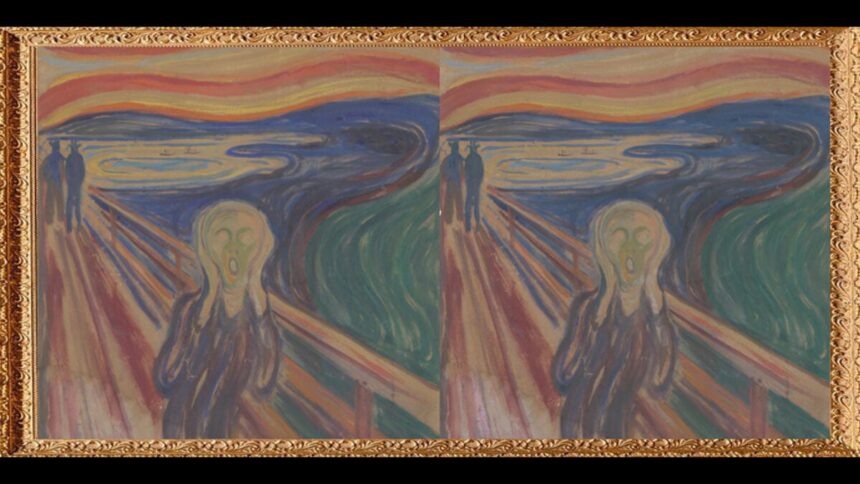
Sometimes, the faded hues of antique art on their own are an aesthetic. Take, for instance, the arguably shocking visuals of Greek marble statues in their original colors. Likewise, some iconic pieces of art we enjoy today will likely look rather different some time from now—and this new tool shows us exactly how that might work.
In a recent announcement, the Norwegian University of Science and Technology (NTNU) unveiled the Light Damage Estimator, a new digital tool that simulates how pigments used for paintings could fade over time. The tool has adjustable factors for color, light source and intensity, and time of exposure. As of now, it’s best suited to describe particularly vulnerable colors in Edvard Munch’s The Scream, but the team hopes to expand the capabilities of its model.
Here’s a video showing the tool’s prediction of how this famous painting could look in about 300 years:
Chemistry of colors
In the world of artificial pigments like paint, not all colors are created equal. By principle, these paints are chemical compounds constructed to appear a certain color. Accordingly, artificial colors are bound to the rules of chemistry. And as the bonds between atoms in these pigments weaken, the colors fade as well.
Irina-Mihaela Ciortan, a postdoctoral researcher at NTNU who led the project, believed that similar processes would have taken place for a painting as vibrant as Munch’s The Scream. That is, not even the advances in conservation techniques could perfectly freeze tiny molecular bonds in time, especially for colors like yellow or red “that are sensitive to light and slowly change over time,” Ciortan added in the statement.
Testing color resilience
To gather data for the tool, Ciortan and colleagues first used X-ray fluorescence to identify the chemical composition of the pigment colors in Munch’s famous painting. They found a variety of compounds, such as mercury in cinnabar for red, cadmium for yellow, and cobalt in cobalt blue and ultramarine.
Then, they reconstructed the painting using this information and stuck it inside a climate chamber for a variety of aging tests. These chemical replicas sat in the chamber for several days, and the team monitored changes in the fake paintings when subjected to “accelerated aging” processes, such as strong humidity and light conditions.
“The idea is that since the samples have the same properties as the original painting, changes in them can reflect both historical and future changes in The Scream,” the researchers explained. It was from these datasets that the team arrived at the Light Damage Estimator.
Going beyond The Scream
But as things stand now, the Light Damage Estimator is more a cool project than it is a practical tool for all conservators. As the team admits, the model works primarily with The Scream and a select few other paintings and only deals with cadmium yellow and cinnabar red, or the most light-vulnerable colors. Hey, you gotta start somewhere.
To expand on the project, the team says it’ll explore partnerships with conservators to collect more data for its model, as well as account for as many environmental factors as possible. The researchers are also considering implementing AI tools to automate the model.
“Until these challenges are resolved, it may be more useful to collaborate with museums that have similar data to what we used in our project,” Ciortan said.
Read the full article here