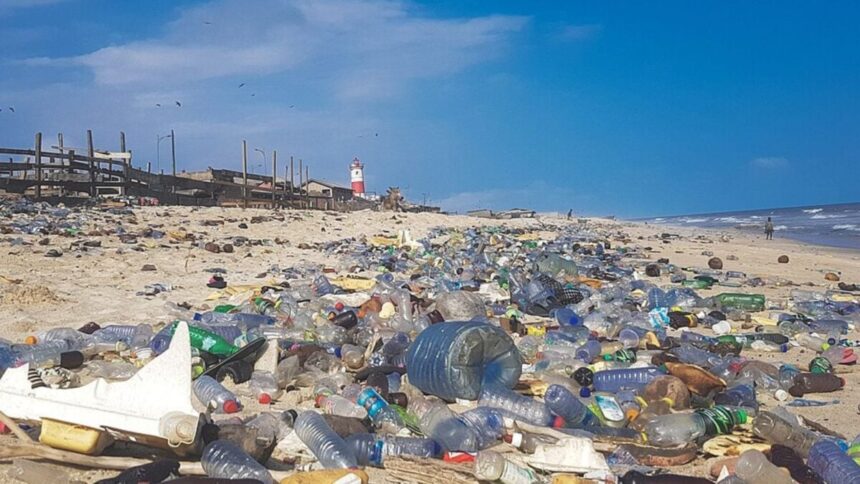
Around the world, plastic is falling through the cracks of waste management systems and into our water, land, and air. The latest assessment of this ongoing crisis paints a grim picture of Earth’s future.
As of 2025, 143 million tons of plastic infiltrate the environment each year, according to a report published by Pew Charitable Trust and institutional partners on Wednesday. Without ambitious global intervention, that figure will rise to 309 million tons over the next 15 years. That’s the equivalent of dumping nearly a garbage truck’s worth of plastic every second, the report states.
Plastic use and production are growing so rapidly that current waste management systems just can’t keep up. The report warns that without intervention, this will lead to a 58% rise in annual greenhouse gas emissions from the global plastic system, a 75% rise in plastic-related health issues, and hundreds of billions of dollars spent trying to curb these impacts.
Now for the good news: The largest source of plastic waste, packaging, can be “virtually eliminated” by 2040 through ambitious global action—primarily reuse and return strategies. The report outlines a path forward that offers a glimmer of hope for tackling this crisis.
Humanity’s addiction to plastic packaging
Annual production of primary plastic—tiny pellets used to make larger plastic products—is on track to increase 52% by 2040, growing twice as fast as waste management, according to the report. This growth is primarily driven by the packaging sector, a trillion-dollar market that produces plastic bags, bottles, containers, and films.
Most of these items are used once and thrown away, and recycling can only help so much. The report points out that plastic recycling is still only technically and economically viable for a small subset of plastics, and the number of times they can be recycled is limited.
“Recycling alone, therefore, can only slow, but not prevent, exponential growth of primary plastic production,” the authors state.
To meaningfully reduce plastic pollution over the next 15 years, they propose focusing on deposit return schemes and reuse, in which consumers return empty plastic containers to a collection point for a small refund or refill them with other products.
A solution is possible
Reuse alone could account for two-thirds of a 97% reduction in plastic packaging pollution by 2040, according to the report. This will require shifting nearly $570 billion in annual private sector spending away from single-use plastics and toward reuse.
Achieving that 97% reduction will also require complementary actions to ban the most problematic plastics, redesign packaging to improve recyclability and reusability, and streamline collection, sorting, and recycling. The authors say investing in this transition would provide other substantial benefits too, such as reducing greenhouse gas emissions by 48% and creating hundreds of thousands of new jobs.
While the scale of the challenge is enormous, the tools to nearly eliminate plastic packaging already exist. Through bold action and global cooperation, these measures could help turn the tide on plastic pollution within a single generation.
Read the full article here