By using this site, you agree to the Privacy Policy and Terms of Use.
Accept
Tech Consumer JournalTech Consumer JournalTech Consumer Journal
  • News
  • Phones
  • Tablets
  • Wearable
  • Home Tech
  • Streaming
  • More Articles
Reading: Watch a Comet Get Torn Apart by the Sun and Become a Headless Ghost
Share
Sign In
Notification Show More
Font ResizerAa
Tech Consumer JournalTech Consumer Journal
Font ResizerAa
  • News
  • Phones
  • Tablets
  • Wearable
  • Home Tech
  • Streaming
  • More Articles
Search
  • News
  • Phones
  • Tablets
  • Wearable
  • Home Tech
  • Streaming
  • More Articles
Have an existing account? Sign In
Follow US
  • Contact
  • Blog
  • Complaint
  • Advertise
© 2022 Foxiz News Network. Ruby Design Company. All Rights Reserved.
Tech Consumer Journal > News > Watch a Comet Get Torn Apart by the Sun and Become a Headless Ghost
News

Watch a Comet Get Torn Apart by the Sun and Become a Headless Ghost

News Room
Last updated: April 11, 2026 4:16 am
News Room
Share
SHARE

Bad news for skywatchers: A sungrazing comet that was set to put on a bright display succumbed to a fateful encounter with our host star.

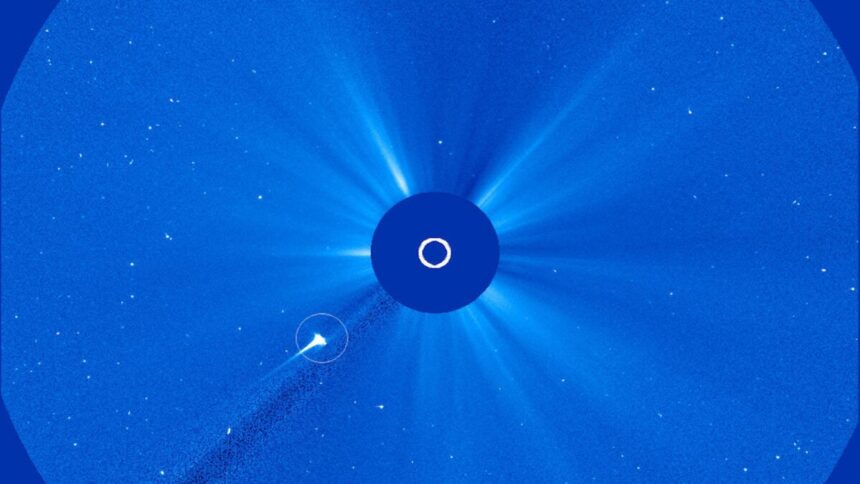
Comet MAPS (C/2026 A1) was obliterated during its perihelion, or closest approach to the Sun, on Saturday, April 4. The Solar and Heliospheric Observatory (SOHO) captured the comet’s death dive as it came within 99,000 miles (160,000 kilometers) of the Sun’s atmosphere.

A view of the comet’s death dive captured by SOHO. Credit: NASA/ESA/SOHO

Lights out

The joint NASA and European Space Agency (ESA) SOHO mission constantly watches the Sun from about 932,000 miles (1.5 million kilometers) away.

During its observing run earlier this week, the spacecraft’s coronagraph captured comet MAPS racing toward the Sun for a close encounter. As the video shows, right before the comet breaks apart, there’s a sudden brightening that was likely due to its nucleus exploding from the intense heat.

After the nucleus exploded, the comet was left behind as a ghostly tail with no head. As the comet hid behind the coronagraph’s disk, its fragmented nucleus vaporized and a trail of dusty debris exited from the other side.

Haunting the skies

Astronomers and skywatchers were hoping for a different ending for MAPS. The recently discovered comet is part of a group of comets called Kreutz sungrazers, which get their name from their uniquely close approaches to the Sun during perihelion.

If MAPS hadn’t been destroyed by the Sun during its close approach, it may have become a bright object visible to the naked eye with a peak magnitude of -4 (around the same brightness level as Venus).

Sungrazing comets are likely broken-off fragments from a larger object that may have broken apart centuries ago during its own solar meet-and-greet. Most sungrazers are tiny comets, which is why they tend to either completely disintegrate or crash into the star during their close approach.

Comet C/2024 S1 (ATLAS) also met its unfortunate demise during its closest approach to the Sun on October 28, 2024, breaking apart into cosmic rubble. Comet Lovejoy, on the other hand, survived its perihelion and emitted a unique blue and green glow that lit up the night skies after its closest approach in 2011.

Astronomers first spotted comet MAPS on January 13 from the AMACS1 Observatory in the Atacama Desert in Chile. At the time of discovery, Comet MAPS was 191 million miles (308 million kilometers) away from the Sun and it was extremely faint at an 18th-magnitude brightness. It showed promising signs as it increased dramatically in brightness over time, as sky watchers enthusiastically cheered the comet on.

Alas, MAPS wasn’t one of the lucky few sungrazing comets that survive the intense heat of the Sun, disappearing from view before it got to put on a show.

Read the full article here

You Might Also Like

Sam Altman’s Home Hit With Molotov Cocktail, 20-Year-Old Man Arrested

Microsoft Says You Should Take Copilot Seriously but Not Literally

France to Ditch Microsoft Windows as Europe’s War on American Tech Rages On

Artemis 2 Returns Home After a Stellar 10 Days in Space

‘Doomsday’ Asteroids Could Have Kickstarted Life on Our Planet

Share This Article
Facebook Twitter Copy Link Print
Previous Article Microsoft Says You Should Take Copilot Seriously but Not Literally
Next Article Sam Altman’s Home Hit With Molotov Cocktail, 20-Year-Old Man Arrested
Leave a comment

Leave a Reply Cancel reply

Your email address will not be published. Required fields are marked *

Stay Connected

248.1kLike
69.1kFollow
134kPin
54.3kFollow

Latest News

It Sure Looks Like This Is the End for the Current Era of ‘Star Trek’
News
Before ‘KPop Demon Hunters’ Blew Up, Disney Scrapped a Pixar Movie With a Similar Vibe
News
What on Earth Is Happening With ‘Doctor Who’?
News
I Can’t Decide Which ‘Resident Evil Requiem’ Perspective I Liked More
News
I Rewatched the Live-Action ‘Speed Racer’ to Feel Something Again
News
The Trump Administration Wants Gamers to Step Up and Fill the Air Traffic Controller Shortage
News
Scientists Used Medieval Poems and Trees to Uncover a 13th-Century Solar Surge
News
Artemis 2 Is Coming in Hot Today—Here Are the 4 Critical Phases to Watch
News

You Might also Like

News

It’s Already Time to Start the Casting Rumors for Marvel’s ‘X-Men’ Movie

News Room News Room 3 Min Read
News

Legacy’ With Hasbro’s Electric New Action Figures (Exclusive)

News Room News Room 3 Min Read
News

These 1970s Predictions for Inflation in 2026 Show Things Could Be a Lot Worse

News Room News Room 5 Min Read
Tech Consumer JournalTech Consumer Journal
Follow US
2024 © Prices.com LLC. All Rights Reserved.
  • Privacy Policy
  • Terms of use
  • For Advertisers
  • Contact
Welcome Back!

Sign in to your account

Username or Email Address
Password

Lost your password?