Late last week, the BBC announced what is probably going to be one of the most shocking pieces of Doctor Who news we’ll get this year, Christmas special or otherwise: the recovery of two missing episodes of Doctor Who for the first time since 2013 in a huge win for not just the series, but the recovery of lost media in general. And now, for the first time since those episodes were broadcast on TV 61 years ago, we’re starting to see them in action.
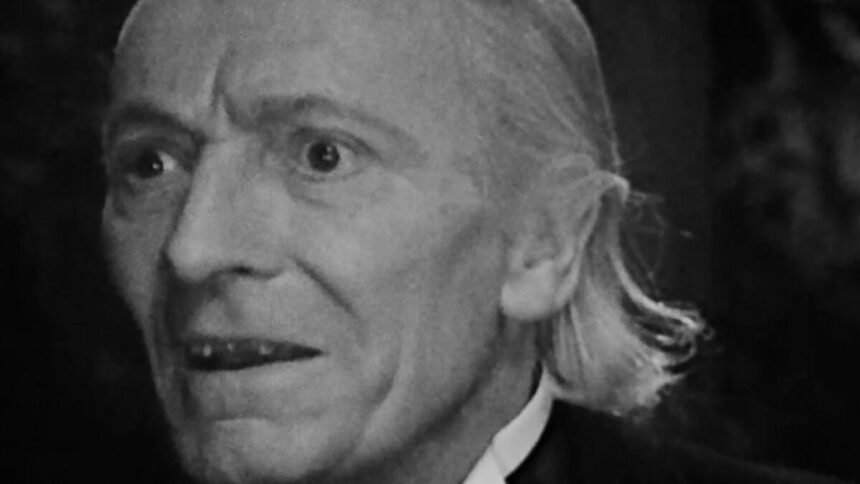
The corporation has released a montage of clips from “The Nightmare Begins” and “Devil’s Planet”, the first and third episodes of the 12-part serial “The Dalek’s Master Plan” that have been unseen since they were first broadcast in 1965, recently recovered as part of a collection donation to the charitable trust Film is Fabulous.
The montage has a ton of interesting looks, including more of William Hartnell’s Doctor, some dastardly Dalek plotting, and, perhaps more sentimentally, a look at the late Nicholas Courtney’s first role in Doctor Who as Space Agent Bret Vyon, before he would return and endure as Alistair Lethbridge-Stewart three years later in “The Web of Fear”, sparking a connection with the show that would continue to his death in 2011. There’s also a brief glimpse of Adrienne Hill’s Katarina, the first Doctor Who companion to ever be killed off—introduced in the story prior in the serial “The Myth Makers”, a handmaiden from ancient Troy, the character was written out quickly to avoid having a companion the Doctor would have to endlessly explain modern concepts to.
But above and beyond all the Doctor Who geekiness, it’s just as remarkable to watch something that has been by and large left unseen by the world since it first hit television over half a century ago. “The Daleks’ Master Plan” is one of many pre-1970s Doctor Who stories to have been impacted by the BBC’s then-limited approach to archiving television.
In the nascent era of television in the 1940s and 50s, the act of even rebroadcasting a production, let alone archiving it for future viewing, was met with actors’ unions lobbying against repeats in favor of simply performing a second taping like a new theatrical run. By the end of the 1960s, as technology progressed to color television, the idea of archiving or selling monochrome broadcasts was initially seen as pointless.
In some cases, what limited archives were kept were destroyed, either through sheer capacity—keeping film reels eventually grew to a point where some were recorded over with more recent material—or human error brought on by inconsistencies between the BBC’s Film and Engineering libraries and the Enterprises division in charge of selling exploitable archival programming for international broadcast. In the case of “The Daleks’ Master Plan” specifically, the latter wasn’t even involved, which has always made the prospect of recovering new episodes from the serial fraught: there are believed to be even fewer film copies of the story in existence, as it was never sold for international broadcast, having been deemed too violent by international censors at the time.
The BBC wouldn’t have official guidelines to maintain a complete archive of its programming until it was enshrined in its royal charter in 1981, after advances in technology and the rise of early home video created increased demand for old film and TV—by which point, 152 episodes of Doctor Who remained missing, with that number slowly chipped down over the decades until last week’s announcement lowered the count to 95.
Now, 60 years later, we’re getting to witness TV history once more—a feeling that is suitably timey-wimey for a show like Doctor Who. Restored versions of “The Nightmare Begins” and “Devil’s Planet” will begin streaming in the UK on the BBC’s iPlayer platform early next month.
Want more io9 news? Check out when to expect the latest Marvel, Star Wars, and Star Trek releases, what’s next for the DC Universe on film and TV, and everything you need to know about the future of Doctor Who.
Read the full article here