
By using this site, you agree to the Privacy Policy and Terms of Use.
Accept
Tech Consumer JournalTech Consumer JournalTech Consumer Journal
  • News
  • Phones
  • Tablets
  • Wearable
  • Home Tech
  • Streaming
  • More Articles
Reading: Upcoming Hack to Keep NASA’s Voyager 1 Alive Exploits a Quirk in Its 1970s Hardware
Share
Sign In
Notification Show More
Font ResizerAa
Tech Consumer JournalTech Consumer Journal
Font ResizerAa
  • News
  • Phones
  • Tablets
  • Wearable
  • Home Tech
  • Streaming
  • More Articles
Search
  • News
  • Phones
  • Tablets
  • Wearable
  • Home Tech
  • Streaming
  • More Articles
Have an existing account? Sign In
Follow US
  • Contact
  • Blog
  • Complaint
  • Advertise
© 2022 Foxiz News Network. Ruby Design Company. All Rights Reserved.
Tech Consumer Journal > News > Upcoming Hack to Keep NASA’s Voyager 1 Alive Exploits a Quirk in Its 1970s Hardware
News

Upcoming Hack to Keep NASA’s Voyager 1 Alive Exploits a Quirk in Its 1970s Hardware

News Room
Last updated: August 8, 2026 1:46 am
News Room
Share
SHARE

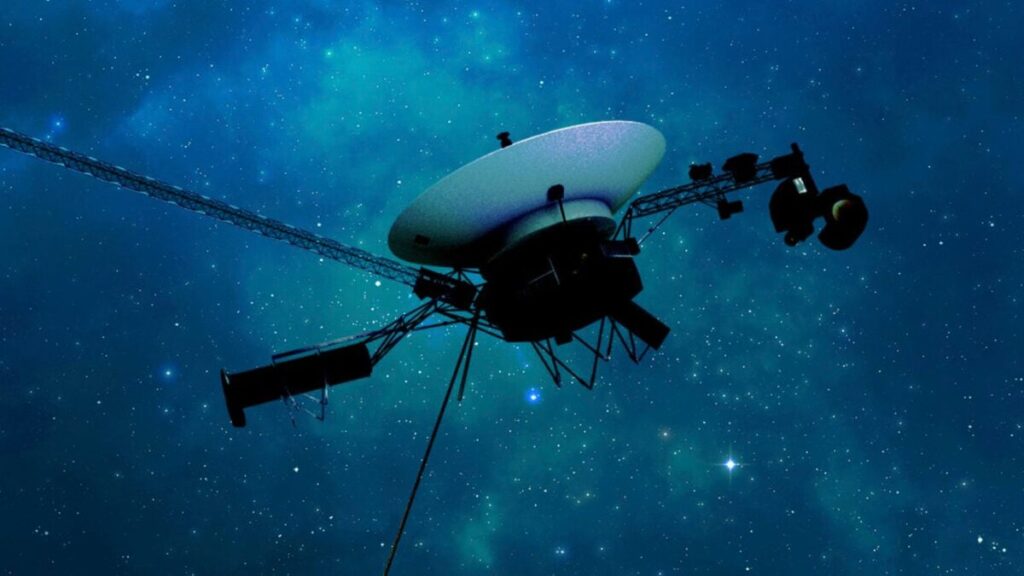
Blitzing through interstellar space at over 35,000 miles per hour (56,000 kilometers per hour), NASA’s Voyager 1 probe is now over 15 billion miles (or about 24 billion km) away from Earth. And the U.S. space agency’s Jet Propulsion Lab just north of Los Angeles is working hard to make sure it keeps going for just a bit longer.

On Tuesday, Voyager mission engineers at JPL announced that they have successfully executed a critical power-saving hack on the spacecraft’s sister probe, Voyager 2. They’re calling it the “big bang,” a delicate toggling on and off of Voyager 2’s key components, in pairs of three, across a coordinated sequence—conserving energy without disastrously freezing the probe’s fuel line or its critical hardware out in the inhospitable cold of deep space. In essence, the scheme makes a virtue of the fact that the Voyagers, both launched in the late summer of 1977, are relics (respectfully) of midcentury electronics: Thanks to good old-fashioned waste heat, practically every instrument onboard these probes can be canily used to help to keep the craft warm.

Voyager 2 was closer to Earth and had more power to test this stunt on. But, now, according to NASA’s Voyager mission manager Kareem Badaruddin, JPL hopes to repeat this hat trick again on the farther out Voyager 1.

“This is the most important thing we’ve done on the Voyager spacecraft in decades,” Badaruddin told Scientific American on Friday. “I don’t want to jinx it, but this ‘big bang’ test has gone remarkably smoothly.”

Hot pursuit

Both Voyagers run on modest nuclear power plants, thermoelectric generators that convert heat produced by the natural radioactive decay of plutonium-238 into electricity. But, as that plutonium isotope decays toward its 88-year half-life, less and less heat is being emitted, losing each Voyager craft about 4 watts of power per year.

JPL’s “big bang” maneuver switches off two of its heaters and one old-school, eight-track tape recorder used by Voyager’s digital Data Tape Recorder (DTR) system while carefully switching on two other heating units and one of the craft’s onboard propulsion systems. The move saves the probe almost 10 watts per year without losing any essential hardware to the cold.

NASA’s Jet Propulsion Laboratory in Pasadena, California, tested the Voyager probes in this 25-foot space simulator chamber in 1976. Now, that hardware is in interstellar space. Credit: NASA / JPL-Caltech

Both Voyager probes launched with 10 instruments apiece, with plenty being natural candidates for powering down much earlier in their lifecycle given that these devices had already served their purpose during the crafts’ “Grand Tour” of the planets in our solar system.

NASA’s Voyager team hopes that its energy savings from the “big bang” might help run one additional instrument on Voyager 1, the Low-energy Charged Particles experiment (LECP), which helps measure the particle density of interstellar space. LECP had to be powered down on Voyager 1 this spring to prevent the probe’s own system reset from taking over.

“Voyager 1 still has two remaining operating science instruments—one that listens to plasma waves and one that measures magnetic fields,” as Badaruddin, who is also a systems engineer at JPL, noted in a NASA announcement this past April. “They are still working great, sending back data from a region of space no other human-made craft has ever explored.”

One light-day away from home

If it makes it to this November, Voyager 1 will hit a historic milestone, passing one light-day’s distance from Earth, which you’re welcome to think about as either merely a small fraction of one light-year or as a staggering 173 times the distance between Earth and the Sun. Past this point, it will take messages over 24 hours to reach Voyager 1, so long as it manages to stay online.

In 2022, Suzanne Dodd, a project manager for Voyager at JPL, told a NASA livestream audience that she thought Voyager 1 would “definitely” make it to its 50th anniversary next year on September 5, 2027.

If NASA gets “really lucky,” as Dodd told Space.com that same year, Voyager 1 “might be able to go out to the 2030s.”

Read the full article here

You Might Also Like

While American AI Models Race to Commit Felonies, China’s Kimi Broke Out and… Just Used GitHub

RFK Jr. Is Too Rich to Know the Price of Groceries, Not Rich Enough to Stop Grifting

‘Lynx’ Is a Sapphic Neo-Noir Thriller About a Damaged Detective and Her Snarky Cat Battling Angels [Exclusive]

Data Center Reps Face the Guillotine, Flee Public Hearing

Flock Reportedly Tried to Turn Uber Drivers Into Mobile Snitches

Share This Article
Facebook Twitter Copy Link Print
Previous Article RFK Jr. Is Too Rich to Know the Price of Groceries, Not Rich Enough to Stop Grifting
Next Article While American AI Models Race to Commit Felonies, China’s Kimi Broke Out and… Just Used GitHub
Leave a comment

Leave a Reply Cancel reply

Your email address will not be published. Required fields are marked *

Stay Connected

248.1kLike
69.1kFollow
134kPin
54.3kFollow

Latest News

‘The Odyssey’ Will Soon Be Christopher Nolan’s Highest-Grossing Film
News
This Super El Niño Could Trigger the Highest Sea Levels Ever Recorded on the California Coast
News
The Team Behind ‘Paddington 2’ Could’ve Made a ‘Star Wars’ Movie
News
A Pretty Screen Stuffed Into an Ugly Laptop
News
The 10 Things We’re Most Excited to See or Learn About at D23
News
OpenAI’s Rumored Smart Speaker Sounds More Like a… Squirming AI Robot?
News
The ‘Sugar’ Season 2 Finale Dropped Yet Another Huge Twist
News
Over 26,000 US Public Parks Border a Toxic Superfund Site—But It’s Worse Than That
News

You Might also Like

News

Get in the Pattiwagon, ‘Widow’s Bay’ Is Going to the Movies

News Room News Room 3 Min Read
News

‘The Legend of Zelda’ May Be Sam Neill’s Final Movie

News Room News Room 3 Min Read
News

GTA VI ‘Extended Look’ Will Hit Netflix First at the End of August

News Room News Room 4 Min Read
Tech Consumer JournalTech Consumer Journal
Follow US
2024 © Prices.com LLC. All Rights Reserved.
  • Privacy Policy
  • Terms of use
  • For Advertisers
  • Contact
Welcome Back!

Sign in to your account

Username or Email Address
Password

Lost your password?