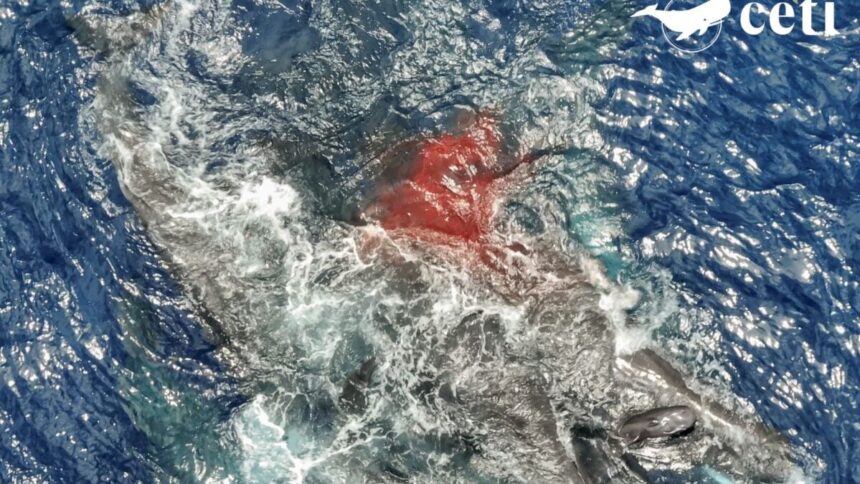
Childbirth can be a beautiful but often grueling process. Amazing footage of sperm whales released today shows that humans aren’t the only animals to rely on others to get them through it.
Researchers at Project CETI described their incredible discovery in a pair of studies published Thursday. They detailed up close how a group of sperm whales all worked together to help a mother deliver her newborn calf, including whales that weren’t closely related to the new family. Combined with other evidence, the findings suggest that such cooperation among whales could date back tens of millions of years ago.
“What makes CETI’s studies novel is that, with the underwater audio and analysis, it is the most extensive documentation of any wild cetacean birth,” study author David Gruber, founder and president of Project Ceti, told Gizmodo.
An incredibly rare sighting
Scientists already knew that sperm whales and other cetaceans (dolphins and whales) live in tightly knit communities, which are typically organized around elder females, a.k.a. matriarchs. Larger whale communities, or units, can feature two or more lineages of matriarchs and their descendants.
Studies have shown that sperm whales commonly practice allomaternal care, meaning that non-mothers might babysit or look after younger calves in the unit, according to Giovanni Petri, Project CETI’s Network Science Lead. But up until now, we knew remarkably little about how these whales actually give birth, as well as the role that other whales in the unit might play as midwives.
“In 60 years of field research, there’s only one previous scientific observation of a sperm whale birth—by Weilgart and Whitehead in 1986, off Sri Lanka,” Petri said. “Across all cetacean species, births have been documented in only eight species in the wild.”
The Project CETI researchers have been tracking a population of sperm whales in Caribbean water for around two decades. And in early July 2023, they came across the opportunity of a lifetime when they noticed all 11 members of one particular unit (Unit A) huddling up together near the surface. While whales from different matriarchal lines can broadly live alongside each other, they tend to stick close to their families most of the time, especially near the surface, making the grouping all the more unusual. Before long, the researchers knew that the female whale, dubbed “Rounder,” was gearing up to deliver a newborn calf, and they kept a close eye on the unit using drone cameras and underwater audio recordings.
All told, the actual delivery took about 34 minutes to complete, but the whales stuck close to each other for about two hours before dispersing. Before, during, and after the birth, the whales cooperated to help Rounder and her newborn calf, including non-kin members.
“The entire social unit reorganizes around the birth—it’s not just the mother and a couple of helpers, but a coordinated, group-level response involving all 11 members,” said Petri. Some whales took on the job of keeping the newborn calf afloat, for instance, which was likely needed because newborns are negatively buoyant.
The audio recording showed that the whales also changed how they communicated with each other, while machine learning analysis of the visual and audio footage calculated the subtle differences in how the whales’ social structure changed temporarily during the delivery and post-birth.
The team’s findings were published in the journals Science and Scientific Reports.
A long history of whale midwifery
The researchers also conducted a literature review of research on other wild whale births.
Several other whale species, including false killer whales (Pseudorca crassidens), orcas (Orcinus orca), and beluga whales (Delphinapterus leucas), have been documented working together to help deliver and keep newborn calves safe. That suggests, the researchers argue, that the evolutionary roots of this behavior originated some 35 million years ago, when the last common ancestor of these whales existed.
“That said, I want to be careful about the inference: we’re documenting one birth event in one population, in extraordinary detail. The patterns are compelling, but generalizing requires caution,” Petri said. “What this work does is establish a quantitative framework for future comparative analysis.”
At the very least, the findings further illustrate that humans are far from the only animals to cooperatively help each other deliver their young. While this behavior was once seen as the unique consequence of humans becoming bipedal and having especially hard births, recent studies have shown that other primates like bonobos can act as midwives, too.
“Now this detailed documentation in sperm whales shows that birth as a socially supported event occurs across species that are separated by tens of millions of years of evolution,” Petri said. “What these species share isn’t close ancestry but a common social profile: long-lived, highly social, matrilineal, with extended offspring dependency and high costs of reproductive failure.”
As for the calf at the center of all this, it was spotted alive with its family a year later, which is a crucial point in its development. So chances are now good that it will survive to adulthood.
The CETI researchers, meanwhile, will continue to study these complex behemoths of the sea, which will include trying to decipher their language.
Read the full article here